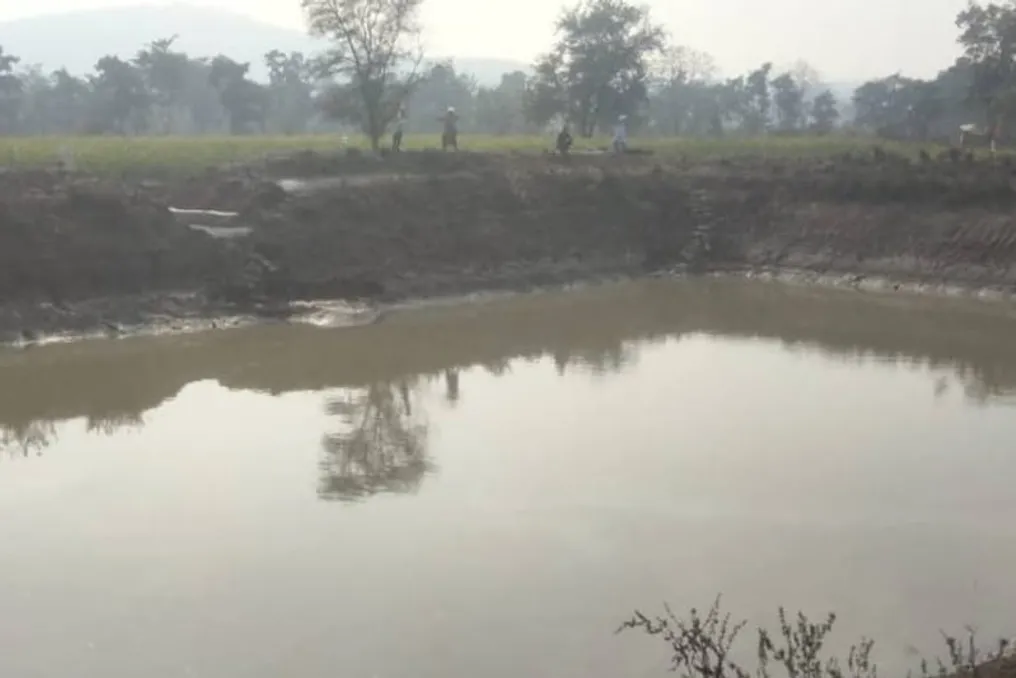
National Green Tribunal (NGT) appoints committee to investigate disappearance of water bodies in Aligarh
Read more
Aaj Tak
www.aajtak.in

National Green Tribunal (NGT) appoints committee to investigate disappearance of water bodies in Aligarh

The National Green Tribunal (NGT) has taken a firm stance regarding the ongoing disappearance of ponds, lakes, and other water bodies in the Aligarh district, Uttar Pradesh, as well as the continuous decline in groundwater levels.

The main bench of the Tribunal in New Delhi, considering the seriousness of the situation, formed a joint committee comprising representatives from four key departments of Uttar Pradesh. The committee was tasked with inspecting the actual condition of the water bodies on site.

This order was passed on November 16, 2026, based on the original application No. 597/2026, filed by Dr. M. Salahuddin against the state of Uttar Pradesh and other parties. The hearing was conducted by a panel consisting of Judge Arun Kumar Tyagi (judicial member) and Dr. E. Santil Vella (expert member). The applicant, Dr. M. Salahuddin, participated in the proceedings via video conference.

According to the data presented in the application, there were approximately 12,000 water bodies in the Aligarh district between 1960 and 1965; however, their number has now reduced to only 400–450.

The application asserts that old ponds and lakes are being encroached upon, water sources are drying up, and natural mechanisms for rainwater accumulation are being disrupted. These processes are creating serious environmental problems. The applicant also expressed concern over the constant drop in groundwater levels, the threat of pump failure, and a potential future water supply crisis.

The application specifically mentioned a large water body located near the Botanical Garden of Aligarh Muslim University. According to the applicant, this water body has been in a state of drought for the last four decades. Given the gravity of the matter, the NGT established a joint committee.

The joint committee was instructed to verify the applicant's complaints and personally inspect the condition of the district's water bodies. Furthermore, it was tasked with taking necessary legal action where violations of environmental regulations are found. The committee must submit a detailed report of its inspection to the Registrar General of the NGT within three months.
Similar stories

Hydroelectric project in Arunachal approved despite protests, leading to felling of 100 thousand trees
Read more
www.aajtak.in

Hydroelectric project in Arunachal approved despite protests, leading to felling of 100 thousand trees

The central government is striving to accelerate the implementation of projects in Arunachal Pradesh despite ongoing protests against the 'Siang Apur Multipurpose Project' (SUMP), which has a capacity of 11,200 megawatts. Amid this situation, a new hydroelectric power plant planned for the Siang River tributary—the 'Siyom' River—received important approval from the Forest Advisory Committee (FAC) of the central government's Ministry of Environment.

This project, named the 'Nying Hydroelectric Project,' has a capacity of 1,000 megawatts and will be operated by 'North Eastern Electric Power Corporation Limited.' Construction is planned in the Shi Yomi and Siang districts of Arunachal Pradesh. The realization of the project requires the use of about 470 hectares of land classified as 'unclassified forest,' which will result in the felling of over one hundred thousand trees.

'Unclassified forest' territories are areas registered as forests but do not fall under the categories of 'reserve' or 'protected forest'; the ownership status of such forests varies in each state. According to the FAC meeting held on October 23, the proposed project area is located in an area of 'high conservation value,' meaning there are very dense forests on the land that is to be used.

The committee recommended granting this project 'Phase I' (theoretical) approval for the use of forest lands. This approval is accompanied by certain conditions, including 'compensatory reforestation,' meaning the necessity of planting trees in exchange for those felled. Fulfilling these conditions is mandatory before obtaining official permission for 'Phase II.'

This development occurred against the backdrop of growing tension surrounding the SUMP project. Local communities claim that the construction of this project will negatively affect their ancestral lands, river system, livelihoods, cultural heritage, and regional rights. Last week, Tagori Maiz, a representative of the 'Siang Indigenous Farmers Forum' (SIFF), stated that more than 3,000 paramilitary personnel are stationed in three districts—East Siang, Siang, and Upper Siang. SIFF is one of the most active organizations opposing the protests related to SUMP.

Maiz also emphasized that local communities or landowners never received information about the proposed dam project nor participated in consultations. He stated: 'Instead, illegal methods are being used to achieve majority consensus, and people are being pushed into signing documents through deception.' This is why the recent approval of the 'Nying Hydroelectric Project' may further worsen the situation in the region.

The project plans to construct a concrete gravity dam 138 meters high with the deepest foundation, which will affect more than 400 families and 12 villages. The environmental impact assessment report noted that although commercial fishing is not conducted here, local residents sometimes fish using cast-nets, gill-nets, and drag-nets. Research and interviews revealed the presence of 20 fish species in the river and its tributaries. The report further indicated that the construction of the dam and the formation of the reservoir will change the natural habitat of fish and affect their reproductive cycle, which is one of the most significant consequences that cannot be completely eliminated. Furthermore, the land used for this project is located 9.71 km from the Yorde-Rabe Supse wildlife sanctuary and 19.55 km from the Mauling wildlife sanctuary.

Popular