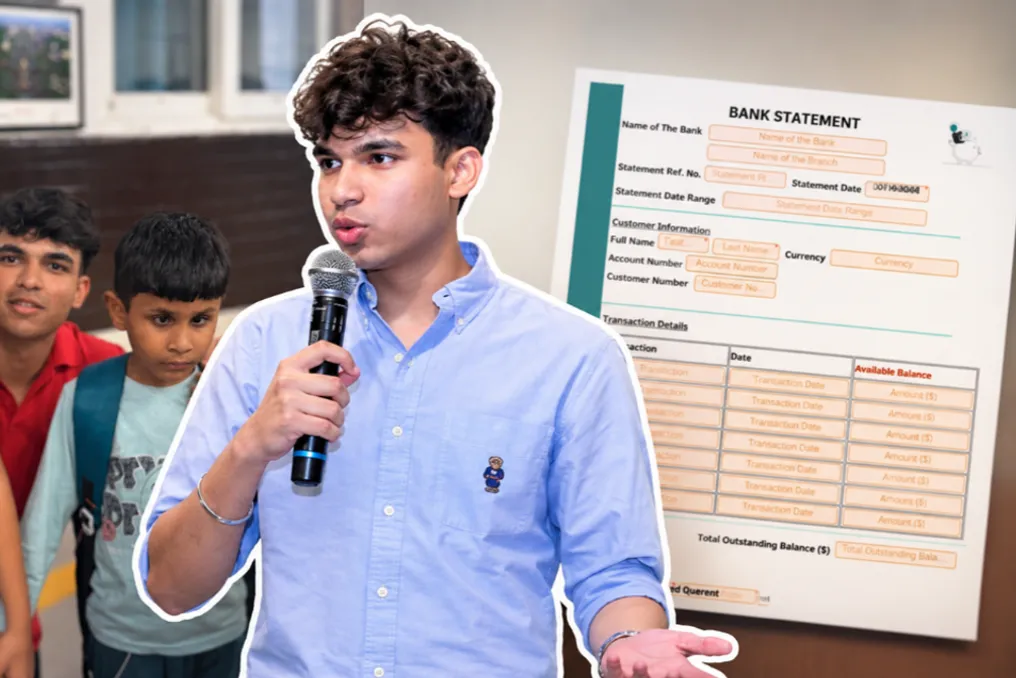
For people with visual impairments, obtaining a monthly bank statement in PDF format can become a daily challenge because screen readers cannot always correctly interpret tables and numbers. This difficulty also extends to school textbooks, government forms, and corporate reports, forcing individuals to rely on the help of others to access personal information.
When 17-year-old Yash Bhatnagar learned about this gap, he wondered if technology could solve the problem. As a self-taught programmer who has already developed several digital tools, he decided to tackle a task that many overlooked. Today, he is creating an artificial intelligence-based solution that converts inaccessible PDF files into documents that people with visual impairments can easily use with screen readers. Furthermore, his goal goes beyond simply reading documents; he aims to prompt organizations to reconsider their approach to creating and distributing information.
From Classroom Tools to Accessible PDFs
Yash's interest in creation arose early. His parents introduced him to programming, and he began studying the basics on Khan Academy, continuing his self-education, especially during the COVID-19 pandemic. His parents recall that he mastered programming very quickly, noting that 'he showed an aptitude for creating new technologies at a very young age.'
Instead of viewing coding as an experimental hobby, Yash aimed to create products that solved real user problems. His first major project was the LitGrades platform, which generates AI-powered flashcards and was launched in early 2023. After testing in his school, the platform reached about 720 students, including those from Ukraine.
He then developed Silenttype—a real-time transcription tool that turned lectures into notes saved in students' digital libraries. In October 2025, while presenting his idea at IIM Ahmedabad, he began exploring the possibility of using the tool to assist deaf users by transcribing conversations and lectures. However, a conversation with the team there introduced him to a different challenge.
As Yash recalls, 'they told me that although they considered it a good tool, there were more blind people who needed technology for optical character recognition (OCR) and converting PDFs into an accessible format.' This suggestion stayed with him. He examined several document samples and began experimenting with ways to adapt them. In studying the problem, he realized that the task went beyond simple text-to-speech conversion. Most PDFs are created without the internal structure necessary for screen readers to interpret the content. A document might look perfectly readable to a sighted person, containing headings, paragraphs, tables, and images, but without proper accessibility tags, a screen reader may not understand the reading order, distinguish sections, or describe visual elements. For a user relying on assistive technology, the result can be a document that is difficult, if not impossible, to use.
Yash started working on the solution, initially gaining support from specialists in the accessibility community. Among them was Rashi, who works with V-Shesh, an organization supporting people with disabilities and promoting accessibility. Rashi notes: 'I saw firsthand how people with visual impairments have to struggle in educational institutions due to inaccessible documents.' She remembers students having to ask for help to have documents read aloud. This experience made the problem particularly significant to her. As conversations continued between Yash and accessibility experts, the initial prototype gradually transformed into Visionably.
What Makes a PDF Readable for a Screen Reader?
Visionably primarily works with enterprises and organizations, not individual users who must fix documents themselves. Yash's approach is simple: make the information accessible at the source. He explains: 'It would be logical to make a news article accessible to every reader, but the newspaper itself should be made accessible.'
Organizations submit their PDF files to Visionably, where they are processed using an AI-powered correction engine. Simply put, the tool helps add the information necessary for screen readers to understand the document's structure. The technology identifies and adds details such as accessibility tags, reading order, and image descriptions. These changes help documents comply with internationally recognized accessibility standards, including WCAG 2.2 and PDF/UA, which define requirements for accessible PDF documents. After processing, the accessible files are returned to the organization. Yash reports that the turnaround time can be around 48 hours, depending on the volume of work.
However, creating this technology proved more complex than developing a tool for extracting text from PDFs. Documents exist in countless formats with various layouts, tables, images, and formatting styles. A system that works for a simple text document may encounter difficulties when handling a complex financial report or textbook containing numerous visual elements. Yash emphasizes: 'Since the number of PDFs on the internet is so vast, and the formats are so diverse, it is very difficult to account for every possible use case.'
He conducted over 1000 test cases and iterations, regularly sharing documents with accessibility specialists and people with visual impairments for feedback. He also received technical guidance from SaralX AI, a company operating in this field. According to Yash, the engine now successfully handles approximately 95% of tested PDF files. It is important to note that the development process includes the participation of people who actually use screen readers. Yash stated that he collaborates with a permanent visually impaired tester who checks documents and helps identify gaps he might miss.
Rashi recalls an instance where a visually impaired person tested an early prototype and pointed out several areas needing improvement. She says: 'Yash said he wanted to meet again in a week. He spent the night, and by morning, everything was fixed.' For her, this willingness to respond to feedback distinguishes his work.
Easing Website Navigation
Document correction is only one of Visionably's tasks. The company also conducts automated accessibility audits of websites. These audits help organizations identify issues such as images without alternative text, missing accessibility features, and elements that do not comply with WCAG requirements. The system uses open-source technology combined with AI-driven corrections to analyze websites and generate reports highlighting problematic areas.
For example, simply checking for the presence of alternative text for an image is insufficient. The description itself must convey the image's content. An image labeled only as 'image' may technically have attached text, but this does little to help a screen reader user understand its purpose. Visionably's AI level helps assess whether such descriptions are meaningful.
Yash also released Outloud—a free, open-source tool that allows people to check if their PDF files meet accessibility requirements. Unlike some existing tools limited to specific operating systems or workflows, Outloud works on Windows, Mac, and Linux. Users can run accessibility checks, review results, and even integrate the tool into their development processes. The goal is to make accessibility testing more widely available, including developers and organizations that may lack resources for expensive assessments.
From Children's Books to Banking Websites
One of Visionably's first paying clients is V-Shesh, which works with organizations on inclusion and accessibility for people with disabilities. As part of this collaboration, Visionably began correcting documents at the page level. Additionally, the company is partnering with Pratham Books to make 10 children's books on the StoryWeaver platform accessible free of charge. At the time of the interview, six books were completed, and the remaining four were in the final stages.
For Yash, ensuring the accessibility of these books is particularly important because their stories must be available to children with visual impairments. Instead of creating separate versions that readers must search for, the plan is to make the accessible versions directly on StoryWeaver. Parallel to this work, Yash is examining the accessibility of some major Indian banking websites. His banking accessibility audit is another attempt to draw attention to often unnoticed gaps.
The Digital Banking Accessibility Index 2026 assessed 30 major Indian bank websites, identifying 2221 accessibility barriers. Yash selected banks based on factors such as their popularity, size, and publicly available website traffic data. The automated audit checked numerous accessibility criteria, including the presence of appropriate alternative text for images and compliance of website elements with established standards. The results were delivered to the respective banks along with reports detailing the issues requiring attention. Yash reported that Kotak Mahindra Bank and Punjab National Bank responded, stating that the concerns had been passed on to the relevant teams. He plans to re-evaluate the websites in December 2026 and publish a comparative report to track improvements.
For Rashi, this accountability is crucial because accessibility cannot remain a secondary issue. She says: 'I have spoken with many children who volunteer in organizations working with people with disabilities, but Yash is someone who does it sincerely because he truly believes in it, not because it looks good in an application.'
His next goal: making accessibility part of the design. Running a tech startup while still in 12th grade requires significant effort. Yash spends about two hours on weekdays managing email, communicating with organizations, product development, and planning new projects. Weekends are often dedicated to longer work sessions and meetings. His parents, who are directors of the company since he is a minor, support him in business discussions and contacts. Nevertheless, they say that he makes the startup decisions himself, seeking advice when necessary.
Meanwhile, Yash sees great potential for expansion. Over the next two years, he hopes to correct at least 5000 files and conduct 200 to 300 website accessibility audits. He is also exploring the possibility of assessing annual reports from the top 100 public companies in India. However, his broader ambition goes beyond fixing documents after they are created. One conversation with a professional with a visual impairment who previously worked at Microsoft Accessibility left a deep impression on him. This person noted that accessibility is often treated as a secondary aspect rather than part of the development process. This distinction is what Yash wants Visionably to eliminate. He states: 'Our ultimate goal is to become an accessibility design firm where we do not view accessibility as something that happens after files are created, but as part of the process from the very beginning.'