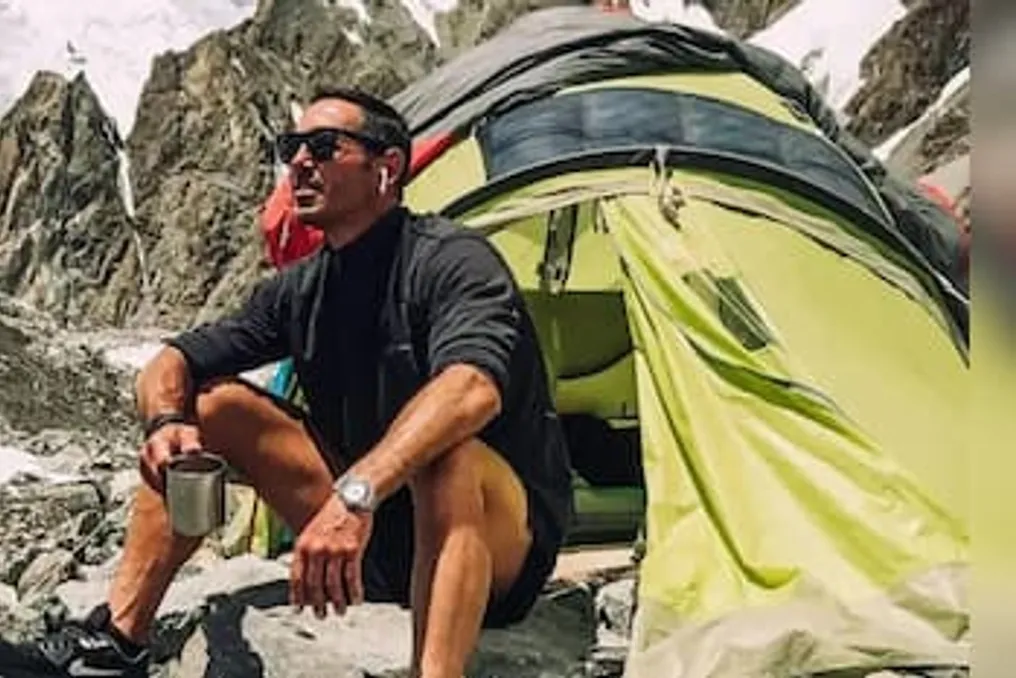
Adam Parore, a former wicketkeeper for the New Zealand national team, shared memories of a moment when he narrowly avoided death while attempting to reach the summit of the world. He recounted being caught in a large ice field collapse shortly after his first unsuccessful climbing attempt.
He described how an ice section the size of a football field suddenly vanished, accompanied by a roar comparable to a 747 takeoff. Parore noted that at that moment, the only thought was 'to stay on one's feet, and then there is a chance.' Four people were on large ice blocks, and although the ice was moving, the movement suddenly stopped. Parore emphasized that he survived due to luck.
During an extended conversation with The Athletic, he also mentioned that his involvement in the climb resulted from encouragement to take up mountaineering after retiring from cricket. He added that there is a saying: 'The mountain does not know that you are an expert,' and that many experienced mountaineers die due to careless mistakes, such as being in an ice bowl after five in the evening.
During his second attempt at the climb, when he reached an altitude of 8848 meters on Everest in 2011, he felt severe fatigue and hypoxia. Although the view from the summit was breathtaking, allowing him to see 'the ends of the earth,' after twenty minutes he felt the need to descend because his mission was not yet complete.
Parore realized that most problems arise during the descent, not the ascent. He noted that the sight of deceased people on the way back is a harsh reminder, and he feels privileged to have managed a relatively safe descent, calling it a journey into 'another world.'
The Everest ascent was the culmination of a six-year period (2011–2017) when Parore engaged in semi-professional mountaineering, regaining a sense of purpose after abruptly ending his career at age 31 following his last match for New Zealand against England at the home ground Eden Park in 2002.
He recounted that his introduction to mountaineering was accidental: his son-in-law, Johnny Davidson, who was a high-altitude mountaineer, suggested he go trekking in Queenstown. After three days of training with Johnny, he met Russell Bryce and the Himex team, as well as Mark Woodward, who became his partner. They went to Manaslu in the Himalayas, where Parore underwent a test that showed him the similarity between the rhythm of high-altitude mountaineering and life in a cricket team.
Upon returning to the elite sporting environment, he realized how much he loved teamwork. The trip to Manaslu first showed him the danger of mountaineering when the weather threatened to sweep them off the mountain. Despite this, he sought new challenges, and Everest 'lit the fuse' for the next project.
Parore secured Russell Bryce's agreement to go to K2 (on the border of Pakistan and China), even though it was initially only accessible to professionals. After Manaslu and Everest, he was drawn to K2, which he called the most beautiful and impressive place, although he could not reach the summit, having been forced to turn back before Camp IV.
Before becoming a mountaineer, Parore was a key player for the New Zealand national teams in the 1990s and early 2000s, playing 78 Test matches and 179 One Day International matches. He explained his aggressive demeanor in the team as a necessary role that developed over the years but does not reflect his true personality. He admitted that it served as a mechanism to bridge the gap in playing level with younger and more talented opponents.
Parore highly values former New Zealand Test coach Stephen Fleming, calling him an influential figure in his career. He predicts that England will continue to improve its results based on the work done under Brendan McCullum's guidance, and sees synergy between McCullum and Fleming.
Now, at 55 years old with a family and a business, Parore believes his days in the mountains are over. He notes that mountain experience is a deeply internal experience that demands respect, given the number of people who perish there. He views his time in the mountains as a partnership with the mountain that requires respect, otherwise the mountain can kill.