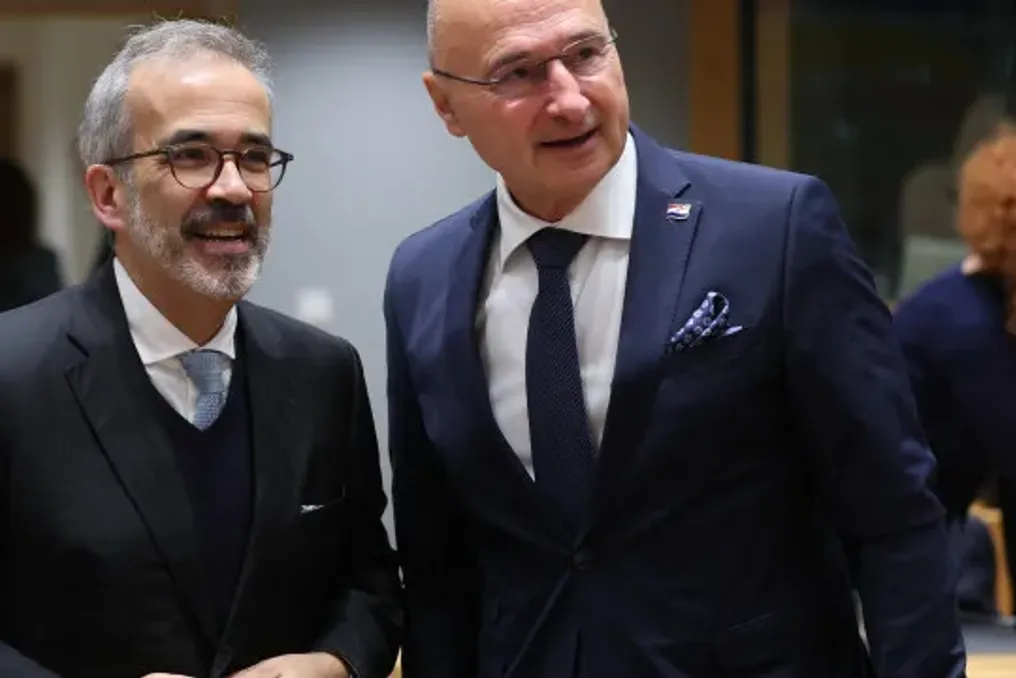
The Foreign Minister stated that a consensus has been reached in the European Union regarding the provision of a new loan of €45 billion for Ukraine. This amount covers two-thirds of the €70 billion budget deficit identified by Kyiv.
Paulo Rangel, speaking to journalists at the end of the EU foreign ministers' meeting in Brussels, revealed that the remaining €25 billion could be allocated to other friendly countries of Ukraine that are not EU members.
The proposal for new financing for Ukraine must be officially presented by the European Commission. It emerged after Ukrainian President Volodymyr Zelensky warned at the Council of Europe summit in October about the need for an additional €70 billion in 2027 beyond the initially planned amount.
Rangel noted that at today's meeting, European Commission Vice-President Valdis Dombrovskis presented a 'technical presentation on this matter.' He also added that the Portuguese government possesses documentation indicating that the public executive body is preparing to submit a corresponding proposal.
The Minister expressed his view that the situation is moving towards the approval of this loan, although he acknowledged doubts from some countries. He emphasized that this will not prevent its approval despite some disagreements.
This statement implied opposition from countries such as Slovakia, the Czech Republic, and Hungary, which refused to participate in another €90 billion loan for Ukraine last year.
When asked if his statements meant that the new loan could be concluded without the participation of these three countries, Rangel replied that this issue still requires further work. He said: 'I will not hide that this issue is on the table. It was not the subject of much discussion, but it was obviously present in our documents. We will see how it develops. Portugal is always at the forefront, contrary to what some say, in defending Ukraine.'
Earlier, on Friday, at an informal summit in Dublin, Prime Minister Luis Montenegro had already expressed support for the new EU loan for Ukraine. He advocated the position that the bloc 'should seek exceptional financing tools for exceptional situations, as was done in the past.'
He cited the economic recovery during the pandemic using NextGenerationEU as an example, stating that similar mechanisms should exist for exceptional challenges like the current war on the threshold of Europe and the EU.
Last year, the EU already agreed to provide Ukraine with a loan of €90 billion, with €45 billion to be allocated in 2026 and the remaining €45 billion in 2027. However, at the Council of Europe summit in October, Zelensky reported that these funds were insufficient and required another €70 billion for the following year, calling on EU leaders to find ways to provide this aid.