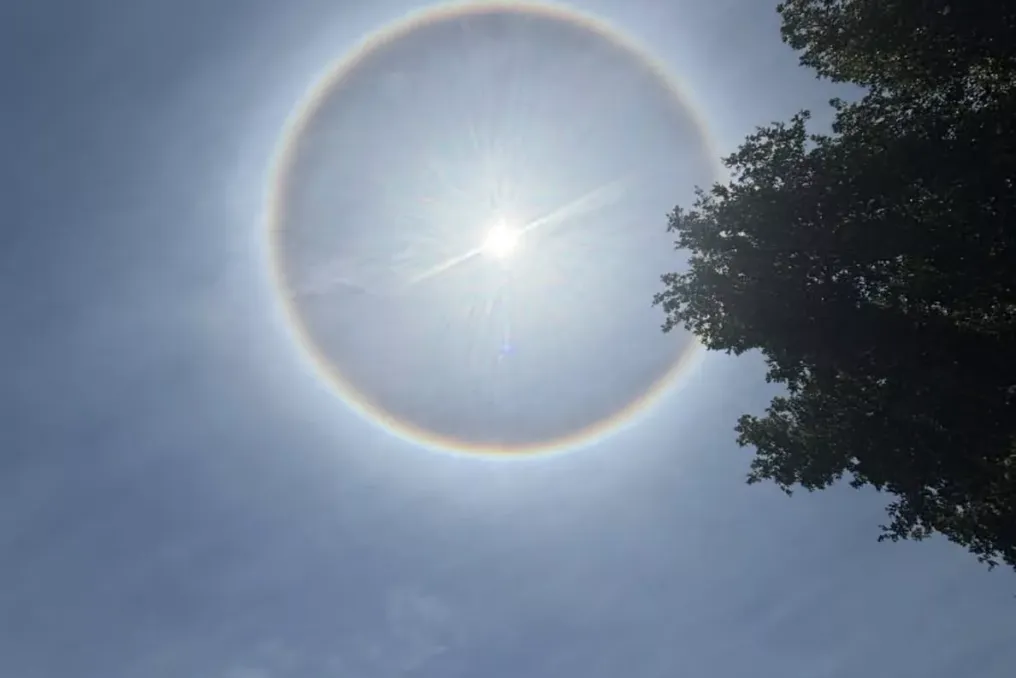
A bright ring of light around the Sun attracted the attention of residents in South Africa on Monday, November 16, after photos of this unusual sight appeared on social media.
Some observers questioned the reason for the colorful display, but the explanation lies in an interesting natural phenomenon. This spectacle, visible over parts of Gauteng and other areas, is known as a 22-degree solar halo.
Despite its unusual appearance, this phenomenon is not related to extraterrestrial activity or changes in the Sun itself. Instead, it is an optical effect resulting from the interaction of sunlight with tiny ice crystals high in Earth's atmosphere.
According to meteorologists, solar halos form when sunlight passes through millions of tiny hexagonal ice crystals suspended in high cirrus or cirrostratus clouds. These clouds are typically located at an altitude of eight to ten kilometers above the ground, where the temperature is low enough to form ice crystals, even if it is warm at ground level.
When sunlight hits and passes through the crystals, it refracts. The light is redirected at a specific angle, creating the characteristic circular ring surrounding the Sun. The most commonly observed form is called a 22-degree halo, which refers to the angle at which the ring appears around the Sun from the perspective of a person on Earth.
Although halos often appear as a bright white circle, they can also exhibit subtle rainbow hues. Red is usually visible along the inner edge, while blue and violet tones may appear closer to the outer edge.
Solar halos sometimes correlate with changing weather conditions, as the high clouds causing this phenomenon may develop before an approaching atmospheric front. Meteorologists note that the presence of a halo can indicate moisture and cloud activity in the upper layers of the atmosphere, but it is not a reliable sign of imminent rain.
Recent weather conditions in South Africa, including thunderstorms over part of Gauteng, also drew attention to the atmospheric activity behind this spectacle. Meteorologists caution against interpreting the halo as a forecast of approaching rain.
Although solar halos are harmless atmospheric phenomena, their observation requires caution. Experts warn against looking directly at the Sun, even when trying to photograph the surrounding ring. Direct exposure to intense sunlight can cause serious and potentially irreversible eye damage.
A safer way to observe is to find a place where a building, tree, or other object blocks the Sun itself, allowing you to see the halo around it without looking directly at the solar disk. Solar halos serve as a reminder of the wonderful natural occurrences that can happen in our atmosphere; although they look unusual, the science behind them is a fascinating combination of sunlight, clouds, and ice crystals.