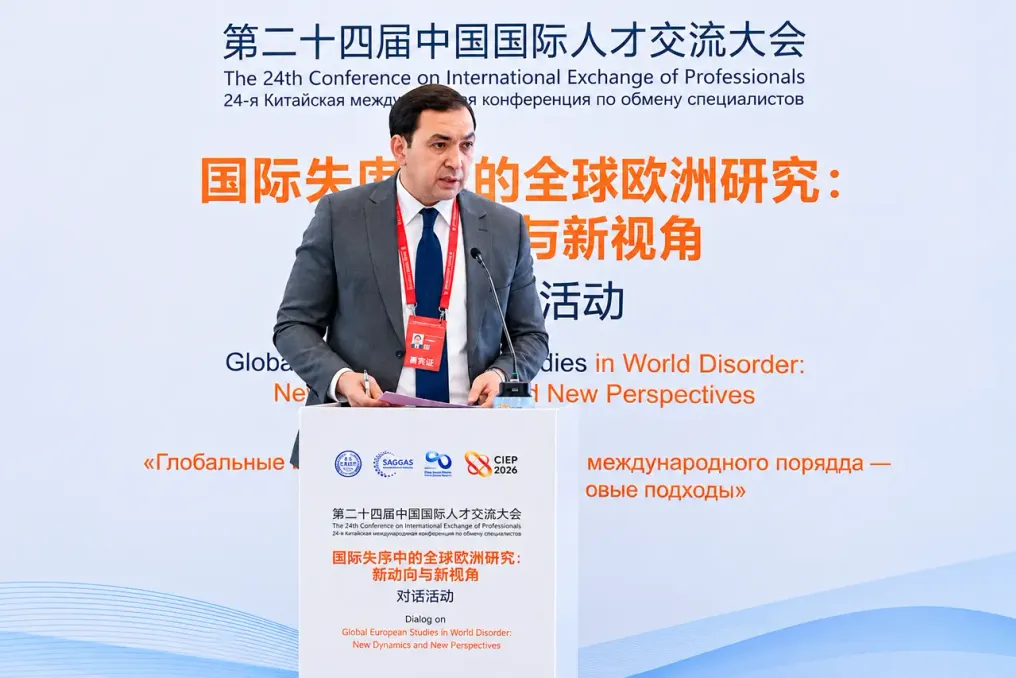
Central Asia becomes a key node of Eurasian economic integration
Read more
UzDaily
uzdaily.uz

Central Asia becomes a key node of Eurasian economic integration

Central Asian countries must play a more significant role in Eurasian production chains by expanding joint investments, localizing production, and exchanging technologies, stated Bakhtiyor Mustafayev, Deputy Director of the Institute of Strategic and Regional Studies of Uzbekistan (ISRS), at an international forum in Shanghai.

The forum, held on November 12–13, 2026, titled 'European Studies in Conditions of Global Disorder: New Dynamics and New Perspectives,' was organized by the Shanghai University of International Studies and the Shanghai Academy of Global Governance and Regional Studies. Participants discussed changes in international economic relations, Eurasian connectivity, industrial cooperation, as well as green and digital modernization.

Speaking at the session on 'Eurasian Economy, Society, and Culture,' Mustafayev noted that amid global changes, Central Asia is gradually transforming from a transit corridor into an independent participant in Eurasian production and logistics chains. He emphasized that the new impetus in regional cooperation opens opportunities to deepen ties with China and other Eurasian partners.

However, according to the expert, countries need to move beyond simply increasing mutual trade and transition to joint investment projects, production, and technology exchange.

Mustafayev identified the development of transport and logistics infrastructure as a priority task. He paid special attention to the China–Kyrgyzstan–Uzbekistan railway project, noting that it can strengthen the connection between Eurasian markets and expand opportunities for industrial interaction. It was also noted that customs procedures need to be improved and digital solutions implemented in logistics.

The expert named the development of regional value chains as the second priority. He advised Central Asian countries to gradually move away from a resource-based model and develop joint production. Promising sectors include the processing of critical minerals, electrical engineering, agricultural product processing, and the production of components for renewable energy. These projects must take into account the complementary industrial specializations of the region's countries.

Mustafayev designated joint green and digital modernization as the third priority. He highlighted the circular economy as a promising area for cooperation between Central Asia and China. Uzbekistan has already begun work on waste processing, including attracting Chinese technology companies. Nevertheless, the limited size of national markets makes it difficult for individual countries to create complete recycling cycles for complex waste.

As a solution, Mustafayev proposed developing cross-border secondary recycling chains. Under this model, countries could specialize in collecting, sorting, and processing secondary raw materials. This approach is particularly relevant for used batteries, electronic equipment, and solar panels.

Furthermore, Mustafayev stressed the importance of human capital development, emphasizing the need for joint educational programs, engineering internships, and applied research. After his presentation, he suggested forming a common agenda for expanding Eurasian production chains, which should include pilot projects in green industry and the circular economy. Another proposed priority was the expansion of specialized training in digital logistics and modern industrial technologies.
Similar stories

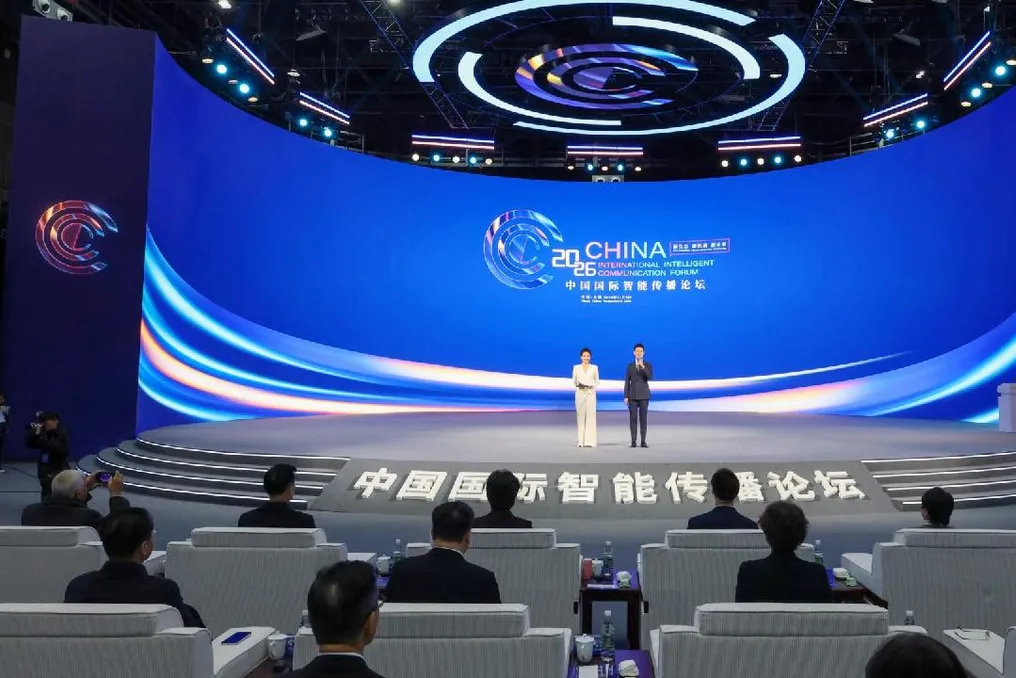
China's International Forum on Intellectual Communications 2026 Opens in Wuxi
Read more
cgtn.com

China's International Forum on Intellectual Communications 2026 Opens in Wuxi

In Wuxi, Jiangsu Province, in eastern China, the China International Forum on Intellectual Communications 2026 (CIICF) is taking place from November 8 to 10. The central theme of the forum is artificial intelligence (AI) and its impact on the global media sphere.

The forum, held in collaboration with the China Media Group (CMG) and the Jiangsu Provincial Government, is the sixth such event. It gathers representatives from government, academics, and industry figures from both China and abroad to discuss the opportunities and challenges shaping the future of intellectual communications.

Yu Juncheng, Vice President of CMG, noted that the forum has become an important platform for international cultural exchange and showcasing China's innovations in communication. He called for the integration of ideas, art, and technology, utilizing digital intelligence to connect the world and aligning with the national 'AI Plus' initiative, so that technological potential can be transformed into accessible and beneficial communications.

Xu Yin, a member of the Standing Committee of the Jiangsu Provincial Committee of the CPC and head of its Propaganda Department, emphasized that AI is changing the landscape of international communications at unprecedented rates. This year, the forum's focus is on the international interaction of digital culture and the industry of AI-generated content (AIGC), which, according to her, should provide a new impetus to global intellectual communications.

Oleg Kopylov, Deputy Secretary-General of the Shanghai Cooperation Organisation (SCO), stated that AI is fundamentally changing the world's information production base and opening new avenues for dialogue between civilizations. The SCO views AI as a factor promoting sustainable development and is ready to cooperate with media in member states to improve global AI governance.

Zamir Ahmed Avan, founder of the Global Silk Road Research Alliance, insisted on the necessity of maintaining respect, honesty, cooperation, and cultural diversity amid technological changes in how people communicate. He also added that the forum can promote expanded cooperation among countries of the Global South.

Acting Mayor of Wuxi, Cai Jianfeng, announced that the city aims to become a landmark point through which the world can understand China by applying AI in all aspects of international communications.

Participants jointly adopted the Wuxi Initiative of the China International Forum on Intellectual Communications, which calls for the use of technology for good, deepening cooperation, and mutual learning. The idea of creating a new global ecosystem of intellectual communications was also proposed—one that should be open, inclusive, collaborative, and mutually beneficial. Furthermore, the Chinese Academy of Social Sciences released the report 'Report on the Development of International Communication Capacity of Chinese Cities 2026.'

As part of supplementary events, forums were held dedicated to digital culture and the AIGC industry, the 'Wuxi Dialogue' on local international communications, and an international media tour.

Popular