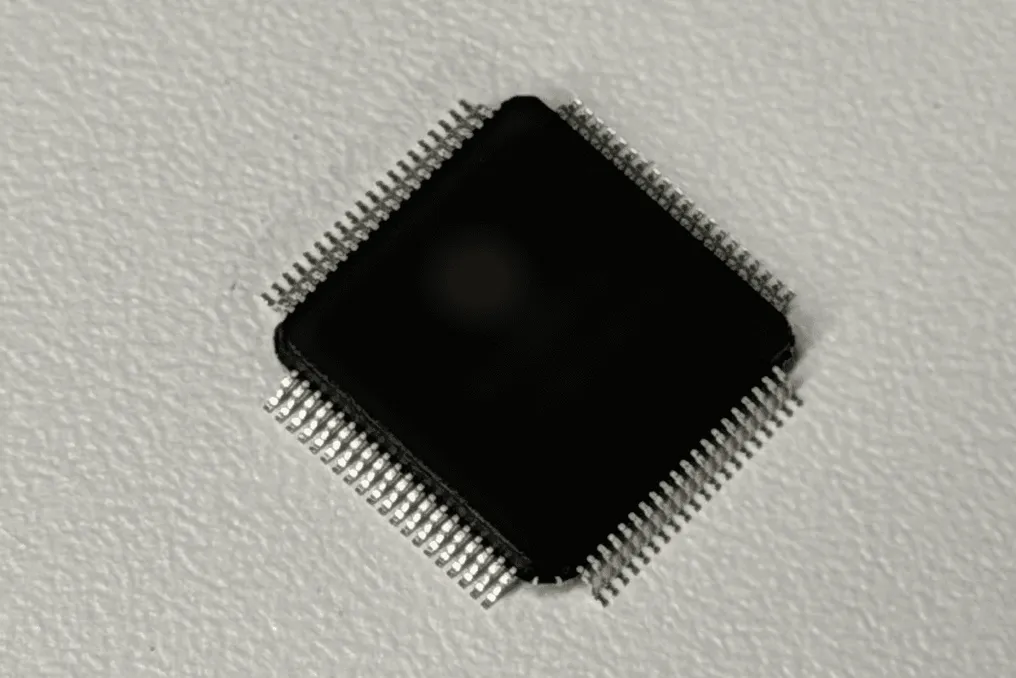
The analog computing startup Anatrix Intelligence announced the completion of the tape-out process for its AX100 chip in October. The company positions this chip as the first fully integrated analog computing chip capable of solving matrix equations in a single stage.
The company reported this achievement to Science and Technology Daily on November 15. It should be noted that all performance metrics presented by the manufacturer are self-reported and have not yet undergone independent verification.
According to the company itself, solving one matrix equation on the AX100 takes less than one hundred nanoseconds and consumes about eighty milliwatts, which aligns with the target metrics established during simulations and design.
Solving matrix equations is fundamental for optimization in artificial intelligence training, robot motion planning, and signal processing of base stations. Digital chips break down each such solution into numerous multiply-accumulate iterations, where the workload grows approximately cubically with the size of the matrix. The company notes that a system of order 512 requires about five hundred million multiply-accumulate operations, taking tens or hundreds of microseconds.
However, on the AX100, as stated by CEO Xiang Rui, 'the matrix equation is directly mapped onto the circuit, and as soon as the circuit stabilizes, the result is read out simultaneously, without the need for iterations.'
This technology was developed by the team of Sun Zhong, a researcher from the Institute of Artificial Intelligence at Peking University. In October 2025, this team published results in the journal Nature Electronics regarding the improvement of analog computation accuracy from approximately one part in a hundred to approximately one part in ten million. Anatrix spent about a year to translate this work into a production chip, utilizing mature process technologies instead of cutting-edge nodes.
Anatrix reports conducting tests in three areas. The company emphasizes that its architecture and core logic differ from digital GPUs, and the chip's goal is to provide an entirely new type of hardware for novel matrix equation-based tasks. Nevertheless, the company has not yet released technical documentation or third-party benchmarks for the AX100, nor has it specified the availability timeline for samples.