Public and private healthcare spending exceeds 20% of India's total health expenditure
Read more
Business Standard
business-standard.com

Public and private healthcare spending exceeds 20% of India's total health expenditure

According to the National Health Accounts estimates published by the Ministry of Health and Family Welfare, in the financial year 2023-2024 (FY24), public health schemes and private insurance accounted for 21.2 percent of Total Health Expenditure (THE) in India. Both segments exceeded the 10 percent mark for the first time.

Spending on public health programs and private medical insurance increased after the COVID-19 pandemic, making up more than one-fifth of India's total health expenditure in 2023-2024. This figure rose from 15.9 percent in 2020-2021 (FY21).

Social health expenditures, which include government spending on contributions to centralized and regional insurance schemes, rose to 11 percent of THE in FY24 compared to 8.6 percent in FY21. This category covers government-funded programs such as Ayushman Bharat PMJAY, regional insurance schemes, employee welfare programs, reimbursement for government employees, and social health insurance.

Similarly, private medical insurance spending reached 10.2 percent of THE in FY24, up from 7.3 percent in FY21. This marked the first instance where both social health expenditures and private insurance spending individually exceeded 10 percent of THE.

The rise in these figures is significant because during the pandemic years, there was a sharp increase in government spending on vaccination, testing, and public health programs, which contributed to a decrease in the share of household expenditure in overall healthcare.

An anonymous official source noted that people have become more serious about health insurance after the pandemic. He added that while subsidized government programs cover employees and lower strata of society, individuals who can afford private insurance are also seeking to avoid high costs of inpatient treatment.

Furthermore, the report shows that household health expenditure has sharply decreased over the last decade, falling from 64.2 percent in 2013-2014 (FY14) to 42.7 percent in FY24. This aligns with the goal of reducing Out-of-Pocket Expenditure (OOPE) to 35 percent of THE by 2025-2026 (FY26).

One of the key factors in this long-term decline has been the nearly threefold increase in Government Health Expenditure (GHE), which grew from 1.3 trillion rupees in FY14 to 4.14 trillion rupees in FY24. The Ministry of Health emphasized that public spending on primary healthcare reached approximately 1.53 trillion rupees, reflecting priority investments in community-level and basic services.

The Ministry of Health stated that these investments are particularly important in the context of expanding Ayushman Arogya Mandirs (AAMs), which bring comprehensive primary healthcare services closer to the population. The official representative also mentioned that the impact of screening and awareness campaigns was reflected in the eighth round of the National Statistical Office survey. According to this survey, the demand for healthcare almost doubled: from 6.8 percent to 12.2 percent in rural areas and from 9.1 percent to 14.9 percent in urban areas between 2017-2018 and 2025.

Similar stories

Rahul Gandhi announces social protection measures for gig workers in Telangana: insurance and data access
Read more
www.aajtak.in

Rahul Gandhi announces social protection measures for gig workers in Telangana: insurance and data access

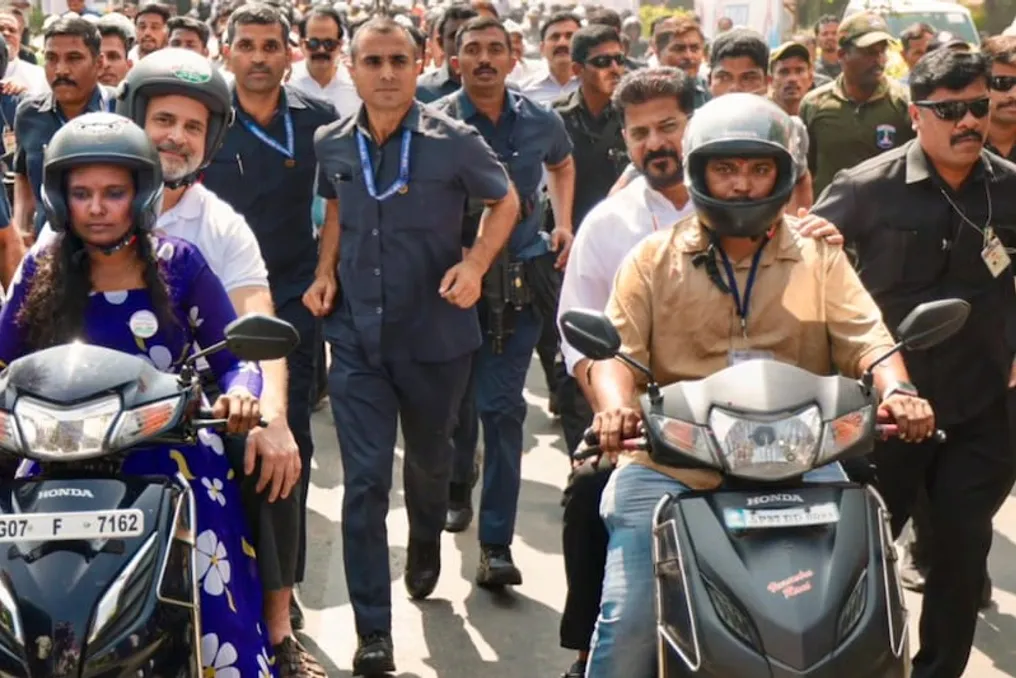
During the launch event of the social security and welfare program for Telangana's gig workers, held in the state capital, Hyderabad, opposition Lok Sabha MP Rahul Gandhi presented a series of social guarantees for workers in this sector.

He announced that the Telangana government will provide gig workers with accident insurance worth 500,000 rupees and medical insurance worth 1 million rupees. Additionally, workers will gain access to data related to their work and earnings.

Rahul Gandhi recalled meeting with gig workers in Telangana who shared their problems. He stated that the Congress party, Governor Revanth Reddy, and all of them promised to take action on their demands and provide them with support and protection, and they are now fulfilling that promise.

Gandhi emphasized that we live in a data age where global companies like Google, Facebook, WhatsApp, and Uber utilize the power of data. However, in India, gig workers have long lacked access to information about their work. They could not see how many deliveries they made, how long they worked, what income they earned, or when the money was credited to their account.

According to Rahul Gandhi, the new law will grant gig workers ownership of their data. The Telangana government guarantees that all information concerning their trips, deliveries, transactions, and payments will be accessible on their mobile phones.

Commenting on the working conditions of gig workers, Gandhi noted that they often transport goods on scooters under the scorching sun, but cities lack designated rest areas for them. He reported that the Telangana government will establish rest zones with Wi-Fi in Hyderabad and other towns in the state. In these places, workers can park their vehicles and take a short break.

Considering that injuries or illnesses prevent gig workers from working, leading to financial difficulties for their families, the Telangana government will provide them with accident insurance of 500,000 rupees and medical insurance of 1 million rupees. Gandhi also stated that gig workers should have the right to a pension, social security, and future savings.

To achieve this, one percent of every transaction, whether it is a delivery or an Uber ride, will be directed to the Telangana gig worker welfare fund. Companies are obligated to make this contribution, and the funds will go into a fund that ensures direct payment transfers to employees' bank accounts.

During the event, Rahul Gandhi also criticized the BJP and the Rashtriya Swayamsevak Sangh (RSS). He stated that two different ideologies exist in the 21st century. Gandhi accused the ideology of the BJP and RSS of seeking to turn gig workers into forced labor, arguing that this ideology wants workers to toil all day facing dangers and hardships, while all the profit from their labor goes to billionaires and large corporations.

Uzbekistanis's spending on medical services exceeded 17 trillion soums since the beginning of the year
Read more
podrobno.uz

Uzbekistanis's spending on medical services exceeded 17 trillion soums since the beginning of the year

In the first nine months of 2026, the total volume of medical services in Uzbekistan reached 17.6 trillion soums. A significant portion of these expenses, amounting to 8 trillion soums, was directed to Tashkent.

Compared to the same period last year, this indicator showed an increase of 14.2%. The expenditure structure revealed that more than half of the total volume is attributed to other medical services—53.3%. The remaining expenses were distributed as follows: 32.3% went to hospitals, and 14.4% to doctors' and dentists' services.

Thus, the capital received about 45% of all medical services provided in the country, which is comparable to the total expenditures of the other regions.

Furthermore, plans were previously announced to launch a unified system for controlling medical outsourcing in Uzbekistan by April 1, 2027. This system is designed to ensure the ability to monitor services transferred from state hospitals to private organizations.

Popular