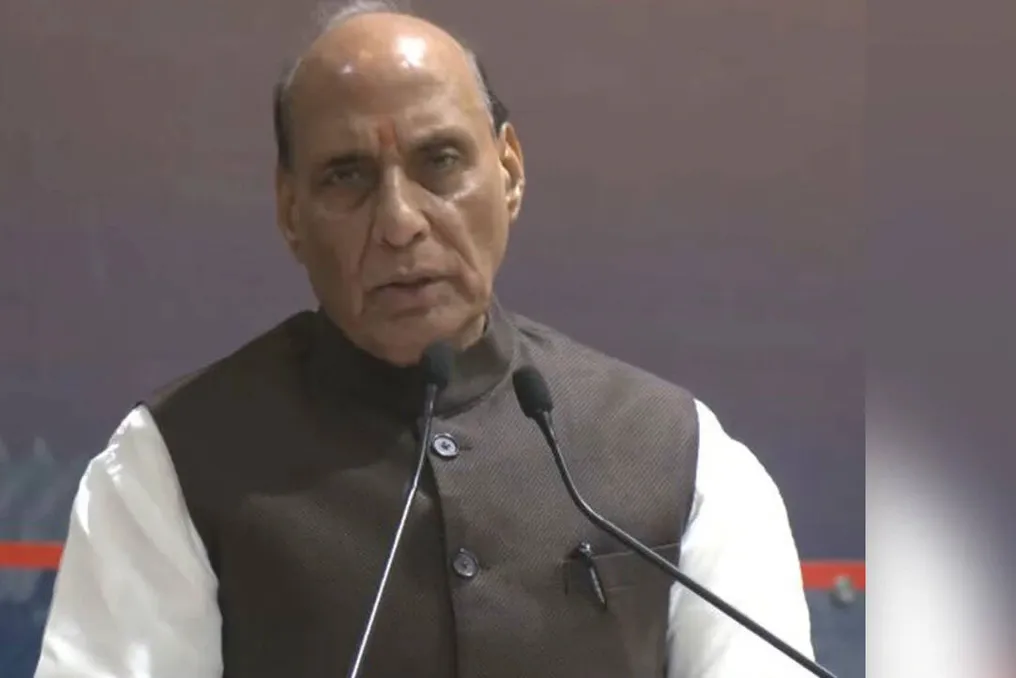
Defence Minister Rajnat Singh called for enhanced quality control in domestic defense manufacturing on Sunday. He emphasized that India must transition from merely detecting defects to preventing them at every stage of the production cycle.
Speaking at the 36th Annual Conference on Non-Destructive Testing and Assurance Technologies and the 15th International Symposium on Non-Destructive Testing in the Aerospace Industry in a virtual format, Singh noted India's significant progress in developing indigenous defense capabilities. However, he warned that increasing technological complexity demands heightened responsibility for ensuring reliability.
He stated that India's achievements in missile weaponry, naval platforms, aerospace technology, radar systems, and space applications reflect the growing competence of scientists, engineers, manufacturing agencies, and industry partners.
As an example of a major milestone in the country's defense manufacturing history, Singh mentioned the commissioning of the aircraft carrier INS Vikrant, which was designed and built in India. He also pointed to successes in developing indigenous missile technologies and space systems as proof of India's scientific and industrial prowess.
Nevertheless, the minister cautioned that these achievements must be underpinned by the strictest quality standards across all defense manufacturing. He stressed that as the defense system becomes more complex, it is essential to guarantee that every critical component, material, assembly, and manufacturing process meets the highest requirements for quality and reliability.
The Defence Minister warned that undetected defects can negatively affect the operational readiness of military equipment, increase maintenance needs, and reduce the service life of the equipment. In critical situations, such flaws can jeopardize mission success.
Calling for a change in approach, Singh highlighted that quality control must be integrated throughout the entire production process, rather than being viewed merely as a measure to identify errors after production is complete. He added that a culture of active defect prevention, not just defect identification, needs to be established, which requires embedding quality at every stage of production.
Singh noted that the conference theme, 'Innovations for Strategic and Economic Supremacy,' aligns with India's aspiration to become a technologically advanced, industrially strong, strategically secure, and globally competitive nation. He added that national progress depends not only on technological development but also on the quality, reliability, and safety of the systems created, especially in strategic sectors like defense, where the consequences of any failure can be far-reaching.
Singh, who could not attend the event in person due to viral fever, joined the meeting virtually. He also congratulated the leadership of the Indian Society for Non-Destructive Testing, the organizing committee, and everyone involved in conducting this prestigious conference.