HyperS2C Launches Full Suite of EDA Tools for Digital Frontend and Two AI Verification Agents
Read more
Pandaily
pandaily.com

HyperS2C Launches Full Suite of EDA Tools for Digital Frontend and Two AI Verification Agents

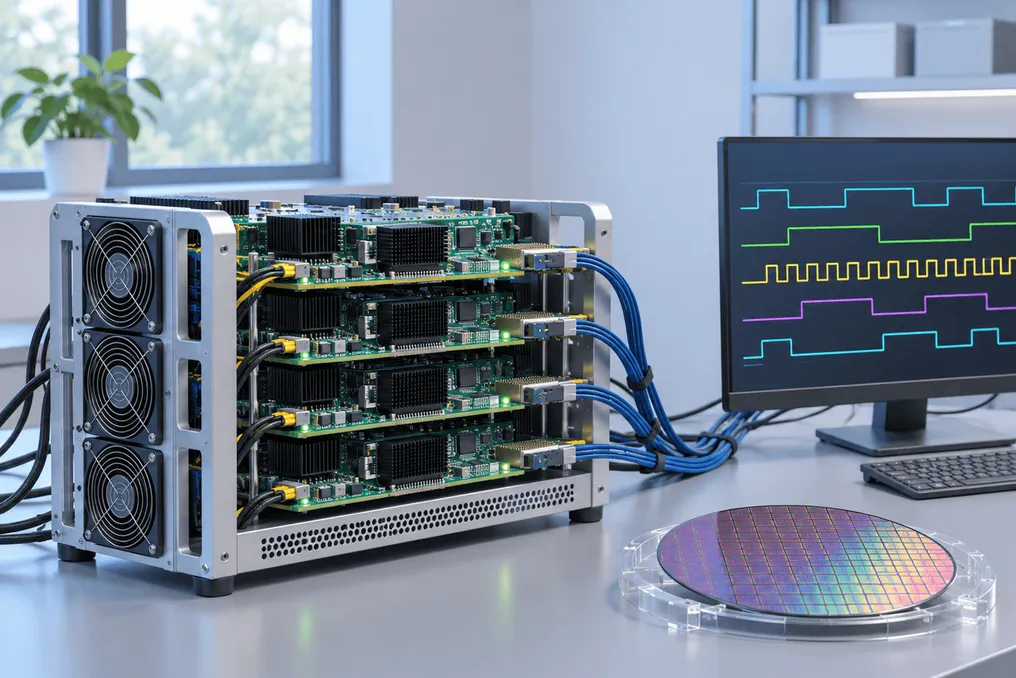
HyperS2C, a new company in the field of EDA for digital frontend formed by merging S2C and HyperSilicon, was introduced on November 13 at the IC China exhibition in Beijing. At the start of sales, the company presented a product line that includes two artificial intelligence (AI) tools for chip verification.

Empyrean Technology, which led the merger process, stated that HyperS2C now provides domestic chip developers with a single supplier for the entire digital frontend cycle—from architecture design to system-level verification.

The merger agreement between S2C and HyperSilicon was signed in October. According to S2C, the combined company is based in Uxi and holds 205 patents and 200 software copyrights, serving over 800 clients. As noted by HyperS2C CEO Li Junxiun, S2C contributes a full suite of tools and an international client base, while HyperSilicon provides deep expertise in both hardware emulation and FPGA prototyping.

Presented Product Lines

Empyrean Chairman Liu Weiping emphasized that developing EDA for digital circuits remains the weakest part of domestic tooling. He added that HyperS2C expands Empyrean's offerings by incorporating hardware emulation and prototyping. Liu Weiping also announced that Empyrean has created a specialized AI team and collaborates with leading domestic companies developing large language models to create an EDA agent platform. He described digital frontend verification as one of the most data-intensive stages of chip design. Empyrean plans to integrate HyperS2C's tools with its own toolchain for analog, digital, and fab processes.

Clients were present at the presentation. Processor designer Phytium reported that they had used S2C's Prodigy FPGA prototyping systems for developing their processors for many years.

HyperS2C has subsidiaries or offices in Beijing, Shanghai, Shenzhen, Xi'an, Hefei, Hong Kong, San Jose, Tokyo, and Seoul. The company has not yet disclosed when the two agents will become publicly available, nor has it provided performance data on them.


Similar stories

Anthropic launches more powerful AI models amid warnings about autonomous evolution
Read more
olhardigital.com.br

Anthropic launches more powerful AI models amid warnings about autonomous evolution

Anthropic announced on Monday (9) the launch of two new iterations of its artificial intelligence models: Claude Fable 5.2 and Claude Mythos 5.2. These tools incorporate notable improvements in areas such as reasoning, programming, and visual interpretation, although their launch occurs during an intense debate about AI's ability to drive its own development.

According to the company, the newly released models demonstrate greater clarity in communication and offer more agile responses. Specifically, Fable 5.2 saw its entry fee decrease from US$ 10 to US$ 8 per million tokens, representing a 20% reduction (equivalent to about R$ 43). Furthermore, Anthropic reports that this model's responses became 30% faster across various complexity levels.

Access to Mythos 5.2 will be limited to organizations validated by the company itself, including those involved in cybersecurity focused programs. On the other hand, Fable 5.2 is already accessible through the Anthropic API and cloud computing platforms.

This launch follows a report issued by the AI safety organization, METR, just a few days prior. This study indicated that Anthropic's developed models are progressing almost twice as fast as before, an advancement attributed partly to the use of AI in the development cycle itself.

The analysis, conducted over eleven weeks and published on November 5, calculated that the performance of the company's models in well-defined tasks advanced 1.9 times faster since October 2025 compared to the preceding period. This finding reignited conversations about the concept of recursive self-improvement (RSI), which describes the potential for AI systems to assist in improving future versions of themselves, thereby accelerating consecutive technological generations.

However, METR made important caveats to its study, classifying the estimate as highly uncertain; the actual acceleration rate could vary between 1.5 and 2.5 times the historical pace. The study also highlighted that AI does not yet have the capacity to generate highly relevant contributions fully autonomously in the crucial phases of model training.

Additionally, Anthropic informed that Fable 5.2 was used in scientific research before its public release. Results credited to this model include solving two pending problems in theoretical physics and formalizing a proof for Fermat's Last Theorem. The company also mentioned that its models helped engineers finalize software migrations considered impractical, conceive three functional electronic devices from scratch, and advance in robotics-related evaluations.

In another disclosure made on Monday, the startup Physical Superintelligence presented a new demonstration regarding the Aaronson-Ambainis conjecture, a topic relevant to defining the theoretical limits of quantum computation. This company claimed to have achieved this result using an undisclosed Anthropic model, although the developer did not confirm whether the specific tool was Fable 5.2.

NPCI establishes technology division to work with AI and blockchain, appoints Vishal Kanwat as CEO
Read more
business-standard.com

NPCI establishes technology division to work with AI and blockchain, appoints Vishal Kanwat as CEO

The National Payments Corporation of India (NPCI) has created NPCI Tech Solutions Limited (NTSL), a subsidiary that will serve as the technological and innovation wing of the NPCI group. The corporation announced on Wednesday the appointment of Vishal Kanwat as Managing Director and Chief Executive Officer (MD & CEO) of this new entity.

NTSL will focus on developing capabilities that extend beyond NPCI's core mandate in payments. The company's main areas of activity include artificial intelligence (AI), blockchain, digital financial infrastructure, and Global Capability Center (GCC) services.

Furthermore, NPCI stated that NTSL will provide technological services for the eKYC Setu program, the Unified Ticket Platform (UTP), and other initiatives in the Digital Public Infrastructure (DPI).

The creation of this subsidiary was approved by the NPCI board of directors and the Reserve Bank of India (RBI). NTSL becomes the fourth wholly-owned subsidiary of NPCI. Previous subsidiaries include NPCI International Payments Limited (NIPL), which handles the international expansion of Unified Payments Interface (UPI) and RuPay; NPCI Bharat BillPay Limited (NBBL), which manages the bill payment network; and NPCI BHIM Services Limited (NBSL), which manages the BHIM application.

Vishal Kanwat has been with NPCI for almost ten years and currently serves as the Chief Technology Officer. He joined in 2017, focusing on product and innovation matters. Before becoming CTO in April 2023, he managed the market innovation portfolio. NPCI clarified that he led the development and commercialization of several market innovation platforms that now fall under NTSL's purview.

Dilip Asbe, Managing Director and CEO of NPCI, noted: 'Technology has always been at the core of NPCI's journey and its contribution to India's digital transformation. As we move forward, advancements in artificial intelligence and other new technologies open up new opportunities in digital infrastructure and financial services.'

Asbe added that NTSL was established to concentrate on these opportunities and further strengthen the technological capabilities of the NPCI Group.

NPCI was founded by the RBI and the Indian Banks' Association (IBA) and is registered as a non-profit company. It facilitates systems such as UPI, RuPay, Immediate Payment Service (IMPS), National Automated Clearing House (NACH), National Electronic Ticketing System based on FASTag (NETC), Aadhaar Enabled Payment System (AePS), and e-RUPI.

Tencent's Hyra 2.0 research agent independently creates tools for proteins, mathematical proofs, and chips
Read more
pandaily.com

Tencent's Hyra 2.0 research agent independently creates tools for proteins, mathematical proofs, and chips

Tencent Hunyuan has released Hyra 2.0, the second version of its autonomous research agent, which was presented on November 2nd. Unlike Hyra 1.0, which focused on solving individual tasks, such as resolving the sum versus difference exponent problem using the Hy3 model, the new version is designed to create reusable research tools. The results and corresponding code are available in the GitHub repository under the Apache 2.0 license.

Hyra 2.0 functions as a three-level system consisting of general, mission, and worker agents. These agents are coordinated through a common research board and a persistent task queue. A specialized worker agent verifies results, agents maintain multi-level memory, and a general knowledge base summarizes learned lessons into applicable skills.

Tools Created by the System

Tencent has introduced a range of tools developed by this system. Among them is HyInv—a protein reverse folding model with 1.96 million parameters. This model operates 57 times faster than ProteinMPNN, demonstrating better structural correspondence and capable of designing 128 sequences in just 50 milliseconds.

The HyPLM-Flash protein language model was also presented, possessing 650 million parameters and trained on 726 billion tokens. It proved to be the fastest among 12 compared models, ranking third on average across 35 tasks, processing about 130,000 residues per second on a single H20 processor.

The HyFF force field family, which includes five variants with parameters ranging from 2.3 million to 1.2 billion across 83 elements, sits on the Pareto front of accuracy and speed compared to 16 other models. Tencent claims that their Largo model shows the lowest energy error—0.364 meV per atom—and this complex was able to simulate a 60,000-atom aquaporin system over 100 nanoseconds.

Achievements in Mathematics and Quantum Computing

In the field of mathematics, the HyProver component achieved two results. It solved Petty's conjecture on equilateral sets in five-dimensional space, raising the maximum solved dimension from four. Regarding Yau's circle action hypothesis, the GitHub description presents a counterexample for the unbounded case—a closed seven-dimensional manifold that is not simply connected; meanwhile, the simply connected version remains an open problem.

In the area of quantum error correction, HyQEC discovered the code [[488,123,22]], which, according to Tencent, surpasses the previous leader by approximately 48% in the qLDPC metric.

Robotics and Chips

Furthermore, Hyra designed a simulated robotic arm mechanism that was 28.6% faster than the reference design. On the open XiangShan RISC-V processor, the agent increased the SPECint2006 score by 5.79% per gigahertz while increasing the area by only 0.3% and detecting ten errors. Tencent reports that Hyra is now being used to train subsequent Hy series models.

It is important to note that all presented results belong to Tencent and have not yet undergone independent review.

Popular