
16-year-old creator Ridit Kumawat developed an offline voice control system for a room
Read more
Aaj Tak
www.aajtak.in

16-year-old creator Ridit Kumawat developed an offline voice control system for a room

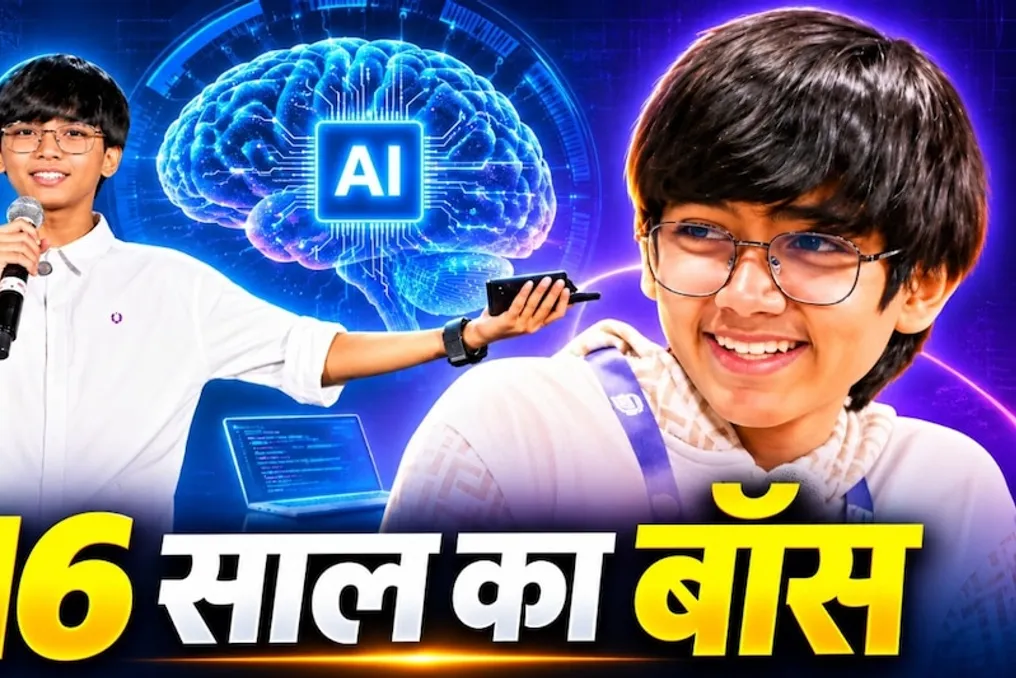
At the age of 16, Indian tech creator Ridit Kumawat was inspired by the idea of Jarvis from the movie 'Iron Man,' who controlled the entire house and laboratory using Tony Stark's voice commands. Kumawat created a similar system for his room, which he named 'Jarvis.'

A key feature of Ridit's system is that it functions via voice commands without an internet connection. He shared a video of this development on his Instagram account. The video shows a small electronic device installed next to the circuit breaker in the room. Ridit controls the appliances in the room by giving voice commands, and the system responds immediately, such as turning off the lights or turning on the fan.

The system is not limited to simple on/off device control. Ridit has also configured preset modes, such as 'Study Mode' and 'Goodnight.' This allows changing predefined room settings with a single voice command. In the demonstration video, he shows commands like 'turn off all lights,' 'turn on the fan,' 'goodnight,' and 'turn on study mode.'

The main difference in Ridit's project is its ability to operate autonomously, without network access. He explained that his Jarvis functions offline, which distinguishes it from many popular smart home assistants that rely on cloud services for voice processing. The system was designed for local control of connected devices according to the given commands.

Due to its offline operation, a privacy advantage is also noted. Although full technical information about Ridit's hardware and software architecture has not been disclosed, it cannot be asserted that all voice processing occurs exclusively locally.

The video of this project quickly went viral on social media, gaining over 30 million views and receiving thousands of comments. Users highly praised Ridit for creating such a project at such a young age; some even offered him an internship. This innovative project attracted the attention of Kiran Majumdar-Shah, founder of Biocon. She noted on X that such a voice control system without the internet could be particularly useful for the elderly and people with disabilities, emphasizing that small and practical ideas can solve everyday problems.

This small project, created at the age of 16, is generating widespread discussion because it connects fictional imagery with everyday technology. The experiment of controlling lights and fans in a regular room demonstrates that huge resources are not always required for technological experimentation.

Similar stories

16-year-old from Kerala founded an AI company and hired his father with a salary of 2 lakh
Read more
www.aajtak.in

16-year-old from Kerala founded an AI company and hired his father with a salary of 2 lakh

Generation Z teenagers are demonstrating their uniqueness in all spheres, including sports, cinema, and business. Young people of this generation are achieving success in the fields they choose, engaging in activities that often seem unimaginable to the older generation at such an early age. For instance, a sixteen-year-old guy from Kerala started his own artificial intelligence startup.

Furthermore, through his endeavors, he was able to employ his father.

Rahul John Ahu began studying AI at the age of nine. At twelve, he created his first robot. By sixteen, he opened his AI company while continuing his 12th-grade studies. He currently leads a team of 15 people in his startup and has developed over 15 AI-based tools.

For many, the idea of hiring one's own father into a company and paying him a salary of two lakhs at such a young age seems like a dream. However, the most interesting part of John Ahu's story is not just the number of AI tools he has created, the people he has trained, or the major venues he has visited. The most exciting thing is that despite all his achievements at such a young age, he understands that there are many things he cannot master alone.

A notable detail in John's story is that at 16, he is not just managing his company but also providing employment to his father. His father, Ahu Joseph, has extensive experience working in large corporations such as Amazon, Adobe, Wipro, and IBM. John believes that learning only through a phone is insufficient to understand the world of business and technology; a person with extensive experience in this field is necessary. This is why he gave his father the opportunity to work in his company. John jokingly notes that his father's presence in the company positively affects its marketing.

John's path is no longer limited to school and classes in Kerala. His work in AI has made him a participant in important discussions related to technology, education, and public services. He has also contributed to some initiatives launched in Kerala and Dubai. In 2026, John participated in the AI Influence Summit in New Delhi. There, he delivered a speech during a session dedicated to child safety and AI, organized by the United Nations (UN). During the event, he met with UN Special Envoy Amandeep Gill and also had the opportunity to speak with UN Secretary-General António Guterres.

Rahul John Ahu's story is not limited to achieving recognition in the world of billion-dollar businesses or AI at the age of 16. His journey demonstrates that to start any venture, it is not necessary to wait for a certain age or degree. Rahul, who started studying AI at the age of 9, has already created over 15 AI tools and trained about 500,000 people. He believes that the drive to learn new things, ask questions, and attempt to create something new is more important than quantity or a diploma. His story serves as an example for Generation Z youth who wish to bring their ideas to life.

Father in China develops system that turns TV watching into educational quiz to combat son's addiction
Read more
www.aajtak.in

Father in China develops system that turns TV watching into educational quiz to combat son's addiction

Due to the growing habit of children watching mobile content and television, a father from China devised an original way to reduce his son's screen time. Instead of scolding the child or taking away gadgets, he transformed the television into an interactive educational quiz.

This incident occurred in Shenzhen, China. The father, who works as a taxi driver and is often away from home for work, was concerned that the long time his son spent in front of the TV was negatively affecting the boy's studies. Initial attempts to restrict access to mobile devices and iPads only resulted in the son spending more time watching TV.

Deciding not to turn off the television completely, the father sought an alternative solution. He used artificial intelligence (AI) to create a special program for the TV system. As a result, the television now automatically pauses every ten minutes, displaying an educational question on the screen.

The system is set up with questions corresponding to the child's school curriculum, covering subjects such as Chinese, mathematics, and English, while also taking into account the grade level and current learning level. After ten minutes of viewing, a question appears on the screen. To resume the program, the child must provide the correct answer. If the answer is incorrect, he has to solve an additional question until he answers correctly, after which the program resumes.

Thus, the child is forced to combine entertainment with learning. The father explains that the goal of this method is to encourage his son to pay attention to his studies between viewing sessions, rather than constantly watching TV.

Before implementing the AI solution, the father tried other methods. Initially, he used the TV's built-in Q&A function, but the son managed to bypass this protection. Then, he tried using a smart plug to automatically turn off the TV, but the child simply pulled out the plug. In October, the father decided to create a new program using AI, detailing his requirements. Even in this new system, the son initially found a loophole by restarting the TV. After this, the father made adjustments to the program, making it more robust. This process became a constant interaction: the son looks for weaknesses in the system, and the father works to eliminate them.

The father emphasizes that his goal is not a complete ban on TV, but rather that his son receives both entertainment and education without neglecting other important aspects of life. He describes this experiment as a kind of 'attack and defense game' between father and son. Initially, he expected that the constant questions would upset the child and make him give up TV, but instead, the son showed interest. Now, the father plans to increase the difficulty of the questions asked.

The spread of this story on Chinese social media caused a wide resonance. Many parents highly praised the approach, asking how such a system could be implemented on a home television. However, some express concerns, believing that tying all leisure time to studying might turn learning into a burden. The father stated that he is willing to share the methodology but notes that due to differences in security and privacy features across various TV models, he first wants to clarify these details. He believes that thanks to AI, people will be able to create the small software solutions they need without needing coding skills.

Popular