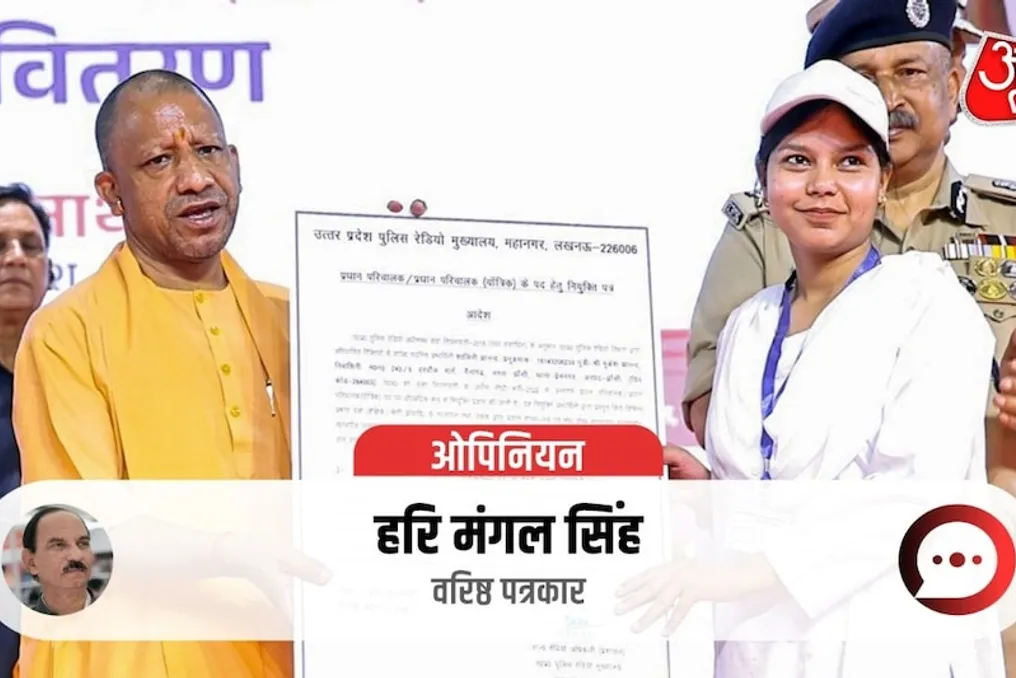
The Uttar Pradesh government presents the distribution of government vacancies and employment contracts as part of its large-scale concept of 'New Uttar Pradesh.' The government asserts that the recruitment process prioritizes qualification and diligence, with no room for nepotism, recommendations, or corruption.
Senior journalist Hari Mangal Singh examines these changes as an attempt to transform the state's recruitment system and administrative culture. He emphasizes that the vitality of any region lies in the consciousness of its youth, which is nourished by the belief that the democratic system ensures equal opportunities and prevents favoritism towards talented individuals.
When a young person marks their answers on the OMR sheet in the examination hall, they place a seal of their deep trust in the Constitution, the system, and the justice of the state. Conversely, when this same young person leaves home in despair, believing that the selection list was predetermined in a closed room and the exam itself was merely a cruel administrative performance, this trust collapses.
In a vast, dense state like Uttar Pradesh, brimming with boundless youthful energy, public service has never been merely a means of subsistence; it is also a symbol of respect and a guarantee of the future. Therefore, when Chief Minister Yogi Adityanath develops a plan for a large-scale employment campaign in the state, it represents a profoundly serious step toward reviving fading trust.
This employment campaign became particularly noticeable after 1,146 junior assistants were recently issued employment contracts, and Chief Minister Yogi Adityanath announced that young people would receive employment contracts on average every five days before Republic Day. This ideological narrative challenges the dark period of the past, which brought only disappointment and frustration to the youth.
Recalling the period before 2017, it tells a horrifying story of systemic decline. It was a time when all major recruitment commissions and selection committees of the state became hostages to political will. Obtaining a job without large 'transactions' and influential recommendations was an impossible dream. There existed an unofficial but pervasive control by a certain 'syndicate,' where one conducted the exam, and the employment contract went to another.
The consequences of this model of corruption were extremely destructive. The legitimacy of the entire administrative generation born this way becomes questionable, as an official who reached a position through favor or financial influence, rather than ability, will never be loyal to the Constitution of India or the people. They will always owe allegiance to the political patron who placed them in that position.
Examples concerning the old periods of the Uttar Pradesh Public Service Commission, public petitions, and the Supreme Court's nullification of the then chairman's appointment in 2015 as an unjust political favor serve as proof of how real the eclipse of electoral integrity was.
Yogi's government linked good governance and employment to the criteria of law and order and civil security in the state to lift the youth out of this darkness of despair. One must consider: only a society free from fear can truly foster development and employment. Looking back, it becomes clear that at one time, about one and a half lakh vacant positions in the police department lay untouched. 54 PAC companies were unjustly liquidated, and months of curfews and unrest left scars on the soul of the state.
In contrast, today, over 2.30 lakh transparent appointments in the police department, along with the recruitment of Home Guards and forensic experts, prove that employment and security are now two sides of the same coin in Uttar Pradesh.
The social impact of this employment campaign is evident. To date, more than nine hundred and fifty thousand young people have received employment contracts. An example of this is the appointment of thousands of Lekhpal and Naib Tehsildars in sensitive departments such as the Revenue Department. For a rural resident, the first battle for their land and rights begins with the Lekhpal's salary. If a young person holding this position achieved it through their abilities and complete integrity, they establish a new standard of fairness in the village.
However, alongside good governance, humanity is also necessary. The decision to waive a bail amount of over 84 crore rupees for newly appointed inspectors is a striking example of administrative sensitivity. This step shows that the system understands the economic difficulties faced by the youth.
This employment contract distribution campaign in Uttar Pradesh is a crucial part of Yogi's government's broader 'New Uttar Pradesh' concept, where talent and hard work are the sole keys to success. The government has clearly conveyed a message: in this system, there is no place for appeasement, nepotism, or corruption. The 'zero tolerance' policy, which was used as a reliable weapon against mafias and criminals, is now being applied to the purity of recruitment processes and the youth.