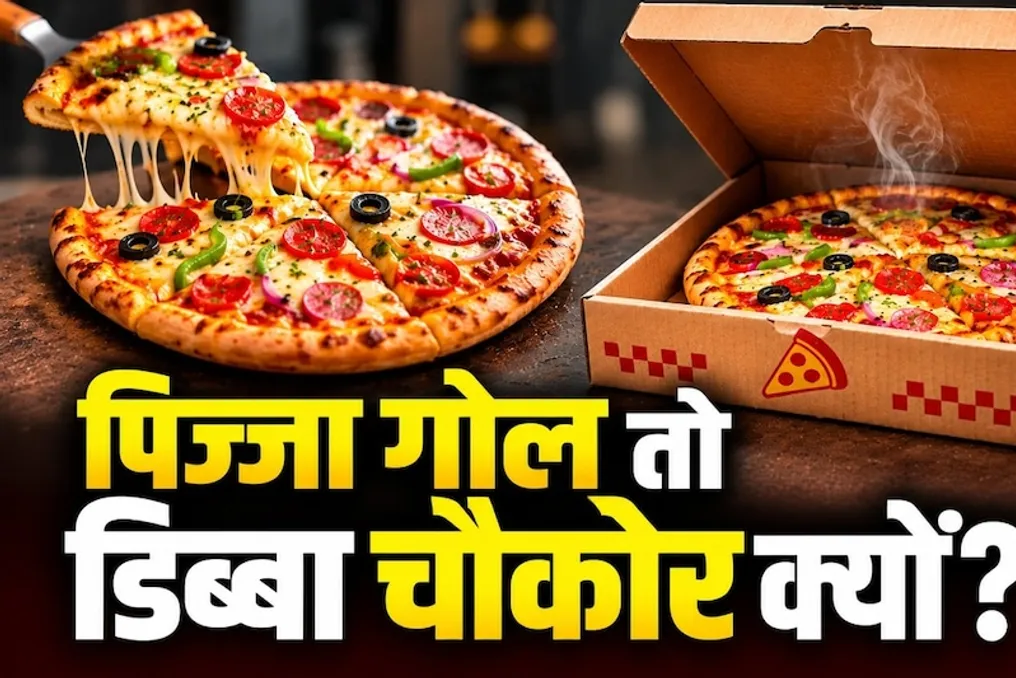
Many people love pizza, and its appearance stimulates the appetite of both children and adults. When you order pizza for delivery, you may have noticed that the pizza itself is always round, while the box it is packed and delivered in is square. This raises the question: why isn't round pizza packaged in a round box? Although this might seem like a minor detail at first glance, there are many reasons behind it.
The main reason is that the square shape of the box simplifies the process of its manufacturing, placement, transportation, and storage in stores. Let's look at these factors in more detail.
Cardboard is used to create the boxes. A square box is relatively simple to manufacture: it is sufficient to cut and fold a sheet of cardboard in a specific way, without the need for a large number of cuts or joining multiple parts. In contrast, creating a round box requires a more complex process—the cardboard must be cut into a circular shape, and the lid and side walls must be properly fitted. This is why square boxes are produced faster and more easily.
Pizza has a round shape, and its size can vary—from 7 to 14 inches. When placing the pizza in a square box, there remains a small amount of free space around it. This allows the pizza to be easily placed and removed, and it also prevents the edges of the pizza from directly touching the walls of the box, which facilitates lifting and stacking.
If pizza boxes were round, difficulties would arise when placing them in delivery bags or stacking them on top of each other. Square boxes have a significant advantage because they can be easily stacked. This greatly simplifies transporting multiple orders simultaneously. Furthermore, square boxes fit conveniently in cars, on motorcycles, or in special delivery bags, reducing the risk of shifting during transit.
Grocery stores require a large number of such boxes daily, and they need a lot of space to store empty packaging. Thanks to the ability to stack, square boxes take up less space than round ones. They can be neatly placed along walls or on shelves, whereas utilizing the space between round boxes is difficult.
During delivery, it is crucial to protect the pizza from dust, dirt, and external influences. The square box allows the lid and sides to be securely closed, protecting the pizza from contact with the outside environment. The box also helps retain internal heat for some time. However, it should be noted that the box shape alone does not determine how long the pizza will stay hot; the material of the box, the presence of ventilation holes, and the external temperature all play a role.
For any restaurant, the cost of packaging is as important as the taste of the pizza itself. Square boxes can be manufactured using a single sheet of cardboard, which is then cut and folded. This simplifies the production process and makes large-scale manufacturing convenient. Moreover, when stacking square boxes, empty space is minimized, which also contributes to their easy storage and transportation.
Essentially, pizza is made round because this format facilitates dough rolling, shaping, and even cutting evenly. At the same time, the box is made square because this ensures simplicity in production, storage, and logistics. Thus, the pizza's shape is determined by the convenience of its preparation and consumption, while the box's shape is determined by packaging and delivery requirements. Therefore, when you open a square box with a round pizza, remember that behind it is not just design, but a well-thought-out solution aimed at convenience, cost savings, and efficient delivery.