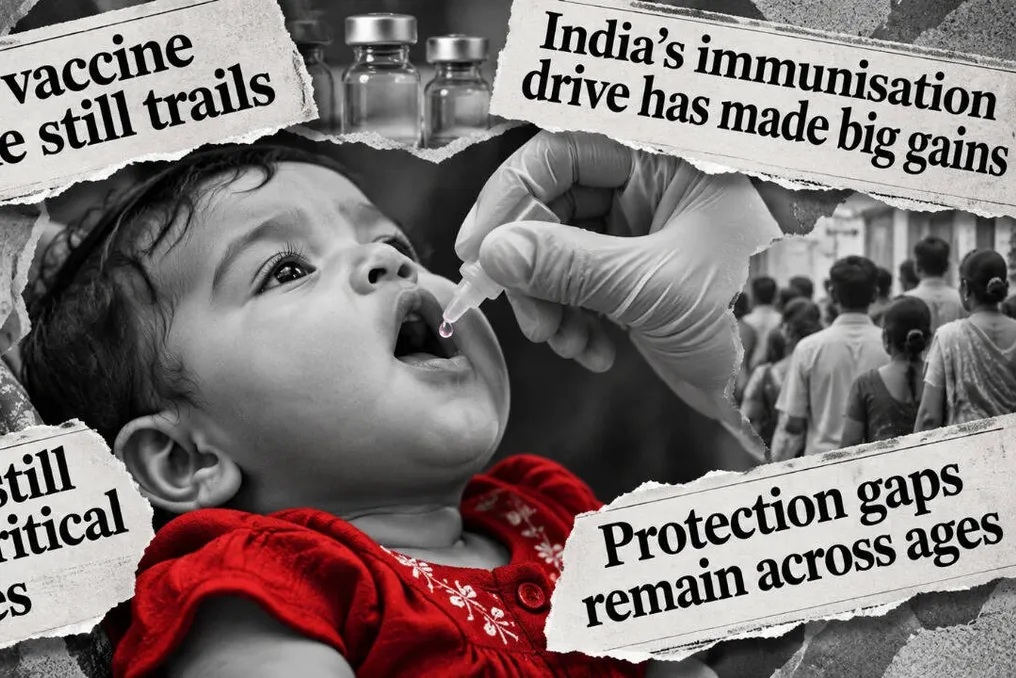
The 'Do boond zindagi ki' campaign has transformed into one of the world's largest vaccination programs, leading to the eradication of smallpox and polio in India, and eliminating maternal and neonatal tetanus as a threat to public health.
India's vaccination history is marked by ambitious campaigns and significant achievements in public health. The country was declared polio-free in 2014 and subsequently eliminated maternal and neonatal tetanus as a public health issue a year later. During the Covid-19 pandemic, over 200 crore vaccines were administered, including preparations developed and manufactured in India.
The program continues to evolve: earlier this year, the government added a national vaccination drive for 14-year-old girls against the human papillomavirus (HPV) to protect against cervical cancer, and also launched a domestic tetanus and diphtheria vaccine (Td). According to the Ministry of Health and Family Welfare, full immunization coverage increased from 62% in 2015 to 98.4% in January 2026, compared to 97.9% last year.
Nevertheless, serious challenges remain: hundreds of thousands of children miss necessary vaccinations due to uneven state-level coverage, and many elderly individuals also remain outside the vaccination program.
The Historical Path of Indian Vaccination
India's vaccination history spans over two centuries. The first smallpox vaccination in the country took place in Mumbai on June 14, 1802, following the arrival of vaccine lymph from abroad. Nearly a century later, in 1897, Dr. Waldemar Haffkine developed the first indigenous plague vaccine in India, also in Mumbai.
Government efforts to streamline immunization accelerated in 1962 with the launch of the national BCG program to combat tuberculosis. This was followed by the establishment of the Expanded Programme on Immunization (EPI) in 1978, marking another step towards broader vaccine coverage. A turning point came in 1985 when India launched the Universal Immunization Programme (UIP), providing free vaccines against 12 preventable diseases to children and pregnant women. This initiative laid the foundation for one of the world's largest government vaccination programs.
International Recognition of India's Vaccination Program
The scale of the current operation is immense. Annually, the UIP covers 2.9 crore pregnant women and 2.54 crore newborns free of charge. The delivery and tracking of these doses are supported by an extensive network of public health centers, frontline workers, cold chain facilities, and digital systems.
The composition of vaccines has also expanded: while the initial focus was on diseases such as tuberculosis, polio, and tetanus, protection is now provided against a wider range of infections, including rotavirus diarrhea, measles, and severe diseases caused by pneumococcal bacteria.
Beyond expansion, major public health victories have been achieved: India has eradicated smallpox, ulcers, polio, and maternal and neonatal tetanus. Immunization has also contributed to reducing child mortality and lessening the burden of diseases like measles and rubella.
The Pulse Polio campaign, launched in 1995, was particularly significant, taking vaccination beyond medical institutions and transforming it into a nationwide movement. Its famous slogan, 'do boond zindagi ki', helped mobilize millions of people to participate. The last recorded case of wild poliovirus in India was on January 13, 2011, in Korah, West Bengal, and in 2014, the country received polio-free certification.
Maintaining high vaccination coverage is an ongoing process. Full immunization coverage stood at 94.7% in 2022–23, dropped to 93.7% in 2023–24, rose to 98.3% in 2024–25, and reached 97.9% in 2025–26. India has also made progress in covering children who received no routine vaccines, known as zero-dose children; their share decreased from 0.11% in 2023 to 0.06% in 2024.
The Science Behind Every Vaccine
Vaccination is not a one-time event. Some vaccines are given at birth, others follow at carefully calculated intervals, and some require booster doses to maintain protection. Essentially, a vaccine prepares the immune system to encounter a pathogenic microbe, teaching the body to recognize the threat and respond faster upon future contact, thereby reducing the risk of infection and preventing severe illness.
In India, this protection begins at birth: newborns receive vaccines against tuberculosis (BCG), polio, and hepatitis B. The Hepatitis B dose received at birth is particularly time-sensitive and must be administered within the first 24 hours.
The next stage begins at six weeks of age, followed by doses at ten and fourteen weeks. These vaccines protect against diphtheria, pertussis, tetanus, hepatitis B, polio, rotavirus diarrhea, and infections caused by Haemophilus influenzae type B (Hib).
The schedule also includes pneumococcal vaccines to protect infants from serious infections, including certain types of pneumonia and meningitis. The schedule does not stop when children become toddlers: between nine and twelve months, children receive their first dose against measles and rubella, followed by a second dose at 16–24 months. Vaccines against Japanese encephalitis are also offered in endemic areas.
As children grow older, booster doses are administered. DPT boosters are given in early childhood, followed by Td vaccinations at ages ten and sixteen to maintain immunity.
The schedule is also expanding beyond childhood infections to include cancer prevention. On February 28, 2026, the government launched a nationwide HPV vaccination campaign, offering a free voluntary single dose to approximately 1.2 crore 14-year-old girls to protect against HPV infections that can lead to cervical cancer.
The pace of implementation has also increased: over 80 lakh doses were administered by September 11, with Uttar Pradesh providing the highest number—over 22 lakh. From a newborn's first vaccination to a teenager's HPV shot, India's immunization schedule covers various life stages. However, having vaccines in the calendar is only half the battle; ensuring that every eligible beneficiary receives the right dose at the right time remains a greater challenge.
Identifying Missed Vaccinations
Recent assessments by WHO and UNICEF for 2025 show that India is making steady progress in child vaccination. Approximately 97% received the first dose of diphtheria, tetanus, and pertussis (DTP), and 95% completed all three doses. Measles vaccination coverage was also encouraging: 98% of children received the first dose, and 95% received the second.
Another milestone achieved is the reduction in the number of zero-dose children, i.e., those who have not received even the first DTP vaccine dose. The number fell from approximately 9.09 lakh in 2024 to 6.79 lakh in 2025, representing a nearly 25% decrease in just one year. India also achieved an important first: for the first time since the WHO and UNICEF assessment began in 2001, it left the top ten countries with the highest number of children missing measles vaccinations.
However, progress is uneven. According to WHO estimates for 2025, only 70% of newborns received the Hepatitis B dose within 24 hours, and rotavirus vaccine coverage was 91%.
India has made stable progress toward universal immunization: according to vaccination cards, full immunization coverage among children aged 12–23 months increased from 83.8% to 87.1%. Household surveys also reveal a gap easily masked by national averages: disparities between states. Full immunization coverage among children aged 12–23 months ranged from 93.8% in Goa to only 64.3% in Nagaland, a gap of almost 30 percentage points.
This gap is also noticeable in Hepatitis B vaccination: while 91.9% of newborns in Goa received the dose at birth, this figure was only 46.4% in Nagaland. Thus, India's vaccination report may improve, but the results are far from evenly distributed, and a child's place of birth can significantly influence the level of protection they receive.
Barriers Preventing Access to Free Vaccinations
If childhood vaccines are free, why do so many children still miss vaccinations? The answer lies in barriers that go beyond the mere availability of the vaccines. Various factors, such as caregiver indecision, migration, and poor access to healthcare, can result in children remaining partially or completely unvaccinated.
A WHO report from April 2026 provides some insight into this issue. As part of its TrackVac initiative, the vaccination status of 224,698 children was assessed in 143 priority districts across 11 states during 2025. Among unvaccinated children, caregiver refusal accounted for 39% of cases, and migration for 34%.
Although this data is based on targeted districts and does not represent a nationwide survey, it highlights two main obstacles to India's immunization efforts: vaccine hesitancy and disruptions in healthcare access. Migration, in particular, can disrupt a child's vaccination schedule. A family moving from one city to another for work might get their child the first dose but miss subsequent visits after relocating. In remote villages and underserved urban settlements, long distances, transportation costs, limited awareness, and loss of daily wages can also deter families from returning for the next dose.
Misinformation and concerns about side effects exacerbate this problem. Since many vaccines require multiple doses, missing even one appointment can leave a child only partially protected. Therefore, the task is not just to make vaccines free, but also to ensure easy access for families, help them understand their importance, and complete the recommended vaccination schedule.