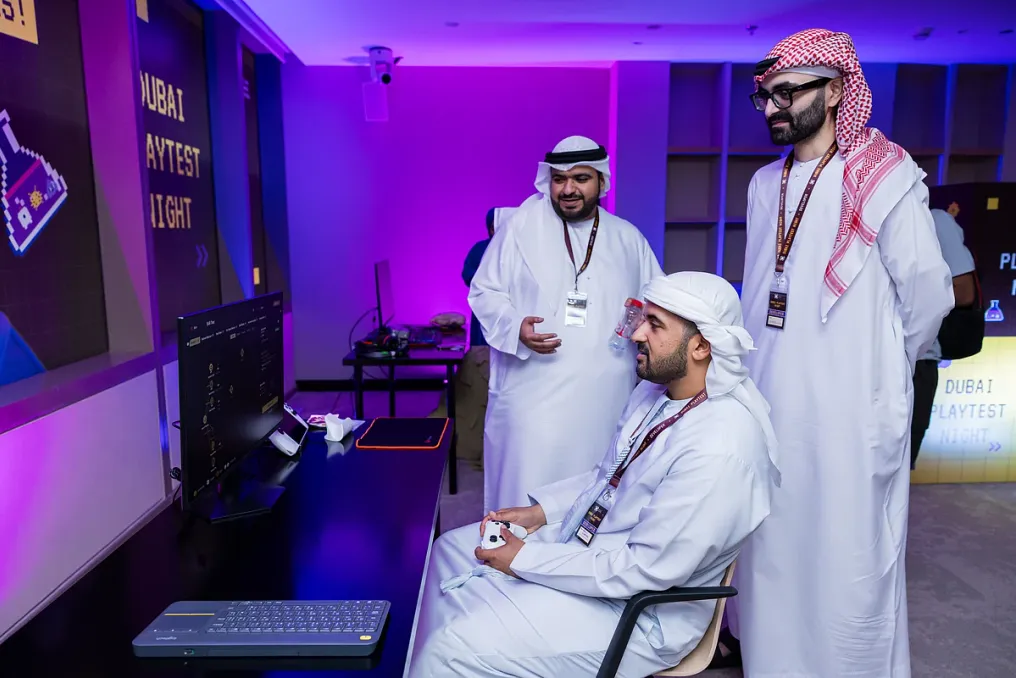
The first gaming testing event took place in Dubai, allowing gaming enthusiasts to try out locally developed games and provide feedback to the creators. The Dubai Playtest Night event was organized by the Dubai Film and Gaming Commission (DFGC) on Friday and brought together local developers, independent studios, and video game fans for an evening of practical testing, honest exchange of opinions, and community building.
Ten locally created games in 2D and 3D formats were presented at the exhibition, including projects from universities and games intended for festivals.
Mariam Lotah, Executive Director of Talent Development at DFGC, noted the high interest from both developers and gamers. She emphasized that she saw a great diversity of games that were previously in development but are now striving for recognition and interaction with each other.
Faisal Kazim, Commissioner for Games at DFGC, viewed this event as a harbinger of the industry's future development. He stated that the enthusiastic reaction confirms the commission's commitment to creating platforms that support local studios and promote the long-term growth of the gaming industry.
Mariam compared this event to how the film industry uses test audiences. According to her, developers can showcase their games to understand what is engaging and effective before releasing the product.
Such evaluation is invaluable for developers. Ibrahim Hindawi, who spent four years creating Sange—an action roguelike RPG with its own game engine where players experience waves of enemies, create various builds, and fight a boss across five chapters—shared his impressions. He noted that the opportunity to receive feedback was very valuable, and people seemed to react positively to the game.
According to Mariam, the variety of games and the cultural code permeating them was impressive. Some games utilized Arab culture and folklore or were based in the UAE; some were created in Arabic, while others depicted Emirati villages. She added that the diversity, including well-thought-out puzzles and adventure stories, exceeded her expectations, as it naturally stems from the desire to share one's culture through games.
The evening also served as a hub for networking in the creative industries, where programmers, artists, students, and curious gamers exchanged experiences. Among them were 3D artists Nada Khalifa and Hazika, classmates from SAE, who work on creating characters, objects, and entire worlds for games.
Nada noted that it was a great opportunity for general networking, emphasizing that the presence of most developers in one place is very inspiring because it allows for direct discussion of their workflow. The pair who also manages the Dubai branch of the art community Sketchouts stated that the local scene is developing. Hazika said that although growth is slow and steady, there are now more opportunities thanks to numerous startups.
DFGC plans to hold a series of such testing evenings to raise awareness of local games and strengthen cooperation between creators and players. Mariam advised aspiring developers to constantly develop, experiment with programming and various design disciplines, and always conduct testing, as much of game development lies in finding what 'hooks' the player.