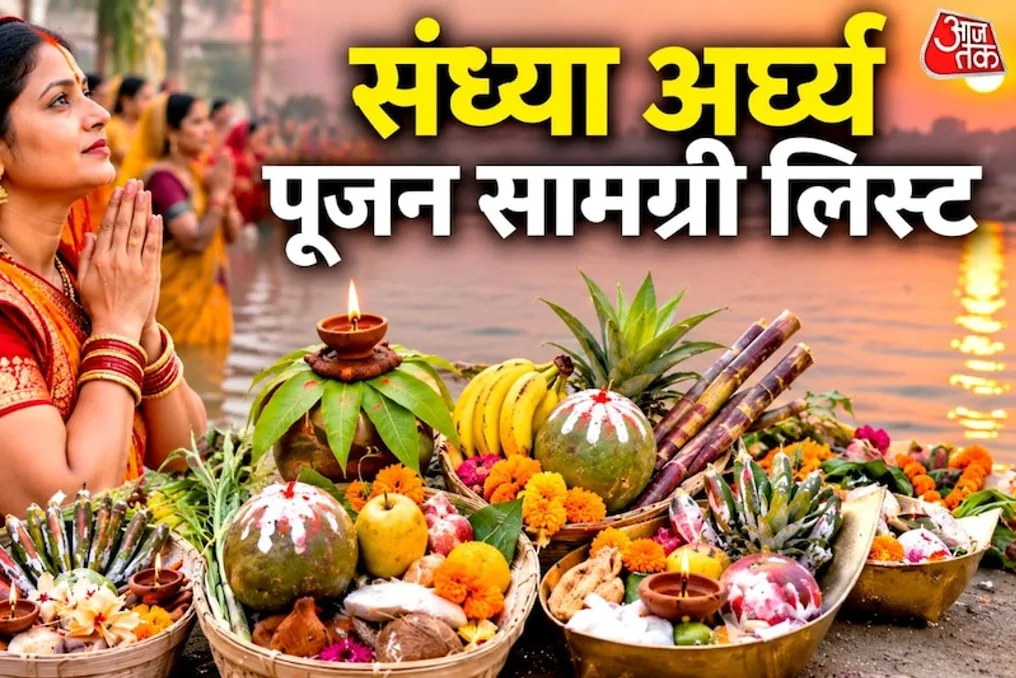
List of necessary materials for Chhath Puja: preparation for the evening offering
Read more
Aaj Tak
www.aajtak.in

List of necessary materials for Chhath Puja: preparation for the evening offering

Chhath Mahaparv holds special significance in Hinduism as it is dedicated to the Sun God and Chhathi Maiya. This festival lasts for four days, with its beginning marked on November 13, 2026. Today, November 15, marks the third day of the festival, during which devotees perform the evening offering (Sandhya Arghya) to the setting sun. This time is used to pray to Chhathi Maiya and the Sun God for the well-being of the family and the longevity of children.

During the worship, various fruits, flowers, and prasad are offered. Those observing the Chhath fast are advised to prepare all necessary items in advance so as not to forget anything. Below is a complete list of items for the worship.

List of materials for Sandhya Arghya

The required inventory includes a bamboo or brass soop, large bamboo baskets and daura, as well as a puja plate, a glass, a bowl, and a spoon. A copper pot or vessel, milk, and clean water are also needed. For lighting, lamps, ghee, or oil are required, and among the offerings are thekua, hada, and other sweets.

The list also includes a new sari, banana stalks and leaves, sweet potato, and radish, as well as pineapple, banana, and a large lemon. Additionally, betel nut and supari, ginger, and raw turmeric, a coconut with water, as well as other seasonal fruits and prasad for worship, are necessary.

Note these points when offering to the Sun

When preparing all the materials for the soop and baskets, they should be carefully arranged. The soop should include thekua, fruits, vegetables, coconut, and other prasad. Before making the offering to the Sun, a lamp is lit in the soop. Then, standing in the water, devotees offer water and milk to the setting sun, praying to the Sun God and Chhathi Maiya for the happiness of the family.

Mantras to recite during Sandhya Arghya

During this time, the mantra should be recited: 'Om Ehi Suryadev Sahasransho Tejorashe Jagatpate. Anukmpyamam Bhaktya Grihanarghyam Divakara.' Other mantras for the Sun are also available: 'Om Suryaya Namah,' 'Om Adityaya Namah,' and 'Om Namo Bhaskarayai Namah,' concluding with the phrase 'Arghyam Samarpayami.'

>


Similar stories

Reasons for Silence During the Acceptance of Harana Prasad as Part of the Chhath Puja 2026 Festival
Read more
www.aajtak.in

Reasons for Silence During the Acceptance of Harana Prasad as Part of the Chhath Puja 2026 Festival

In the Chhath Puja 2026 festival, every tradition holds a special significance. During this great festival, devotees worship the Sun God and Goddess Chhathi while observing all rules and deep devotion. The four-day festival begins with Nahay Kai. Then, Harana is observed on the second day. On this day, devotees observe a complete waterless fast throughout the day and accept prasad after the evening prayer. This raises the question of why devotees remain silent while accepting Harana prasad, and what the religious justification for this tradition is.

Chhath Puja 2026

Harana is the second day of the Chhath Puja celebration. On this day, devotees observe a waterless fast from morning till evening, meaning they neither eat nor drink anything. In the evening, after bathing, they wear clean clothes and prepare for worship.

Traditionally, Lassi (Kheer) made from palm sugar is prepared on Harana. It is usually cooked in an earthen stove using mango wood. Bread or puri is also prepared. In many places, new utensils are used to prepare this prasad. First, offerings are made to Goddess Chhathi and the Sun God, and then the devotees accept the prasad.

Why Do They Remain Silent While Accepting Harana Prasad?

The tradition of maintaining silence while consuming Harana prasad is very ancient within Chhath Puja. According to religious beliefs, during the acceptance of Harana prasad, the devotee's attention must be completely focused on their devotion to Goddess Chhathi and the Sun God. Therefore, conversations are avoided during this period.

Essentially, Harana prasad is considered not just food, but a blessing from Goddess Chhathi. It is accepted with complete purity and concentration. There is a belief that one must maintain a calm mind and not be distracted by any conversations or other activities while eating. Furthermore, it is after accepting Harana prasad that the 36-hour waterless fast begins for the devotees, making this time extremely important for Chhath Puja. Devotees accept the prasad while adhering to all rules and self-control.

Significance of Harana Prasad

Harana prasad is an important part of Chhath Puja. On this day, lassi made from palm sugar and bread are prepared. Great attention is paid to the purity and sanctity during the preparation of the prasad. There are also special rules associated with its preparation and consumption. According to religious beliefs, consuming Harana prasad brings the blessings of Goddess Chhathi. After this, the devotees observe a waterless fast for two more days. On the third evening, they make offerings to the setting sun, and on the fourth morning, to the rising sun. After this, the fast concludes.

Start of the 36-Hour Waterless Fast After Harana

After accepting Harana prasad, the 36-hour waterless fast begins for the devotees. During this time, they neither eat nor drink anything. On the third evening, the devotees go to the bank of a river or pond to offer prayers to the setting sun. The next morning, they offer prayers to the rising sun. Thus, the Chhath fast concludes. The day of Harana is special because the most difficult part of the fast begins after it. During this period, devotees perform worship with complete devotion and adherence to rules. This is why the tradition of silence while accepting Harana prasad is considered unique.

Chhath Puja 2026 Schedule and Rituals: The Festival Begins with Nahay Khay
Read more
www.aajtak.in

Chhath Puja 2026 Schedule and Rituals: The Festival Begins with Nahay Khay

Chhath Mahaparv, which lasts for four days, involves observing various religious traditions, and each day holds its own significance. During this festival, devotees perform worship while maintaining purity and self-control. On the third day, they offer oblations to the setting sun, and the fourth day concludes with worship of the rising sun.

Chhath Puja is a festival of gratitude to nature, piety, and asceticism, during which the deities of the Sun and Chhathi Maiya are revered. This rigorous fast, lasting four days, requires devotees to follow specific rules. The festival, starting with Nahay Khay and ending with Usha Arghya, includes daily rituals, and during this time, devotees observe a complete waterless fast for about 36 hours. This year, Chhath Parv will be celebrated from November 13th to November 16th.

A series of religious traditions are observed during Chhath Mahaparv over four days, and each day has its importance. Devotees perform their worship while maintaining cleanliness and self-restraint. On the third day, they offer an offering to the setting sun, and on the fourth day, the fast concludes with worship of the rising sun.

On Kartik Shukla Shashti, devotees arrive at rivers, ponds, or other water bodies in the evening. There, they offer an oblation to the Sun deity, decorating a bamboo basket with fruits, theekua, coconuts, sugarcane, and other items for worship. The next day, on Kartik Shukla Saptami, they offer an oblation to the rising sun in the morning. After this, the devotees perform Paran and end their waterless fast.

Friday, November 13th — Nahay Khay

Chhath Mahaparv begins with Nahay Khay. On this day, after bathing in the morning, devotees clean their homes and prepare sattvic food. Typically, they prepare rice, lentil dal, and a pumpkin vegetable dish. The meal marks the beginning of observing the strict rules of Chhath.

Saturday, November 14th — Harna

The second day of Chhath Puja is observed as Harna. On this day, devotees fast from morning till evening. After sunset, they perform worship and consume prasad made of rice porridge with palm sugar and bread. Following this, the waterless fast of about 36 hours begins, during which both food and water are abstained from.

Sunday, November 15th — Sandhya Arghya

The third day of Chhath Mahaparv is considered one of the most important rituals. On this day, devotees arrive at a river, pond, or Chhath Ghat in the evening and offer an oblation to the setting sun. A bamboo basket is filled with seasonal fruits, theekua, coconuts, sugarcane, and other offerings. Praying to the deities of the Sun and Chhathi Maiya, they wish well-being for their families and happiness for their descendants.

Monday, November 16th — Usha Arghya and Paran

On the last day of Chhath Mahaparv, devotees arrive at the Ghat before sunrise. The worship concludes with an offering to the rising sun. After this, they wish health, peace, and longevity for their family's descendants. After Usha Arghya, the devotees perform Paran, and their waterless fast, which lasted about 36 hours, concludes. Thus, the four-day Chhath Mahaparv comes to an end.

Popular