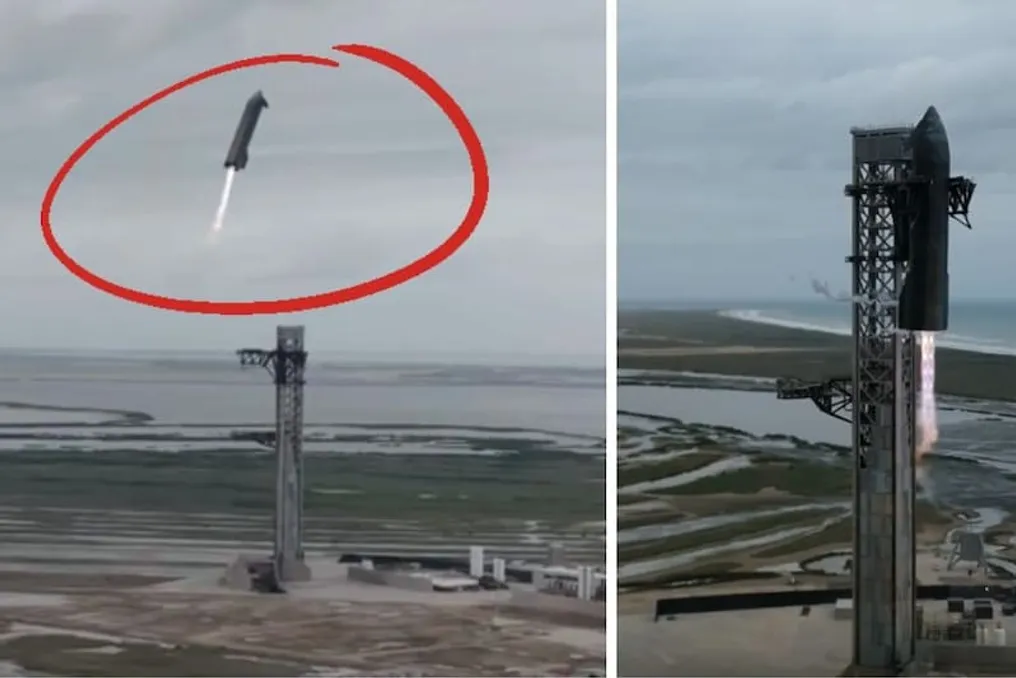
A historic milestone in space exploration was achieved when Starship, the world's most powerful rocket developed by SpaceX, returned to Earth in an inverted mode and was captured in mid-air by the mechanical arms of the launch tower itself.
This feat occurred after the spacecraft completed more than 22 and a half hours in orbit, making a total of 14 laps around the planet. The event was part of test flight number 15, conducted on Friday (the 13th).
During this flight, Starship executed several maneuvers to leave orbit, pass through the atmosphere, and return to the SpaceX launch base located in Texas. Upon arrival, it was intercepted by the mechanical arms of the Mechazilla tower, known as 'chopsticks'.
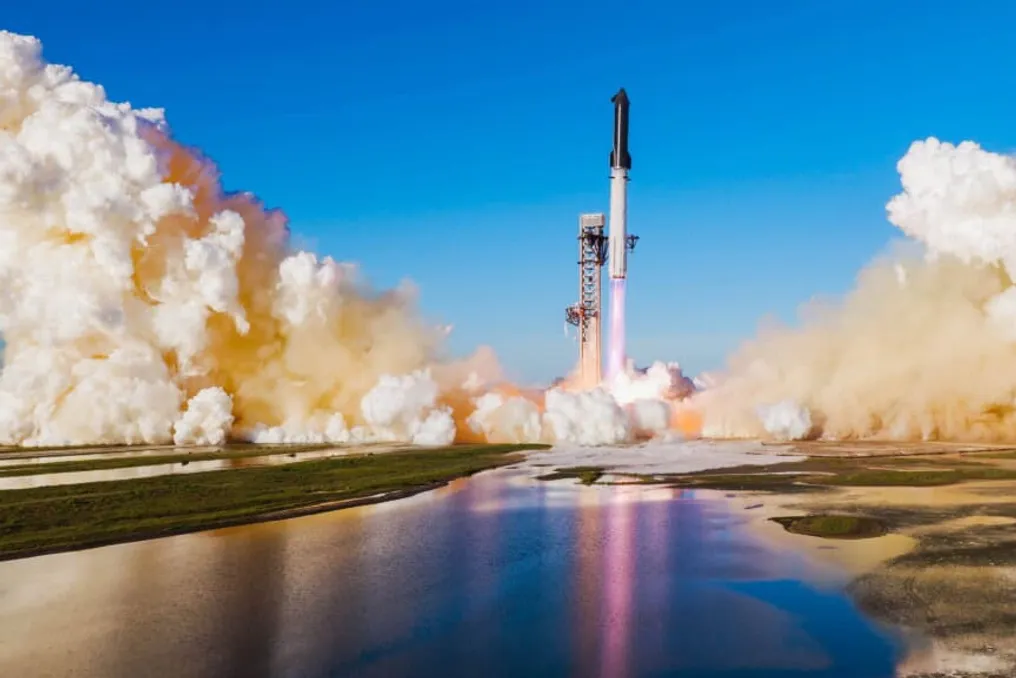
Unlike conventional rockets, which discard their stages, Starship was designed to be fully reusable. This implies that both the Super Heavy booster, responsible for the initial thrust, and the Starship upper stage, which travels into space, must return to the surface to be reused.
The first phase of the return consisted of a deorbit burn, which lasted approximately ten seconds. The Raptor engines were ignited during this procedure to adjust the ship's speed and trajectory, removing it from orbit and directing it back into the Earth's atmosphere.
Although brief, this operation was crucial for guiding the ship to the expected return point. Without this course correction, Starship would have continued orbiting the Earth instead of initiating descent.
About 35 minutes later, the craft began its atmospheric entry. At this moment, it had to withstand extremely high temperatures generated by friction with the air and by the compression of the air in front of it during the high-speed descent.
To resist these severe conditions, Starship possesses a thermal shield composed of thousands of protective ceramic tiles, which prevent extreme heat from damaging the ship's metal structure. The performance of this system is a primary aspect evaluated during flight tests.
The final phase began with the ignition of the Raptor engines, which provided the necessary thrust to slow down and control the ship's fall. Two seconds later, Starship performed a maneuver called the 'landing flip,' which consists of rapidly changing its orientation to achieve a vertical position.
Up to that point, the craft was in a more horizontal position, ideal for passing through the atmosphere and managing its trajectory. The inversion allowed it to position itself with the engines facing downward, replicating the launch configuration of a rocket, which culminated in a 'backwards' landing.
The landing burn also involved the gradual shutdown of the engines. Initially, the configuration changed from three to two operational engines, and subsequently, one of them was shut down, leaving only one active Raptor to manage the final moments of the descent.
The last leg was the approach to the launch tower at Starbase, Texas. Instead of landing on supports or a platform, Starship was met by the mechanical arms installed on the structure.
These arms were designed to hold the ship during descent, enabling its recovery without touching the ground. This system had already been used in previous tests to capture the Super Heavy booster, but this Friday's flight marked the first time the procedure was attempted with the upper stage.
The success of this recovery represents a significant advance for SpaceX's plans to create a fully reusable space transportation system capable of performing frequent trips without the need to build a new rocket for each mission.
The recovery of both stages is vital for reducing costs and increasing launch frequency. However, more tests are still needed to prove that Starship can repeat such operations safely and reliably before transporting humans.
The text also summarizes previous flights, mentioning everything from explosions associated with Super Heavy to controlled landings in the Indian Ocean and Gulf of Mexico, highlighting milestones such as the first separation of Super Heavy and the deployment of Starlink satellite simulators.