The composition of the bones of some of the largest dinosaurs that inhabited the planet includes the mineral hydroxyapatite, which is also present in the human skeleton, as well as in small frogs and light birds. In giant dinosaurs, these bones could withstand tens of tons and even greater loads during movement, including situations where they stood on two legs. Nevertheless, fossilized bones of these animals with signs of stress fractures are rarely found. This raises the question of how this is possible, given that Earth's gravitational conditions from the Jurassic period to the present day have remained unchanged.
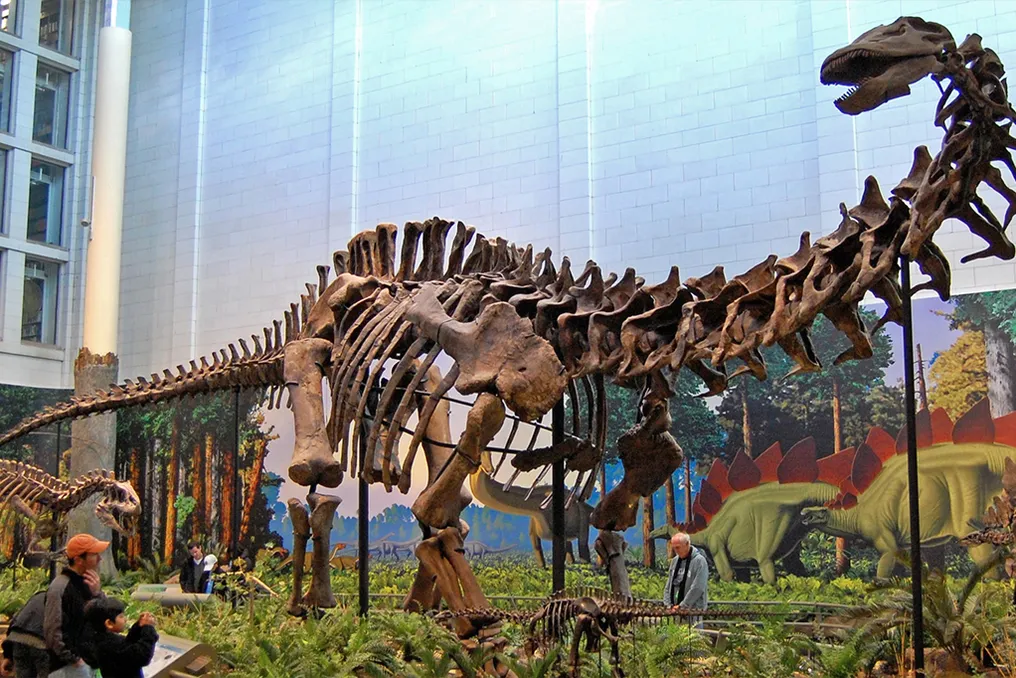
A new study brought together paleontologists and physicists to answer this complex question by analyzing fossil sauropods—giant herbivorous dinosaurs known for their long necks and tails. The results showed that the internal organization of the bones is part of the explanation.
During the work, the pressure exerted by the body weight of various species in this group on the bones was calculated, and it was established that it was significantly below the level required for a compressive fracture. However, the question arose: how was this achieved? The first author of the article, Tito Aureliano, a researcher at the Federal University of Rio Grande do Norte (UFRN) and the State University of Campinas (Unicamp), explained: 'The answer must lie in the arrangement of tissues, in the architecture of the bone microstructure. Therefore, we collected data on the configuration of the leg bone tissue of various sauropod species and individuals to assess how close the load on the feet approached the limit of bone destruction.'
Analyses indicated that as the size of the species increased, the bone structure acquired characteristics that promoted better weight distribution and increased resistance, which eliminated the need for a constant increase in bone thickness. Thus, although an increase in cortical thickness (the outer layer of the bones) is associated with increasing gravitational loads in all neosauropods, this may not have been the main evolutionary response.
Different lineages exhibited different biomechanical strategies. The authors note that diplodocoids (sauropod dinosaurs with tail-like tails) maintained the center of mass behind, which corresponded to the possibility of selectively standing on two legs. Meanwhile, brachiosaurids shifted this center of mass forward through hypertrophy of the neck and forelimbs. The group of titanosaurs reached extreme sizes through secondary bone remodeling—a process in which tissue formed during rapid animal growth is reabsorbed and replaced by dense bone—as well as due to the large number of pneumatic cavities in the skeletal bones located below the skull.
Aureliano emphasized that biomechanics is already a well-established field of paleontology. He added: 'We combined it with paleoichnology, the study of fossil tissues. Bone tissue is biomineralized, so we can work with colleagues from materials physics to create models explaining the phenomenon of gigantism.'
Professor Guilherme M. Cipahi from the Institute of Physics of São Carlos (IFSC), a co-author of the article, told the USP Journal: 'Bone is not entirely a crystal, but it has a crystal in its composition.' The physicist, who studies crystals and semiconductors, noted that 'the crystal I work with has the same elastic properties as the crystal contained in bone.' Based on this, he suggested: 'perhaps we could look at this from a more or less general point of view, how the failure limit of this bone is determined.' He reported that he performed all calculations, mathematical and physical analysis of the study, as well as related graphs.
The scale of the colossal achieved by some animals is itself an object of many other research areas in evolutionary science, and some hypotheses gain strength. Tito Aureliano believes that 'gigantism is a response to selective pressure between prey and predators in the evolutionary race. Some groups of animals became giants from the Jurassic period to the present day.'
In his opinion, the greatest advantage lies in protection: 'An adult organism is more protected from attacks by predators of the same size or smaller.' However, the life of a giant is not as simple as it seems. First, a huge amount of food and water is required to reach large sizes in a short time. 'This makes the giant animal vulnerable to changes in the environment and climate. In fossils of various ages, we notice that the largest animals die out first during sudden ecological disasters.'
Among the questions driving researchers in this field is understanding how each lineage became gigantic, especially from the perspective of anatomical adaptations to colossal sizes. Aureliano explains that in the case of long-necked dinosaurs, the pneumatic skeleton—that is, the vertebral bones with air cavities—combined with thick and strong limbs and a joint that allowed a vertical posture on four legs (unlike the bent joint in reptiles and crocodiles), contributed to the development of giant organisms in this lineage.
He emphasizes that there was no single 'evolutionary recipe' that paved the way for the appearance of giant animals. 'Giant mammals, such as mastodons and giant sloths, had different adaptations compared to enormous dinosaurs like titanosaurs and stegosaurs. We want to understand these biological solutions that solved the mechanical problems imposed by the gravitational conditions of our planet.'
Guilherme Cipahi recalls that the idea for the article arose during a casual conversation with Tito Aureliano on the way to the airport, when the paleontologist visited São Carlos as a guest of the Ciência science popularization project, which Cipahi supervised.
For the physicist, good science includes that which is created creatively. 'This creativity sometimes comes simply from a conversation with one field, from introducing a concept from another field, even a simple one, into another,' he says. 'The idea we proposed is simple, but I had the opportunity to present a result that paleontologists could then analyze.' In his opinion, the best moment occurs when a different way of thinking is achieved by combining knowledge from different fields.
Tito Aureliano gives other examples of interdisciplinary collaboration. 'Physics helps us calculate the walking and running speed of dinosaurs based on fossil tracks, understand their bite force, the mechanics of their skeleton, and also helps in the absolute dating of many fossil sites containing minerals with radioactive elements. In general, there are many applications,' he lists, emphasizing that disciplines of knowledge have artificial subdivisions because 'the cosmos is interdisciplinary.'