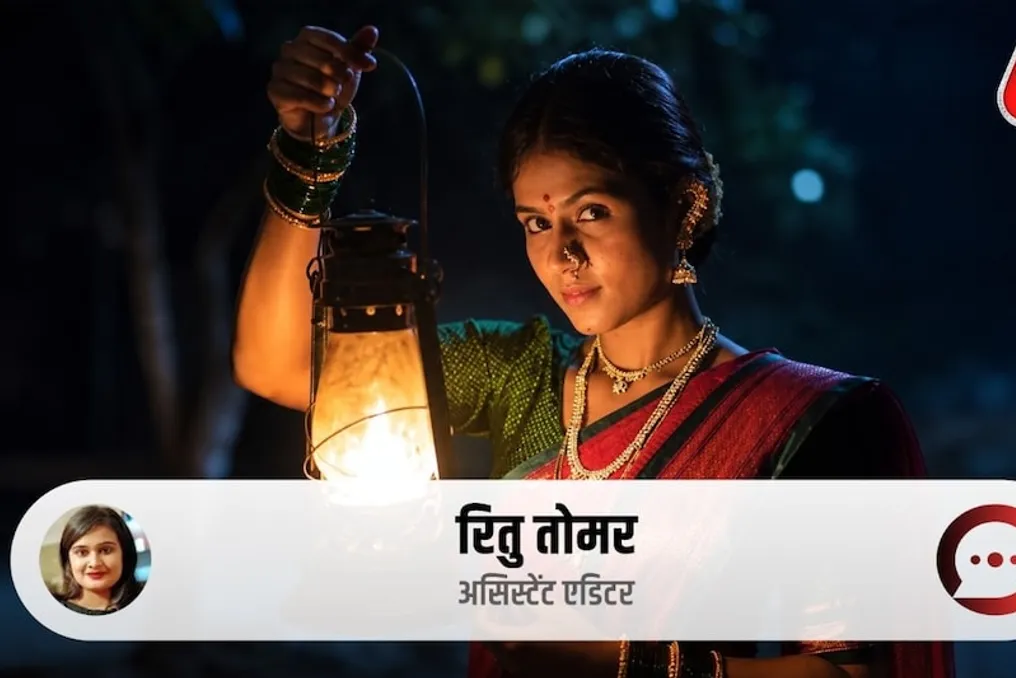
In the darkness of the night, lights from lanterns are visible on the village paths, drums sound, and hymns to the goddess are sung. The villagers gather to perform a special ritual that has been observed for generations, but much must happen on this one night. A young bride is dissatisfied with her wedding and wishes to get rid of her husband, choosing a path where love, selfishness, and deceit intertwine. In this game, some become pawns, others are used for their own desires, and some make decisions whose consequences no one foresaw.
Parallel to the rhythm of the drums, the goddess is invoked. This is the Maratha depiction of 'Gondhal.' Here, real chaos unfolds not only in one family but also in human thought and relationships themselves.
In the film, Santosh Davakhar, the main character Sumana marries Anand. Although Anand comes from a wealthy family, Sumana does not feel happy in the marriage. Her lover is Sarjirao. Sumana wants to live by her own rules, and the plan she develops gradually takes a dangerous turn. The entire story of the film unfolds over one night. Many characters participate in this night, each with their own motives, secrets, and calculations. At first, it seems like a love triangle story, then suspicion of a crime arises, but as the plot develops, it becomes clear that every character is hiding something. Some strive to save their honor, some their status, and some to determine their lives independently.
During the viewing, the viewer's attention is drawn to Sumana. The image of a woman dissatisfied with her marriage is not new in Indian cinema, but such characters are often portrayed from a specific perspective: either the woman fights for freedom, suffering from her husband and family, or she is condemned for extramarital affairs. Sumana fits into neither of these categories. She desires change in life and is willing to take risks to live according to her will. However, her methods are not justified; she uses people's feelings and weaknesses.
This is what makes her character interesting. In films, we often see male characters making mistakes for love, ambition, or money, and they are called characters with gray shades. But when a woman does this, a discussion about her character begins. In Sumana's case, the same question arises: does respecting a woman's desire mean accepting all her decisions as correct? Of course not. But condemning her desire based on her mistakes is also incorrect. To understand the character of Sumana, both aspects must be considered simultaneously. This is why she remains in memory after the film ends.
Now about the film's title. Gondhal is an ancient folk tradition of Maharashtra associated with the worship of the goddess. During auspicious events, such as weddings, families organize this event in honor of their Kuladevi. Gondhali artists invoke the goddess, performing all night with the help of drums, jangha, songs, and dances, including religious tales and folk stories. According to belief, thanks to the goddess's blessing, the newlyweds' life will be happy, and household problems will disappear. This is not just an entertainment show, but part of the folk memory, communal identity, and religious beliefs of Maharashtra.
The film does not just show this tradition; it makes it the core of the narrative. While the Gondhal ceremony takes place outside, a human game unfolds inside. The family wishes for blessings from the goddess, but the same people become a source of problems for each other. Some are busy defending their reputation, some fulfilling their desires, and some controlling the lives of others. This reveals the second meaning of the film's title. In colloquial speech, Gondhal is also associated with confusion, disorder, and hustle. In the film, this word is present in both senses: on one hand, it is a living religious tradition of Maharashtra, and on the other, it is a storm in human relationships.
I found the idea of the film that religious faith and human behavior do not necessarily have to align to be the most intriguing. A person can pray to the goddess for hours, yet commit injustice against another in private life. They can follow traditions but not be honest in relationships. This does not mean that faith is wrong. The question is whether we turn faith into a means of evading responsibility for our behavior? It is easy to bow down before the goddess, but difficult to admit one's selfish actions and mistakes. The film reflects exactly this contrast in its plot.
At the beginning of the film, director Santosh Davakhar shot a long take of about 25 minutes. This means the camera moves from one place to another, follows the characters, shows the village, and immerses us in the world of the story without ordinary editing cuts. The fact that the camera moves continuously for 25 minutes while maintaining viewer interest is not an easy task. In this shot, the villagers, their homes, relationships, and social status are gradually revealed. This approach allows not so much telling a story as...