Mumbai Museum Teaches Over 9000 Children AI Basics Through Practical Learning
Read more
The Better India
thebetterindia.com

Mumbai Museum Teaches Over 9000 Children AI Basics Through Practical Learning

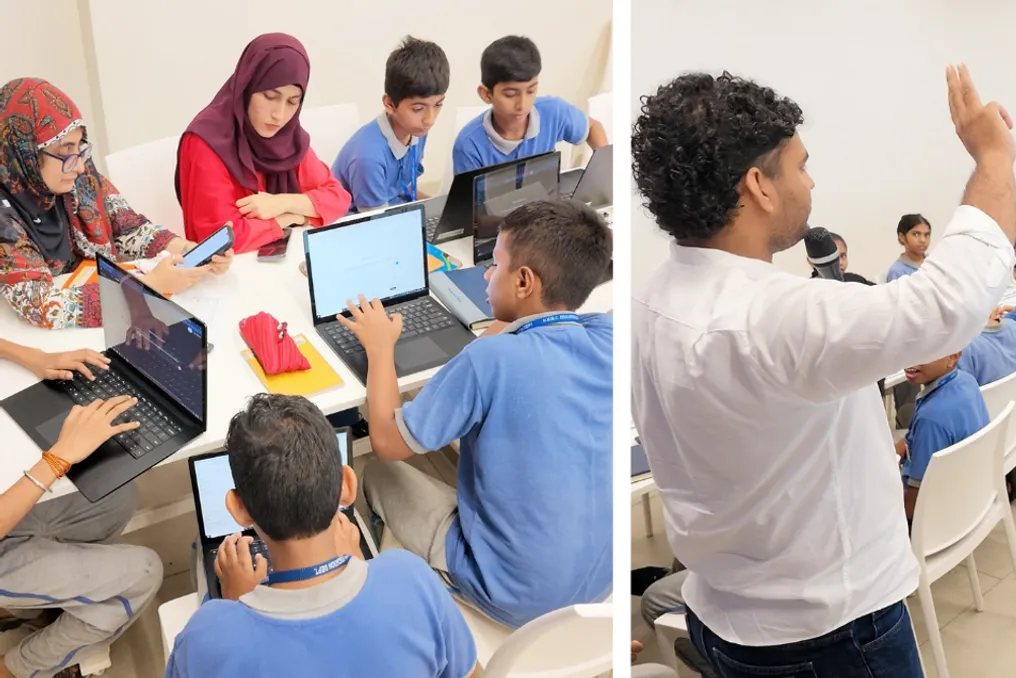
For a child who has never independently used a computer, the first lesson in artificial intelligence (AI) is not about algorithms but about the cursor. This experience began with a sixth-grade student from a government school in Raigad, Maharashtra, inside the ten-story children's museum in Lower Parel, Mumbai—the Museum of Solutions (MuSo).

When the student joined an immersive AI training course, computers were an unfamiliar territory for him. Even using the laptop's touchscreen and entering basic commands presented difficulties. However, during subsequent sessions, the situation began to change. By the end of the program, the student was able to create an email account, master Microsoft Word and OneDrive, and participate in coding assignments through Minecraft Education.

What started with basic computer operation paved the way for learning artificial intelligence, experimenting with technologies, and understanding the principles of their functioning. Meera, one of the workshop participants at MuSo, noted: 'It was very interesting from day one. The AI workshop at the Museum of Solutions brought together teachers and students to learn about technology, explore AI, and understand how it can be used to find solutions to various problems, from school-related to global.'

For thousands of children from underprivileged backgrounds across the state of Maharashtra, opportunities like this serve as their first introduction to the technologies increasingly shaping the world around them. Through the AI Explorers initiative at MuSo, children learn about AI through interactive games, experiments, creative exercises, and coding.

This program, supported by Microsoft Philanthropies India and implemented by JSW Foundation, aims to increase the accessibility of AI education for children with limited opportunities for digital learning. Between July 2025 and June 2026, the initiative reached 9087 children in basic AI workshops, and an additional 313 students participated in a more intensive 10-hour pilot project. Furthermore, 80 teachers were trained, and the work was conducted in 36 schools and in collaboration with 17 NGOs and community partners across six districts of Maharashtra.

Similar stories

Crucifer Academy's assessment system uses student learning to verify knowledge through interaction with an AI avatar
Read more
www.khaleejtimes.com

Crucifer Academy's assessment system uses student learning to verify knowledge through interaction with an AI avatar

A central element of one of the most unusual assessment methods at Crucifer Academy is a concept based on interaction with an AI avatar called AI Kid. This avatar acts as a curious interlocutor whom the student must teach after completing each learning module.

AI Kid asks clarifying questions and demands clearer explanations. After this, it takes an exam in the presence of the learner, and the avatar's answers must be based on what the student taught it. The goal is not just to reproduce material convincingly in class, but to ensure a deep understanding of the underlying idea.

This system is not a separate children's program, but rather a teach-back mechanism within the Knowledge Guarantee Methodology developed by Crucifer Academy, which is part of Crucifer AI Technologies, based in Dubai.

The broader model is built on a simple principle: completing the course schedule and demonstrating understanding are not the same thing. The Crucifer program is designed for six months, but the learner can spend nine or twelve months mastering it. Furthermore, extra time does not incur additional tuition fees, as repeated learning and additional support are provided.

The Knowledge Guarantee establishes demonstrated understanding as a condition for moving to the next stage, but it does not guarantee employment. The program is in active development before the launch of the first cohort.

Christopher Richard, founder of Crucifer AI Technologies, emphasizes: 'We are not asking employers to trust that someone attended a course. We are creating a model where the learner must repeatedly demonstrate that they understand, can apply their knowledge, and can explain their decisions.'

English language proficiency is required for admission, but a diploma, programming experience, or prior knowledge in AI is not necessary. Admission is based on an entrance assessment designed to evaluate learning potential.

One component involves studying a concept through an eight-minute video about a fictional world, followed by an assessment of understanding and ability to apply knowledge. This setting is designed to reduce dependence on familiar topics. Other parts of the assessment evaluate concentration and short-term memory.

After enrollment, learners study material from the basics. Premises are taught, not taken for granted, and terminology is clarified before its use. Live sessions are planned in the studio with a limit of 30 participants per instructor.

The process unfolds as follows: first, an assessment is conducted after the learning session, then games reinforce vocabulary and knowledge application. Next, the student teaches AI Kid. The process concludes with a progression decision that verifies compliance with all requirements and understanding of the module.

If the standard is not met, the learner returns to the material with instructor support, using recordings and additional Q&A sessions. A single successful pass of AI Kid is not enough to bypass other checkpoints.

The avatar training aims to reveal what a course completion record cannot show: whether the learner can explain the idea when the questions change. Laboratory work extends this requirement into a practical dimension. Students receive parts of a business problem and independently devise solutions without AI assistance. The instructor reviews and records their developments, which are then compiled into a comprehensive approach.

During the BUILD phase, AI assistance is permitted, but students must implement the documented approach. During the EXPLAIN phase, they analyze the result: what worked, what failed, why it happened, and what they would change. The original structure remains available for comparison; the evaluation focuses on reasoning and judgment, not just the working code.

Through the WITT—Where Talent?—initiative, Crucifer plans to engage industry specialists for quarterly feedback on the curriculum. The goal is to maintain a link between learning and employer needs, rather than viewing industry input as a one-time endorsement. A separate talent access pathway is designated to connect qualified graduates with employer interviews, although consultative participation itself does not obligate the employer to hire.

Crucifer seeks dialogue with employers, industry leaders, education innovators, and investors as the model develops. The design of the learning is presented as a basis for such a conversation, not as proof of already achieved graduate results. The company's proposition is that qualification should mark the process through which understanding becomes visible multiple times before the learner reaches the finish line. Crucifer's core principle is clear: 'Time is a variable. Ability is a constant.'

Tamil Nadu Minister accuses previous DMK government of AI book purchasing scandal
Read more
www.aajtak.in

Tamil Nadu Minister accuses previous DMK government of AI book purchasing scandal

The Tamil Nadu School Education Minister A. Rajmohan once again raised allegations on Saturday that irregularities occurred during the procurement of books for the Periyar Arivulagam and other state libraries while the previous DMK party was in power. He termed it the 'first AI scandal in India.'

The opposition DMK party categorically rejected these accusations and demanded that the government disclose documents related to the book purchases. At a press conference on Saturday, Minister A. Rajmohan stated that the previous DMK government used artificial intelligence to create low-quality and offensive content books. These books featured names of fictional authors such as 'Tamara Murilli,' 'Kamalaambal Karunanidhi,' and 'Trisha Vijay.'

The minister claimed that an order for thousands of books was placed with a single publisher, 'Agal Vilku Pattippagam,' on February 14th, requiring delivery within seven days. He also stated that payment for these books was made from the state treasury in March, before the elections. The minister emphasized that the book content was entirely machine-generated. He cited the classic work 'Naldiyar' as an example, where a person was described as a philosopher.

He demanded that the DMK publicly apologize to the students of Tamil Nadu and civil service candidates. The state government has officially filed a complaint. The minister announced that a special committee would be formed to investigate such library procurements, including those at Kumararaja, Anna, and Kalagnar Shattadi Libraries.

DMK leader I. Parntamen refuted the allegations, calling them a 'false story' created to cover up administrative failures of Chief Minister Joseph Vijay's government. He questioned why the government did not immediately order the removal of the books from the libraries if they were indeed low quality or contained errors.

Parntamen urged the government to publish official documents instead of running a social media campaign. He demanded the disclosure of bank transaction data, order dates, and precise recommendations from expert committees. The DMK leader noted that his party's government implemented a transparent online procurement policy through expert committees in 2024.

Parntamen also pointed out that the printing of the controversial books took place in June 2026, after the DMK's term had expired. He added that there were no issues with books purchased in March during his party's tenure. Regarding the allegations of fictional authors, Parntamen asked why his party approved books by authors like 'Trisha Vijay' or 'Singita Vijay.' He stated that the DMK is an intellectual movement and does not engage in such policies. This dispute first arose due to author Perumal Murugan, who was part of the 137-member book selection committee. The government labeled him the one who exposed the scandal, whereas the DMK asserts that committee members like Murugan were also unaware of these fictional books. The party demanded a transparent investigation to identify the real culprits.

CERT-In gains access to powerful AI model Mythos to secure government portals
Read more
www.aajtak.in

CERT-In gains access to powerful AI model Mythos to secure government portals

The Indian cybersecurity agency, Computer Emergency Response Team - India (CERT-In), has gained secure access to the Claude Mythos model, which will help strengthen cybersecurity. This information became known through media reports.

Mythos is a powerful artificial intelligence model from Anthropic, developed to support tasks in the field of cybersecurity. The company introduced Mythos in April of this year. According to reports, CERT-In is already using Mythos to detect vulnerabilities and weaknesses in systems.

This step came shortly after CERT-In reported that some AI agents had unauthorized access to several selected Indian organizations, although specific organizations were not named at the time.

According to available data, CERT-In plans to test Claude Mythos very cautiously. This process will be carried out gradually and is a lengthy procedure.

According to a report by Money Control, CERT-In is currently testing Mythos in an isolated, controlled environment, without connecting any external digital devices to it.

CERT-In is conducting tests not only with Mythos but also with other AI models. These alternative models possess approximately 80-85% of the functionality similar to Mythos. This allows the government structure to use multiple models during the testing process, avoiding dependence on any single system.

Claude Mythos was first launched in April of this year. Initially, access to it was provided only to a limited circle of organizations. The Glasswing project was initially launched, restricting access only to selected institutions. Claude Mythos is designed to identify shortcomings in cybersecurity.

Popular