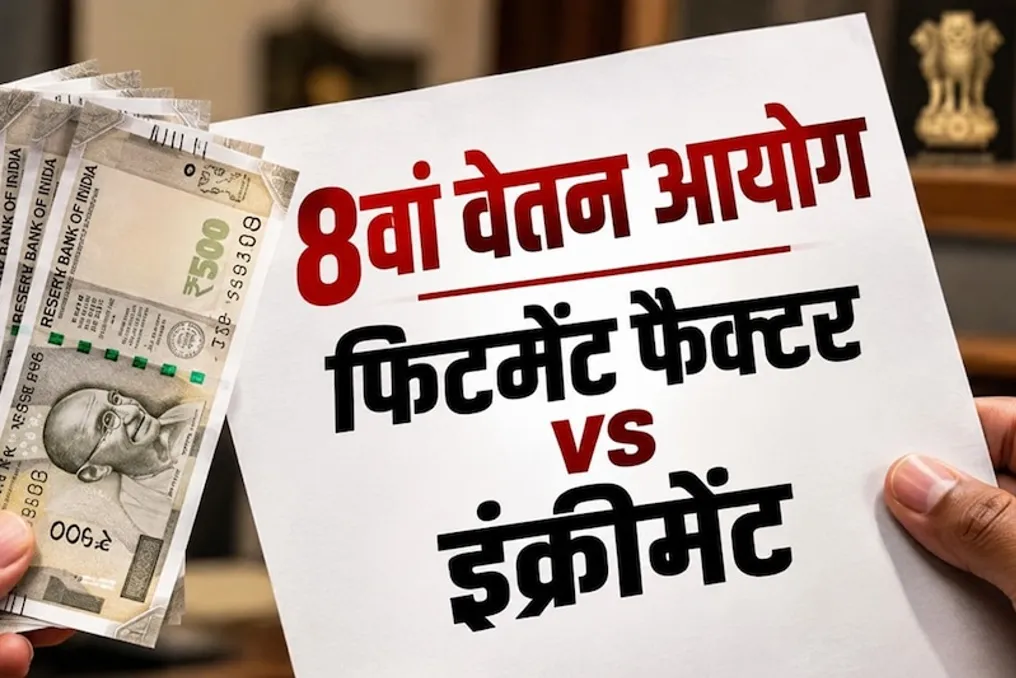
Salary Growth Comparison: High Fitment Factor or High Increment Rate for the 8th Pay Commission
Read more
Aaj Tak
www.aajtak.in

Salary Growth Comparison: High Fitment Factor or High Increment Rate for the 8th Pay Commission

Currently, there is active discussion among civil servants regarding the 8th Pay Commission, with primary attention focused on the fitment factor and the annual increment rate. Trade unions are demanding an increase in both the fitment factor and the annual increment rate. Both of these parameters directly influence the employees' basic salary.

A higher fitment factor leads to a significant increase in the initial basic salary during the salary revision, whereas a higher annual increment rate provides long-term benefit in the form of annual salary growth.

The question arises: what will happen to salaries if the 8th Pay Commission sets a low fitment factor, but the annual increase is raised to 7%? Can a 7% increase overtake the benefit of a high fitment factor over several years? This can be illustrated using the example of basic salaries for employees at levels 5, 6, and 7.

Under the 7th Pay Commission, the fitment factor was 2.57, and the annual increase was 3%. Currently, trade unions are insisting on increasing the fitment factor for the 8th Pay Commission and are also putting forward proposals to increase the annual increment rate. It is important to understand that the functions of the fitment factor and the increment are different. The fitment factor is used to determine the new basic salary by multiplying the old basic salary when the new pay commission comes into effect. The annual increment, conversely, increases the employee's basic salary every year.

Several organizations, including the National Council – Joint Consultative Mechanism (NC-JCM), the Federation of Defense Industry Workers (AIDEF), the Federation of National Postal Organizations (FNPO), the Federation of Indian New Pension System Workers (AINPSEF), and the Society of Indian Pensioners, have requested a fitment factor of 3.833. If this demand is met, the minimum basic salary of 18,000 rupees under the 7th Pay Commission could rise to 69,000 rupees. Furthermore, the Indian Railway Technical Supervisors Association (IRTSA) has proposed fitment factor options of 2.92, 3.50, 3.80, 4.09, and 4.38 for different levels.

One organization also proposed setting the minimum salary at 52,560 rupees. Delhi Government school teachers recommended a minimum salary of 47,210 rupees with a fitment factor of 2.62. Chennai GPO pensioners proposed a minimum salary of 68,000 rupees based on a fitment factor of 3.77. Nevertheless, some experts believe that the fitment factor in the 8th Pay Commission may remain at 2.5. At present, all these demands and estimates are merely assumptions; the final factor will be known after the committee's recommendations and the government's decision.

In addition to the fitment factor, demands are being made to increase the annual increment rate. NC-JCM, AIDEF, and FNPO have proposed setting the annual increment at 6%, while AINPSEF is pushing for an increase to 7%. IRTSA, for its part, has proposed a 5% annual increment. The argument in favor of increasing the annual rate is the desire to ensure a more substantial salary growth for employees every year and to avoid the long wait for the next pay commission. AINPSEF claims that with a 7% rate, the total income of employees could double in about 7–8 years.

Three basic salary scenarios were calculated to understand this situation. Scenario one: fitment factor 2.57 and annual increment 3%. Scenario two: fitment factor 2.1 and annual increment 7%. Scenario three: fitment factor 2.57 and annual increment 7%. The existing basic rate from the 7th Pay Commission was used in these calculations. The first-year salary was calculated based on the fitment factor, and then the basic rate was projected for the 5th and 10th years considering the annual increment.

Salary Calculation for Level 5 Employees

The initial basic salary for Level 5 employees under the 7th Pay Commission is 29,200 rupees. Applying a fitment factor of 2.57 results in a new basic salary of 75,044 rupees. With a factor of 2.1, it reaches 61,320 rupees. The projected basic salary for the first, fifth, and tenth years in the three scenarios is as follows:

  • 2.57 fitment factor and 3% increment: 75,044 rupees in the first year, 84,463 rupees in the fifth year, and 97,915 rupees in the tenth year.
  • 2.1 fitment factor and 7% increment: 61,320 rupees in the first year, 80,378 rupees in the fifth year, and 112,734 rupees in the tenth year.
  • 2.57 fitment factor and 7% increment: 75,044 rupees in the first year, 98,367 rupees in the fifth year, and 137,965 rupees in the tenth year.

It is evident from this data that although the initial basic salary will be lower with a 2.1 fitment factor and 7% increment, by the tenth year it may exceed the projection obtained with a 2.57 fitment factor and 3% increment.

What Gain Will a Level 6 Employee Receive?

The current basic salary for Level 6 under the 7th Pay Commission is 35,400 rupees. Applying a fitment factor of 2.57 increases it to 90,978 rupees. With a factor of 2.1, the new basic salary will be 74,340 rupees. Next is a table with the projected basic salary for all three options.

Similar stories

Five Key Union Demands Presented to the 8th Departmental Wage Committee
Read more
www.aajtak.in

Five Key Union Demands Presented to the 8th Departmental Wage Committee

Central employees and pensioners are expecting significant changes from the 8th Pay Commission. In this regard, the leading employee organization has put forward a number of major proposals concerning wages and retirement.

These proposals include increasing the minimum basic salary from 18,000 to 69,000 rupees, raising the pension rate from 50% to 67%, and doubling the annual increase to 6%. Furthermore, it was proposed to increase the House Rent Allowance (HRA) and the amount paid for vacation upon retirement.

The main organization of central employees, the National Council (staff side) Consultative Mechanism (NC-JCM), presented its recommendations to the 8th Departmental Committee. The implementation of these proposals may affect central employees, pensioners, and recipients of family pensions. However, at this moment, these are only union demands, and the final decision will be made after the recommendations of the 8th Departmental Committee and approval by the central government.

NC-JCM proposed raising the minimum basic salary of central employees from the current 18,000 rupees to 69,000 rupees. To achieve this goal, a Fitment Factor of 3.833 was requested. The adjustment factor is a multiplier used to transition from the old basic salary to the new pay scale. It was also proposed to merge some levels of the salary matrix; for example, it is suggested to create a new level by combining levels 2 and 3, with a minimum salary of 83,200 rupees.

The union also called for substantial changes in pension legislation. According to this proposal, instead of 50% of the last salary upon retirement, the pension should be paid at 67%. Additionally, a request was made to increase the family pension from the current 30% to 50%. An example is provided: if a pensioner has an insurable salary of 100,000 rupees and the calculation uses a 2.0 adjustment factor, the estimated monthly pension would be around 134,000 rupees, and the family pension would be 100,000 rupees. It should be noted that this is only an example to illustrate the proposal and not an approved pension.

Currently, central employees receive an annual basic salary increase of 3%. NC-JCM believes that due to the rising cost of living and inflation, this percentage should be increased to 6%. To illustrate this proposal, an example of a level 4 employee is given: using an adjustment factor of 2.1, the adjusted basic salary is 53,550 rupees. If the employee receives an annual increase of 6%, their basic salary could grow to 90,472 rupees in 10 years. If the current increase of 3% is maintained, this amount would be 69,871 rupees. According to these calculations, the difference in total estimated salary over 10 years between the two scenarios could be 1,103,290 rupees, demonstrating the significant long-term impact of increasing the increase rate on employee income.

Regarding the House Rent Allowance (HRA), the union also demanded an increase. Currently, central employees receive HRA of 30%, 20%, and 10% depending on the city category. NC-JCM proposes increasing these rates to 40%, 35%, and 30% respectively. A table shows the changes: for category X, the transition is proposed from 30% to 40%; for category Y, from 20% to 35%; and for category Z, from 10% to 30%. This means that if the proposal is adopted, employees living in large cities could receive an HRA increase of 10 percentage points in category X, 15 percentage points in category Y, and 20 percentage points in category Z.

Upon retirement, central employees can receive monetary compensation for accumulated leave of up to 300 days. NC-JCM demands that this limit be increased to 600 days. The calculation of leave compensation is based on the employee's actual salary, which includes the basic salary and Dearness Allowance (DA). If this proposal is accepted, employees will be able to receive a larger sum of money for accumulated leave upon retirement compared to the current system.

In addition to these five key proposals, NC-JCM also raised demands for the restoration of the Old Pension Scheme (OPS), increased opportunities for employee promotion, an increase in the Children Education Allowance, and improved medical care. However, it is important to understand that all these proposals originate from NC-JCM and are not yet final. The exact amounts of the minimum wage increase, adjustment factor, pension, raises, and allowances will only be known after the recommendations of the 8th Departmental Committee are adopted and approved by the central government.

Eighth Pay Commission: Salary Hike Timelines and Fund Deposits
Read more
www.aajtak.in

Eighth Pay Commission: Salary Hike Timelines and Fund Deposits

A year has passed since the formation of the Eighth Central Pay Commission (8th CPC), yet government employees are still awaiting clarity regarding the timelines for salary review and the date when increased amounts will start being deposited into their bank accounts. The commission's work continues, facing numerous demands, including a request to increase the fitment factor, which plays a key role in salary increases. Nevertheless, the picture regarding the new salary structure remains unclear.

The 8th Pay Commission was given 18 months to submit its report, and 12 months of that period have already passed.

The Eighth Commission was formed by the government led by Prime Minister Narendra Modi on November 3, 2025. Despite the passage of a year, information about salary hikes or the fitment factor remains uncertain. The deadline for submitting the eighth commission's report is set for May 2027, leaving only six months.

Regarding when employees will receive the increased salary, everyone is looking for an answer. The commission must submit its report within 18 months. Furthermore, the salary increase will not happen automatically; first, the government must review the commission's recommendations before deciding whether to accept them entirely or approve them with amendments. Only after receiving government approval will the situation regarding the salary hike become clear.

According to experts, the commission was allocated about 18 months from November 2025 to discuss issues of wages, allowances, and pensions and present its recommendations. Although the 8th CPC is tasked with reviewing salaries effective January 1, 2026, past experience shows that there is usually a delay between the effective date and the receipt of the first increased salary in the account. For example, the salary review under the seventh commission came into effect in January 2016, but Cabinet approval was received in June of the same year, and arrears payments were made in subsequent months.

Since there is no official data yet on the amount of the salary increase after the implementation of the eighth commission, experts are putting forward various assumptions based on employee union demands. Analyzing previous commissions, it is noted that after the introduction of the sixth commission, the average salary increased by approximately 40%. The seventh commission provided employees with a salary increase of about 23–25% with a fitment factor of 2.57. Currently, the main demand for the eighth commission is to set the fitment factor at 3.83, which would lead to a significant salary increase.

It is important to understand that the fitment factor is the metric used by the central pay commission to convert the previously revised basic salary (or pension) into a new, adjusted structure. Any change directly affects the salary, pension, and associated arrears.

How will the salary change on 51000

The significance of the fitment factor is evident in its calculation and impact on salary. The calculation formula is: 'New Basic Salary: Current Basic Salary x FF'. Thus, in the sixth commission, the minimum basic salary was 7 thousand rupees, which grew to 18 thousand rupees after applying a FF of 2.57. If the government approves an increase to 3.83, the minimum basic salary will be 68,940 rupees (18000 x 3.83), leading to a direct salary increase of 51,000 rupees. However, the final decision rests with the government.

On the 8th Departmental Commission Meeting: Discussion on Salary and Pension Increases
Read more
www.aajtak.in

On the 8th Departmental Commission Meeting: Discussion on Salary and Pension Increases

One year has passed since the formation of the 8th Departmental Commission (Pay Commission); it was established on November 3, 2025, and has been given eighteen months to submit its report, which is tentatively expected in May 2027. Despite the commission holding meetings with trade unions in many states, the picture regarding changes in wages and pensions remains unclear.

Nevertheless, various reports contain significant projections. In addition to salary increases, the possibility of improving the status of pensioners is actively being discussed, as a pension of 25,000 rupees could rise to 87,500 rupees after the commission's recommendations are approved.

Currently, the 8th Departmental Commission continues its meetings with trade unions, and the commission is still reviewing the demands put forward. Last October, the team visited Mumbai. On August 10, Finance Minister Pankaj Choudhary responded in Lok Sabha, clarifying that the commission has not yet submitted its recommendations. He emphasized that decisions regarding the effective date and the fitment factor will be made by the government after receiving the report.

Thus, the final determination of employee salaries, pensioner pensions, and other issues will depend on the commission's report and subsequent government decisions. Experts and reports are publishing forecasts for salary and pension increases based on organizational demands. Therefore, it is crucial to rely only on the Ministry of Finance and PIB for updates on the 8th CPC before the government makes official comments.

One of the most significant demands voiced during negotiations between the team of the 8th Departmental Commission and the trade unions is an increase in the basic rate by at least 69,000 rupees and setting the fitment factor at 3.833. This demonstrates what employees are striving for, but the adoption of these measures remains at the discretion of the government.

Although figures such as 2.57, 2.86, 3.00, and 3.15 are also actively discussed, none have received official approval. According to a recently circulated statement, the basic pension of 25,000 rupees could increase to 87,500 rupees, and this projected pension hike is based on the commission's demand for a fitment factor of 3.5. However, the government will consider the proposals presented after the publication of the departmental commission's report and then announce the amendments. Consequently, the size of the salary or pension increase entirely depends on the government.

Popular