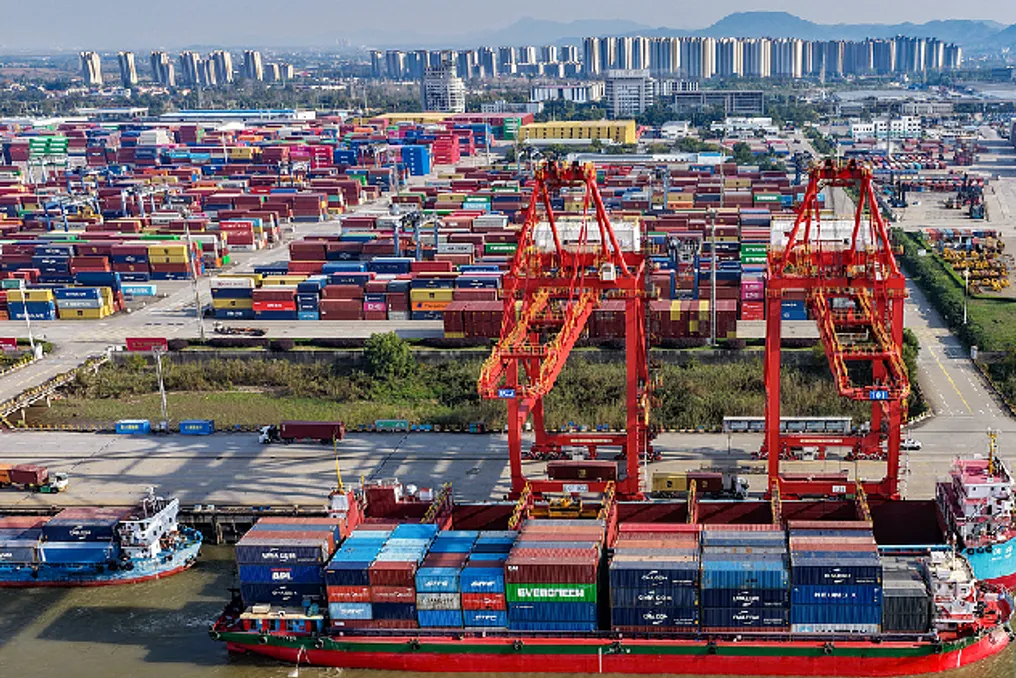
Analysis of China's Trade Surplus: Rethinking Concepts of International Trade
Read more
CGTN
cgtn.com

Analysis of China's Trade Surplus: Rethinking Concepts of International Trade

There is a common misconception that the closer a country's economic ties are with China, the larger its trade deficit with China will be, leading to a deterioration of its economic situation. However, this assumption does not reflect the full complexity of international trade.

Among China's closest economic partners are member states of the Association of Southeast Asian Nations (ASEAN). For instance, Vietnam has demonstrated strong economic growth in recent years. According to the General Statistics Office of Vietnam (GSO), in the first quarter of the current year, the country's GDP increased by 9.95% year-on-year, making it one of the fastest-growing economies in the world. The data also showed that Vietnam's goods exports grew by 24.5%, and imports by 36.7%.

All these indicators suggest that trade has become an important factor in expanding Vietnam's economy, providing businesses and consumers with more opportunities to leverage their strengths and participate in global markets. Nevertheless, a trade surplus or deficit is essentially an arithmetic measure; the factors behind these balances, as well as their economic consequences, are far more complex.

Vietnam's Trade Patterns as an Illustration

Vietnam's trade models serve as a clear example. The United States was the largest export market for Vietnam, receiving $140 billion in exports during the first three quarters of the year. Meanwhile, China acted as the main source of imports for Vietnam, totaling $187.3 billion over the same period, according to the GSO. Vietnam's trade surplus with the US, the European Union, and Japan continued to grow, while deficits with China, South Korea, and other ASEAN countries also increased.

These figures must be viewed in the context of comparative advantages and the division of labor in global supply chains. Trade is not simply a situation where one economy benefits at the expense of another. A significant part of modern international trade involves combining resources, components, and technologies from different countries to produce finished goods, rather than just exporting raw materials such as ore and crude oil. This is particularly evident in Vietnam's trade structure.

Imports Stimulate Exports Through Global Chains

According to GSO data, the share of finished products in Vietnam's total exports was $392.8 billion, or 90.4%. At the same time, materials and raw materials for processing and production amounted to $426.9 billion, or 94.1% of imports. Among imported goods, machinery, equipment, tools, and spare parts accounted for 58.3%, while raw materials made up 35.8%. This contrast between the composition of imports and exports helps explain the country's position in global supply chains: imported equipment, components, and materials support local production, which in turn generates exports.

Thus, this model demonstrates how international trade allows countries to utilize their resources and capabilities more effectively, rather than reflecting the benefit of one economy at the expense of another. As for China, it continues to expand trade with its partners to ensure mutual benefit. As a major trading power, China consistently fulfills its obligations under international economic and trade agreements, including the World Trade Organization (WTO).

China provides equal treatment to products from WTO member countries, reduces tariffs on a range of imported goods, and cooperates with relevant authorities in other countries to expand access to agricultural markets. This year, the Chinese government also identified more balanced trade as a priority in its efforts to deepen economic and trade cooperation with partners.

China's Customs Statistics Reflect This Trend

According to China's customs statistics, imports grew by 22.3% year-on-year in the first three quarters of the year, with growth remaining above 20% since March. Although China's economic structure and development model differ from Vietnam's, the basic logic of international trade remains unchanged. China's vast domestic market creates significant demand for imported goods, and the continuous development of its advanced manufacturing sector drives growing demand for key intermediate products.

In the first three quarters of the year, China's imports of components such as storage components, integrated circuits, and aircraft parts and components increased by 150%, 56.6%, and 17.6%, respectively. These imports support production activities, helping to manufacture goods for both domestic and international markets. China's imports of raw materials and agricultural products also contribute to global supply and demand. During the first three quarters of the year, China's import of mineral materials exceeded 1.2 billion tons, and imports of crude oil and natural gas exceeded 400 million tons. Imports of fresh durians from Malaysia, salmon from the Faroe Islands, and Italian olive oil increased by 330%, 41.4%, and 28.6%, respectively. This data illustrates the breadth of China's demand for resources and consumer goods from around the world, as well as the opportunities its market offers to trading partners.

Beyond Goods: Services and Investment Matter

China's approach to trade development extends beyond merchandise trade. According to the Ministry of Commerce of China, the development of international trade relies on three main pillars: merchandise trade, trade in services, and digital trade. Unlike merchandise trade, China continues to run a deficit in trade in services. According to the Ministry of Commerce, China's trade in services reached 5.77 trillion yuan (about $859 billion) in the first nine months, an 8.5% increase compared to the previous year. During the same period, the country recorded a service trade deficit of 1.23 trillion yuan.

China has also made a significant contribution to the global services sector by committing to market access in 100 sub-sectors and continuing to expand its openness. Ultimately, trade balances alone are insufficient to fully reflect the economic relationship between countries. The scale and structure of trade, the integration of industrial and production chains, as well as broader flows of services and investment, are important. A more comprehensive assessment must also consider the operational activities of foreign-invested enterprises in China and the economic value they generate. China is ready to work with its trading partners to strengthen mutual trust, deepen trade cooperation, and seek new opportunities for joint growth.
Similar stories

Expert notes structural problems in Chinese economy despite technological progress
Read more
www.aajtak.in

Expert notes structural problems in Chinese economy despite technological progress

After a two-week stay in China, British writer James Crabtree identified significant discrepancies in the state of the country's economy. While impressed by achievements in artificial intelligence, electric vehicles, and drones, he also found that the economy is facing issues related to weak demand, declining investment, rising unemployment, and a protracted crisis in the real estate sector.

In his publication titled 'China: Through the K-hole,' Crabtree characterized China as a 'K-shaped economy,' where rapid technological growth coexists with deep economic difficulties. He noted that upon leaving Shenzhen, he was struck by the power of the technological ecosystem, which surpassed his previous expectations, but the internal state of the economy turned out to be much worse than he had assumed.

Crabtree, an invited research fellow at the European Council on Foreign Relations, highlighted the growing gap between China's technology sector and its overall economic situation. He reported that while GDP grew by 4.5% in the last quarter, there is a decline in investment, weakening demand, a serious drop in property prices, and a cessation of spending by private businesses.

The geopolitical analyst also pointed to reduced tax revenues, pressure on China's stock market, and restricted access to advanced computing technologies. In Crabtree's view, China's remaining growth depends on exports, which are facing tariffs from trading partners.

During his trip to Beijing, Crabtree met with economist Michael Petis, who discussed the possibility of a prolonged period of weak growth in China, similar to what Japan experienced after its asset bubble burst. Analyst Petis assessed China's economic prospects as a period of slowdown, stagnation, and slow recovery that could last a decade or more, given that the country is grappling with one of the largest debt burdens in history. He called this a positive scenario.

Crabtree questioned whether official unemployment figures reflect the reality of the labor market. He cited an example where official unemployment is just over 5%, which, in his words, raises doubts. Chinese economist David Daokui Li recently reported the actual unemployment rate at 10.2%. Petis believes even this figure remains high. Quoting a Financial Times report, he mentioned that 53 million Chinese workers are employed in food delivery and ride-hailing, and about 200 million people work in the large gig economy.

The author suggested that China is using the informal economy as a kind of temporary buffer against unemployment amid the economic slowdown. His comments mentioned employment forecasts and alternative unemployment data that were not separately verified in the publication.

Crabtree noted that Chinese businesses are facing excessive domestic competition, especially in the electric vehicle sector. He recounted that during his visit, he often heard entrepreneurs say that the struggle in China resembles a civil war. Over a hundred EV brands are actively competing by lowering prices, leading to a significant reduction in margins for most companies. In Crabtree's opinion, such domestic competition forces Chinese firms to expand abroad in search of profit.

Furthermore, Crabtree drew attention to China preparing new export control regulations due to increased competition with the US. He stated that China is beginning to restrict the export of technologies, including powerful open-weight AI models, as well as drones and tunneling equipment. Beijing is creating systems similar to those in Washington to limit access to strategic technologies.

Ultimately, Crabtree concluded that China maintains technological competitiveness and strengthens its international standing despite structural problems in its domestic economy. He noted that Xi feels confident on the world stage, for instance, meeting with representatives from Washington in 2025. Although China's technological superiority is growing, the country feels economic weakness, which, in his opinion, explains Beijing's desire to maintain stable relations with the US.

CSIS Analysis: Combating Tariff Evasion Will Not Resolve the US-China Imbalance
Read more
noticiasaominuto.com

CSIS Analysis: Combating Tariff Evasion Will Not Resolve the US-China Imbalance

According to an analysis by the American think tank CSIS, increased US scrutiny over Chinese products exported through third countries will not resolve the trade imbalance between Washington and Beijing.

Researcher Hugh Grant-Chapman from the Center for Strategic and International Studies (CSIS), based in Washington, argues that the administration of US President Donald Trump confuses fraudulent customs duty evasion schemes with the legitimate reorganization of international production chains.

He notes that the White House mistakenly equates entirely legitimate business operations with criminal behavior, referencing the Trump administration's August report titled The Great Transshipment Scam.

In this document, the White House accuses China of using more than 40 intermediate economies to bypass US tariffs by redirecting Chinese goods.

In Grant-Chapman's view, the US administration has expanded the concept of re-export, which traditionally implied goods passing through third countries without substantial transformation, to include products actually manufactured in these markets using Chinese components.

The researcher acknowledges documented cases of customs fraud, particularly those related to batteries, steel products, and solar panel components, but insists that these practices only explain part of the indirect presence of Chinese products in the American market.

He emphasizes that re-export itself is not inherently illegal or undesirable from a governmental policy perspective.

The study mentioned by CSIS shows that in 2024, Mexico and Vietnam accounted for 23% and 15% of China's added value, which indirectly flowed into the US, respectively.

Nevertheless, the research concludes that most of these flows are driven by industrial processing rather than simple goods redirection.

A study by the US Federal Reserve estimates that China's production in Mexico contributed to an increase in Mexican exports by approximately 14 percentage points after the imposition of tariffs on Chinese goods in 2018 and 2019, whereas direct re-export was less than one percentage point.

The CSIS analysis also demonstrates that countries such as Malaysia, Mexico, Thailand, and Vietnam have not recorded a wide increase in the matching of goods imported from China and exported to the US.

Conversely, Cambodia and Laos show more evident signs of growth in these flows, especially concerning steel products and photovoltaic elements.

For Grant-Chapman, the fundamental problem lies in the structural imbalance of the two largest global economies. In China, high trade surpluses are maintained by low domestic consumption, state support for industry, and an export-oriented growth model.

In the United States, import demand is stimulated by low savings rates, budget deficits, and increased investment, particularly in artificial intelligence infrastructure.

The researcher explains that these macroeconomic foundations place the United States in the position of a net importer, and China as a net exporter.

He recalls that in 2025, Chinese exports grew by 5.5%, despite sales in the US declining by approximately 20%, with some products being redirected to other markets, including the European Union.

CSIS also points out that many intermediate countries currently benefit from US tariffs that are 10–20 percentage points lower than those applied to China, which encourages companies to move production operations to these markets.

Grant-Chapman concludes that a sustainable path requires a more thorough analysis of global trade standards, a reassessment of the impact of US tariff differences on the market, and open dialogue with trade partners and business leaders.

Popular