Students from Chinese College Create Robots for RoboMaster Competition in Shenzhen
Read more
CGTN
cgtn.com

Students from Chinese College Create Robots for RoboMaster Competition in Shenzhen

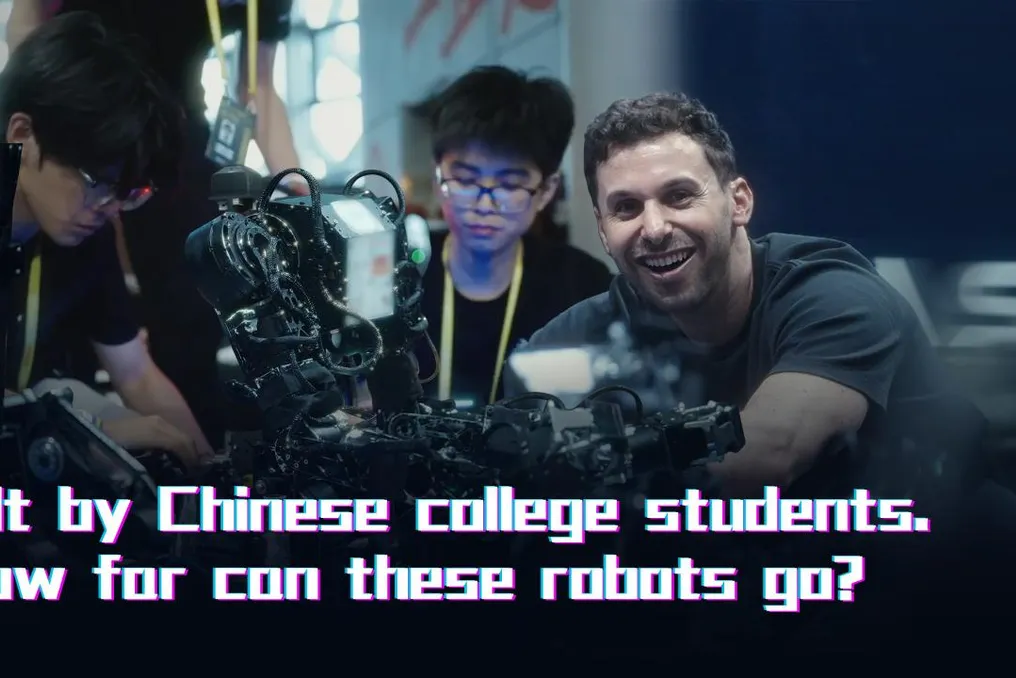
Author Young China, Zack Dichtwald, visited the RoboMaster competition taking place in Shenzhen. There he met university students who are involved in designing, assembling, and fine-tuning their own robots.

Dichtwald had the opportunity to remotely control an engineering robot while observing the long hours of work, continuous testing, and determination required to bring ambitious ideas to life.

Similar stories

Four-meter tall Chinese robot capable of lifting loads up to 500 kilograms
Read more
olhardigital.com.br

Four-meter tall Chinese robot capable of lifting loads up to 500 kilograms

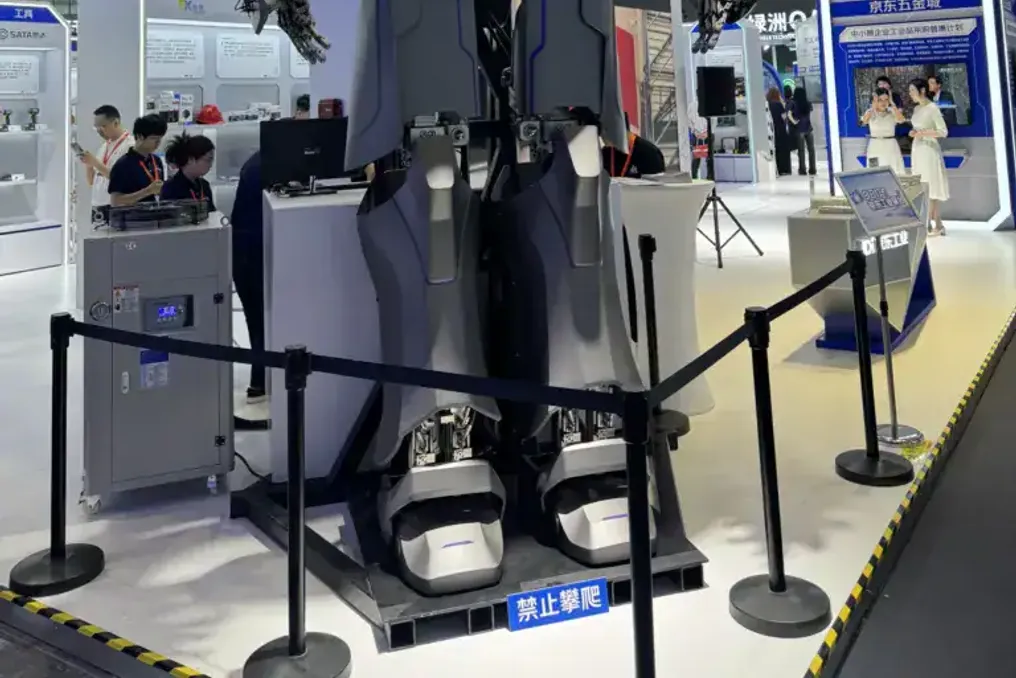
The Chinese company NeodraDynamics has unveiled the Neo1 robot, which stands 4 meters tall and weighs 1.2 tons. This apparatus is designed for performing heavy and hazardous tasks, with its stated capability being the lifting of up to 500 kilograms using two manipulators.

Despite its high load capacity, the project is still in the development stage. The machine requires an external power source via a cable and computer control, and it is not yet capable of moving or operating autonomously.

Neo1 was demonstrated at the World Robotics Conference in Beijing and at the China International Industry Fair in Shanghai. The robot utilizes a hybrid system combining hydraulic and electric mechanisms.

The structure is equipped with 41 active degrees of freedom, meaning it can independently control numerous movements. Of this total, 39 elements operate hydraulically, where oil pressure drives pistons. The remaining two elements are controlled electrically and manage the rotation of the forearms.

According to information published on the CyberRobo profile, each manipulator can withstand a load of up to 300 kg, with a combined total capacity reaching 500 kg. This publication also indicates that the equipment's reach is 1.7 meters, gripping force is 500 kgf, and fingertip accuracy is 0.01 mm.

Among the robot's declared characteristics are resistance to temperatures from -50°C to 250°C, the ability to operate at depths up to 10,000 meters, and tolerance to radiation, dust, and vibration. It is important to note that this data represents project specifications, not results from independent testing presented in the material.

In an interview with New Atlas, Kui Dalon from NeodraDynamics explained that Neo1 functions as a remotely controlled demonstration unit. Although the power remains external and connected by a cable, the company plans to integrate a battery in the future.

The manufacturer is still working on creating the artificial intelligence system necessary for autonomous operation, as well as completing the leg movement control. NeodraDynamics intends to test the equipment's performance in real industrial conditions. According to CyberRobo, the company is sending Neo1 to supply chains and JD Industrial sites.

Potential application areas include material handling in ports and mines, assembly of heavy components, servicing nuclear facilities, and working on oil and gas platforms and power lines. Kui Dalon told New Atlas that a full humanoid format might be excessive for these tasks, as 'walking on legs is not a priority for industrial applications.'

As an alternative, the company is considering mounting the manipulators on a wheeled base. This configuration would allow for cargo transport capabilities without waiting for the walking system to be completed. The next step is transforming the prototype into a tool that meets the requirements of real industrial operations. Initially, the post about the Chinese-made robot appeared on Olhar Digital.

Canine robots compete in climbing on Mount Taishan, China, overcoming over 3 thousand steps
Read more
olhardigital.com.br

Canine robots compete in climbing on Mount Taishan, China, overcoming over 3 thousand steps

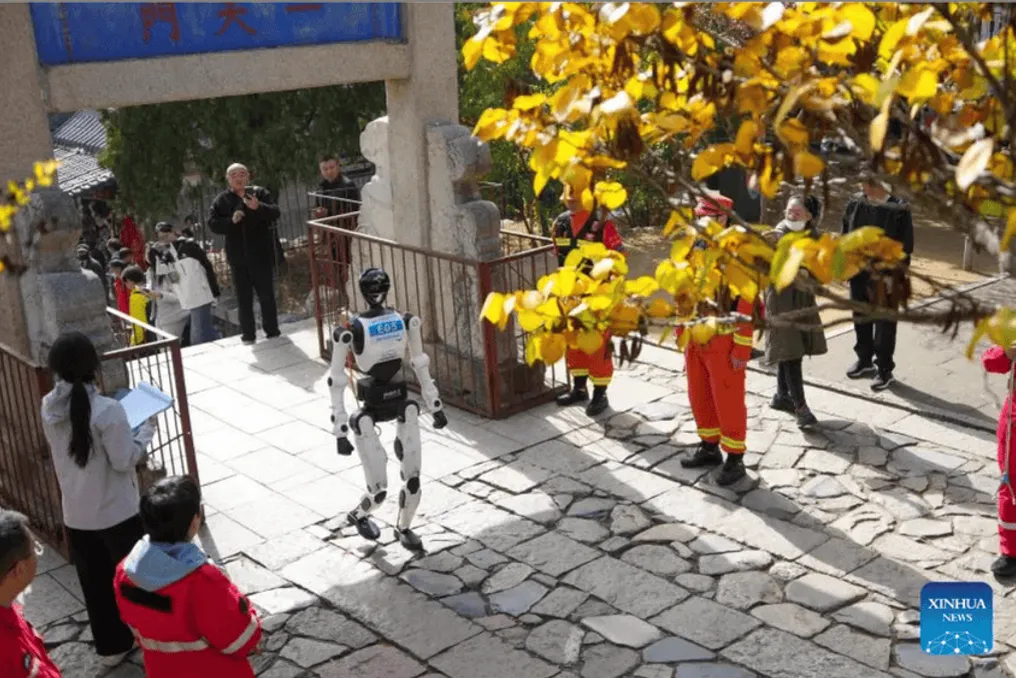
Humanoid robots and dog-robots participated in the first robotic climbing competition held on Mount Taishan in China. The established course spanned 3.9 kilometers, with an approximate elevation of 600 meters and over 3,100 stone steps. This challenge aimed to assess the machines' ability to adapt to uneven surfaces, as well as their navigation and balance systems.

The competition included other events, such as cargo transport, exoskeleton use, and terrain recognition. Approximately 90 teams attended the steps of Mount Taishan to test their respective technologies.

The robots, especially the canine models, were subjected to various operational tests, such as recalculating routes, transporting items while ascending the steps, and making sudden changes in direction. The purpose of these exercises was to measure the agility, decision-making capability, and operational fluidity of the machines.

The quadruped equipment from Beijing Lingyi Technology was declared the winner of the main event, completing the course of over 3 thousand steps in 43 minutes and 41 seconds. In previous tests, a model from competitor UNIUBI AI had finished the route in 35 minutes and 47 seconds, although it failed to replicate this time in the official competition.

The winner, from Beijing Lingyi Technology, has ties to Unitree. It is worth noting that the same route, when undertaken by humans, takes an average of an hour and a half.

Chen Lin, engineer responsible for the UNIUBI AI team's robot, told the Global Times that the biggest obstacle was adapting to the specific conditions of Mount Taishan. He detailed that the steps were built centuries ago and exhibit significant variations, including high and low, wide and narrow steps, in addition to sections paved with cobblestones.

Xiang Ligang, president of the Beijing Intelligent Era Industry Institute, considered the event a significant milestone for both technological advancement and refinement. According to Ligang, when multiple robots compete in the same scenario, their vulnerabilities are quickly revealed, allowing effective approaches to be observed, evaluated, and incorporated from competitors. Thus, the competition acts as a practical testing ground that accelerates product improvement.

The Mount Taishan International Mountaineering Championship, also known as Mount Tai, is an ancient tradition. Since 1987, thousands of mountaineers have traversed a route even longer than the one used by the robots, totaling 7 thousand steps over about 8 kilometers. The 40th edition of this championship took place in September and attracted more than 13 thousand participants from various parts of the world.
South Korean Students Visit Exhibition on Disposal of Japanese Chemical Weapons in China
Read more
cgtn.com

South Korean Students Visit Exhibition on Disposal of Japanese Chemical Weapons in China

Recently, a group of students from the Republic of Korea visited an exhibition hall in Dunhua, Jilin Province, located in northeastern China. This exhibition is dedicated to China's efforts to destroy remaining Japanese chemical weapons.

The visit to the exhibition hall made a strong impression on the students. They expressed hope for deepening exchanges between the youth of China and South Korea, and called for joint actions to maintain peace and prevent the horrors of war from recurring.

Popular