Lakes with Floating Houses and Markets in India: A Review of Dal and Loktak Lakes
Read more
Aaj Tak
www.aajtak.in

Lakes with Floating Houses and Markets in India: A Review of Dal and Loktak Lakes

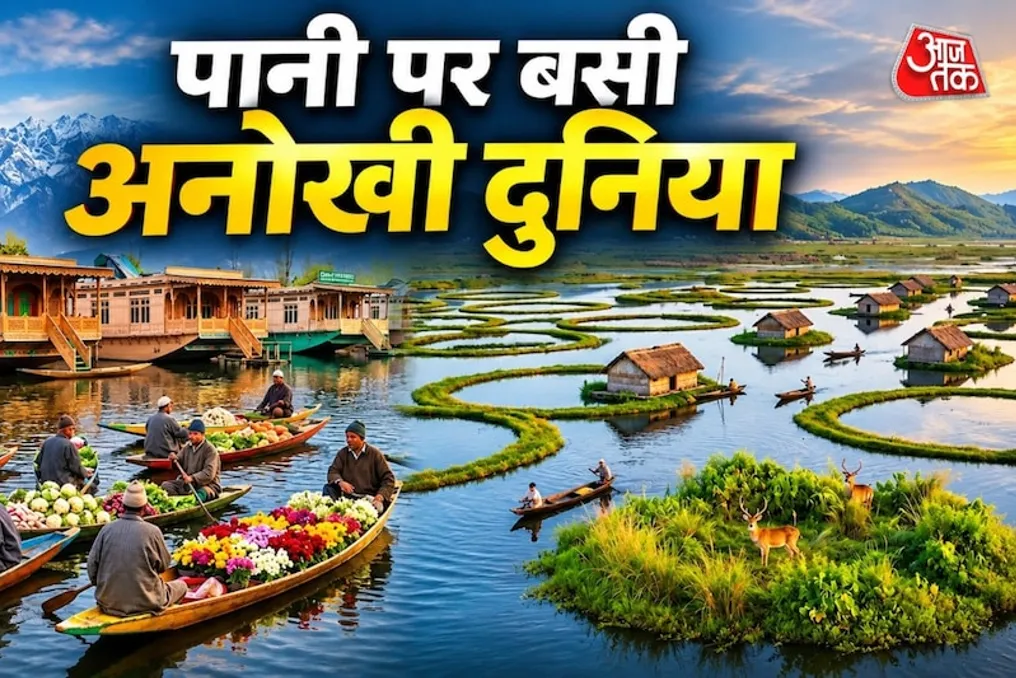
India has many picturesque places to visit, including mountains, waterfalls, seas, and forests. In addition, there are lakes whose landscapes can remind one of foreign countries. These lakes are distinguished not only by their beauty but also by the unique world that lies in the middle of the water. In some places, you can see beautiful wooden houses floating on the water, and in others, you can buy vegetables and flowers on boats. Moreover, India has a national park entirely built on floating land known as phumdi.

If you want to see something unusual, away from crowded tourist spots, Dal Lake in Jammu and Kashmir and Loktak Lake in Manipur might suit you. The following discusses the interesting features of these two lakes and the best time to visit them.

Dal Lake in Jammu and Kashmir

Dal Lake in Jammu and Kashmir is called the pearl of Kashmir. It is world-famous for its beauty and tranquil atmosphere. The most notable feature of this lake is the beautiful wooden houseboats that float on the water. Tourists can stay in these houseboats. The experience of staying amidst beautiful mountains and water waves is very memorable.

Another feature of Dal Lake is the floating vegetable market. Early in the morning, many vendors arrive at the lake on Shikara boats, bringing vegetables, flowers, and other goods. People shop here while sitting on boats. This market, located in the middle of the water, looks exceptionally original. Furthermore, you can view the beauty of the lake up close by taking a ride on a Shikara.

The best time to visit Dal Lake is from March to October, when the weather is pleasant and you can enjoy the beauty around the lake. If you like cold and snowfall, you can also visit it from December to February. The view of the lake is completely different in winter, although it is very cold during this time.

Loktak Lake in Manipur

Loktak Lake in Manipur is one of the largest freshwater lakes in India. It is known for its floating islands. Circular formations made of grass, earth, and plants, called phumdi, are visible on the surface of the water. From a distance, it seems as if small islands are floating on the water.

The settlement of Champu Hangpok is located on this lake. The residents here depend on the lake and boats for their daily lives. People move from one place to another by boat, fish, and carry out other necessary tasks. Life here is very different from life in other cities and villages.

The Only Floating National Park in the World

The most outstanding feature of Loktak Lake is the Keibul Lamjao National Park, which is located here. It is considered the only floating national park in the world. This park is situated on phumdi in the lake. Many species of animals and plants live here.

This park is also a natural home for the rare Sangai deer, known as the dancing deer of Manipur. Its special gait and unique structure distinguish it from other deer. This is why this place is particularly valuable for people interested in nature and wildlife.

The best time to visit Loktak Lake is from October to March, when the weather is cool and pleasant. Especially from November to February, you can observe migratory birds. If you want to enjoy the lake's floating islands and the surrounding beautiful scenery, you can plan your trip for winter.

Why Are These Places So Special?

Both Dal Lake and Loktak Lake are famous for their unique characteristics. At Dal Lake, you can experience staying in floating houseboats and seeing a market that takes place directly on the water. Meanwhile, Loktak Lake offers the sight of floating islands, a settlement living on the water, and a unique national park. If you want to see something new, you must include these two lakes in your travel list.
Similar stories

Sukun Wetland Complex in Chandigarh Recognized as India's 103rd Ramsar Site
Read more
thebetterindia.com

Sukun Wetland Complex in Chandigarh Recognized as India's 103rd Ramsar Site

The famous Sukna wetland complex in Chandigarh has officially been designated as India's 103rd Ramsar site, receiving the number 2602. This inclusion places Chandigarh on the global map of internationally recognized wetlands.

Located on the outskirts of Chandigarh, where the Shivalik Hills rise towards the Himalayas, Lake Sukna offers residents more than just an open body of water. Its shores, surrounding vegetation, and adjacent forests form a habitat that supports wildlife, including birds that travel thousands of kilometers between continents.

Sukna functions as a peri-urban water body, meaning it is a water feature located within or near an urban area while maintaining critically important ecological functions. This ecological significance has now received international recognition.

Four Habitats, One Interconnected Ecosystem

A wetland is not merely an extensive surface of water. Its ecological character is defined by the various habitats existing within and around it, and it is these habitats that allow different species of wildlife to utilize the area in diverse ways. Some species depend on open water, while others use the vegetation along the banks or the surrounding forest.

This diversity is particularly important for birds that use Sukna as a seasonal stopover. For migratory waterfowl, wetlands are not isolated points; they are part of larger geographical routes connecting breeding grounds, feeding zones, and wintering areas.

Stopover on the Central Asian Flyway

Sukna is situated along the Central Asian Flyway, which is a primary route for birds migrating between breeding and wintering grounds. During these journeys, birds require suitable places to rest, feed, and recover before continuing their migration. Wetlands like Sukna provide these vital habitats.

The lake serves as a feeding, breeding, roosting, and wintering ground for migratory waterfowl. Each of these functions is significant at different stages of the bird's life cycle. Furthermore, Sukna supports species with varying conservation statuses, highlighting the importance of protecting its habitat.

India's network of Ramsar sites has expanded to 103! With the addition of Lake Sukna in Chandigarh and Sauj Gill in Uttar Pradesh to the list, India's commitment to wetland conservation continues to grow. These wetlands preserve biodiversity, strengthen water and climate security, and support local livelihoods. Their recognition also reinforces the importance of protecting these vital ecosystems for future generations.

Among three notable species associated with this wetland are: the Common Moorhen, classified as a vulnerable species that depends on suitable freshwater habitats; the Pallid Harrier, classified as endangered, a large predator associated with wetland and riverine ecosystems; and the Black Swamp Turtle, classified as endangered, a freshwater turtle that requires suitable aquatic conditions to survive.

What Does Ramsar Status Mean?

The Ramsar Convention is an international agreement for the conservation and wise use of wetlands. It is named after the Iranian city where it was adopted in 1971 and establishes the framework for recognizing wetlands of international importance.

Inclusion in the Ramsar List grants the wetland international recognition of its ecological significance and draws attention to the need for its preservation. With the inclusion of Sukna, India's Ramsar network now comprises 103 sites. For Chandigarh, this designation places one of its important urban wetlands into this international system of nature conservation.

Thus, Sukna's new status is more than just an international listing. It is a recognition that even in a planned city, a wetland can remain part of a much larger ecological network connecting local landscapes with wildlife and migratory routes stretching far beyond national borders.

Popular