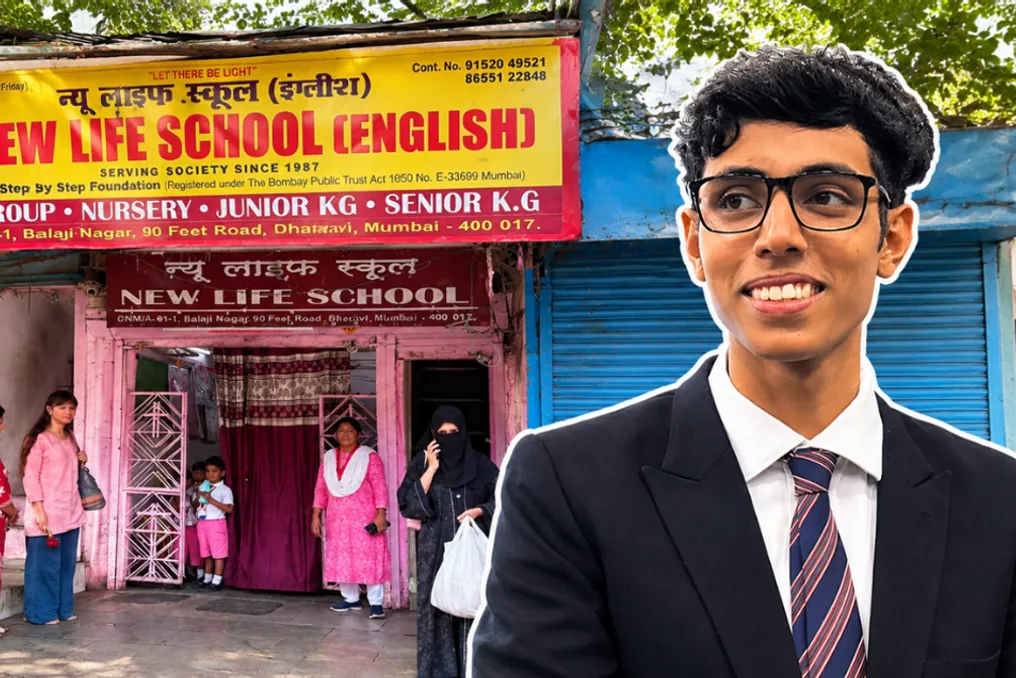
The future of education for 560 children at New Life School in Dharavi, Mumbai, hinges on one question: whether the school can continue operating in its current location. This preschool educational center has been operating in the area for four decades, yet it has never owned the land on which it is situated.
Due to the redevelopment process in Dharavi, securing land ownership has become a critical condition for the school's survival. An unusual group of people has come together to help this organization: a 19-year-old college student, his friends, and the local community striving to maintain access to education for the area's children.
Daniel Gupta, a third-year student in Advertising and Media at the University of Mumbai, heads this initiative called Dharavi Rising. After the team raised 22 lakh rupees, exceeding the initial goal of 20 lakh rupees for school expansion, they set a more ambitious target—to raise 1.5 crore rupees to help the school purchase land and continue serving the children in the vicinity.
For Daniel, this initiative goes beyond simply keeping the school running; it is also an attempt to change the perception of Dharavi—an area often viewed through the lens of overcrowding, poverty, and redevelopment, rather than the lives, aspirations, and institutions of its residents.
He is tackling this complex challenge while continuing his studies in college, without prior experience in fundraising or established professional connections.
Building a Movement Around the School
Daniel's connection to New Life School came through a friend whose parents run the institution. Studying the school's forty-year history, he encountered a pressing question: how can an institution that has served generations of children ensure a future for the next generations?
Daniel notes: "People are often surprised to learn that this school has been operating for 40 years without owning its land. We want more people to know about this and understand why securing its future is important."
What started as an effort to support the school gradually transformed into Dharavi Rising—an initiative uniting youth and the wider community to address the institution's long-standing issues. For teachers, this campaign provides an opportunity to draw attention to a school that continues to serve children despite the uncertainty of its future.
Teachers Kelsey Rani Raja and D. Pakia Hinsi state: "We wholeheartedly support Daniel's mission to secure the future of our school in Dharavi. We want to do everything possible so that children's education continues without interruption."
Their support also reflects a practical concern for families dependent on affordable education. The team aims to preserve an institution that parents can afford, rather than allowing its future to be compromised by surrounding changes.
From 20 Lakh to 1.5 Crore
When Daniel and his college friends began working on Dharavi Rising in November 2025, the goal was to find creative ways for young people to contribute to the cause. Daniel was only 19 when he took responsibility for creating this initiative. Without prior experience in fundraising or social impact work, he had to learn how to approach potential donors, understand funding mechanisms, and articulate the school's needs.
The team's first campaign set a goal of 20 lakh rupees for school expansion. They ultimately raised 22 lakh rupees, which was a significant milestone for the student-led initiative. However, this achievement was just a starting point, as a larger problem remained—securing ownership of the land where the school is located.
This prompted the team to launch Dharavi Rising 1.5 with a target sum of 1.5 crore rupees to help secure the school's future. The new campaign takes on a more ambitious, long-term task: ensuring that the institution that has educated generations of children can continue to do so.
Tackling the Unknown Challenge
Taking on a fundraising campaign of this scale required Daniel to study several areas outside his university curriculum, including corporate social responsibility (CSR) funding, institutional philanthropy, and campaign strategy.
He admits: "I had absolutely no prior experience in any of this, so I needed guidance. I realized there would be no better tool than ChatGPT."
Daniel used the AI tool even before Dharavi Rising began. Like many students, he initially used it for help with presentations and assignments in college. But as the initiative developed, his questions became more specific: How does CSR funding work? What policies should I study? How do I explain the initiative to potential supporters? What should the fundraising campaign convey to people unfamiliar with this school?
ChatGPT became one of the tools he used to work through these questions. He told The Better India: "I used it to research naming and branding ideas, work on the campaign strategy, understand general concepts of fundraising and CSR, and develop outreach materials. I also used it to determine website requirements and organize my thoughts on how to present Dharavi Rising to potential donors."
The tool helped him break down a complex and unfamiliar task into smaller, manageable steps. He also incorporated AI-generated text into communications with donors. Daniel estimates that ChatGPT saves him two to three hours a day, helping him balance college studies with the demands of organizing the campaign and communicating with potential donors.
Nevertheless, he recognizes that AI cannot replace the judgment and effort required to run such an initiative. He rejects suggestions that do not align with the goals of Dharavi Rising and is cautious about the information he shares with the tool. He also acknowledges that he did not follow a systematic process to independently verify all recommendations generated by ChatGPT. Ultimately, the campaign remains dependent on people: the school staff who understand its needs, the families whose children attend the school, the friends supporting the initiative, and the donors willing to contribute.
Keeping Education Within Reach
For the teachers at New Life School, the central issue remains the well-being of the children. The campaign is not just about raising money for a building or expansion; it is aimed at helping secure the future of an educational institution that has remained accessible to local families for four decades.
The current task is to build upon the team's initial achievements and attract enough support to meet the school's long-term needs. For Daniel, this effort carries a broader meaning: changing perceptions of Dharavi and highlighting the aspirations, initiatives, and public institutions present in the area.
Daniel says, pointing to vibrant art boards in a classroom where he spoke with The Better India: "My work with Dharavi Rising started with a desire to change perceptions of the area. Since then, it has evolved into a concrete effort to protect one of its educational institutions. Yes, AI helped me navigate this unfamiliar territory, but the goal of all our work is rooted in the school and the children it serves."
For the 560 children attending New Life School, the goal is simple: to ensure that the school, which has been part of their neighborhood for decades, can remain part of their future.