Tencent Hunyuan Hy Realtime Voice AI Model Can Independently Determine the Need for Search and Perform Songs Upon Request
Read more
Pandaily
pandaily.com

Tencent Hunyuan Hy Realtime Voice AI Model Can Independently Determine the Need for Search and Perform Songs Upon Request

Tencent Hunyuan has introduced the Hy Realtime model, a real-time voice model that integrates tool invocation and singing capabilities into everyday conversation. This model is already available in voice calls on the Tencent Yuanbao platform and in Tencent's customer support service. The company announced that Hy Realtime will soon be offered via API on Tencent Cloud. The model was unveiled on November 13th.

According to Tencent's statements, Hy Realtime was developed taking into account the characteristics of human speech. The model is capable of handling features such as mumbling, phrase interruptions, or self-correction during thought. The context of the surrounding conversation is used to reconstruct the true meaning. Furthermore, its capabilities for multi-turn instruction following and context management have been improved, allowing the model to track the user's intent throughout extended dialogues.

The model also possesses the function of invoking external tools. Based on the content of the conversation and the user's intentions, it decides whether a web search is necessary, then manages this search, executes the tool call, and provides a voice response within a single process. Regarding output quality, Tencent asserts that the model surpasses its predecessor in audio quality, pronunciation, prosody, and emotional expression, ensuring more natural tonal variations during the dialogue.

The singing functionality was developed in collaboration with the Tencent Music Entertainment AI team. Users can request compositions by specifying parameters such as artist, album, genre, language, release year, or popularity, and they can combine these conditions and refine their requests in subsequent turns. In an example from Tencent, a user requested an English folk song released between 2010 and 2020, and the model found a suitable option and sang it. Tencent notes that they tuned the vocals to provide expressiveness, natural phrasing, breathing, as well as melody and rhythm.

Tencent reports positive results from internal blind tests conducted by experts in search and answer tasks, as well as from an internal test set for the no-thought mode and several public voice benchmarks. The company characterizes its overall performance on these public tests as leading. It should be noted that these are the company's own evaluations, and the published text does not provide sample sizes or test configurations.

Users can test the model in the latest Yuanbao application by selecting the 'Chuyu' voice in voice calls, or through the Tencent Cloud web demo. Tencent plans further development in the direction of two-way interaction, long-term personalized memory, and coordination between the main conversational agent and background agents.

Similar stories

MOSS-Live system shows high performance in voice metrics but lags behind GPT-Live-1 in multi-turn tasks
Read more
pandaily.com

MOSS-Live system shows high performance in voice metrics but lags behind GPT-Live-1 in multi-turn tasks

The OpenMOSS team from Fudan University and MOSI Intelligence presented a detailed evaluation of their full-duplex voice interaction system, MOSS-Live. This system was compared against OpenAI models such as GPT-Live-1 and GPT Realtime 2.1, as well as ByteDance's Doubao SeedDuplex and two Qwen Audio 3.0 models. The publication on the OpenMOSS blog from November 13th outlines the areas where MOSS-Live excels and where it falls short. It should be noted that all presented figures are vendor data, and information regarding sample sizes, uncertainty estimates, and full testing conditions has not been disclosed.

MOSS-Live ranked first across all six stated full-duplex interaction metrics. The system responded to speech not addressed to it only 2% of the time, which is significantly better than 68% for GPT-Live-1 and 75% for Doubao SeedDuplex. Furthermore, it interrupted the user during pauses only 1.44% of the time, compared to 10.37% and 14.29% for its competitors. The system correctly ignored external interruptions in 68% of cases, whereas other models showed rates of 21% and 13%, and maintained its behavior during brief confirmations like 'mm-hmm' in 98.17% of instances.

Results on other parameters were mixed. Using the FDB v3 toolkit, MOSS-Live achieved 51% success, placing it on par with Doubao SeedDuplex as a leader and surpassing GPT-Live-1 with its 45%. However, the system's response time in tool-use scenarios, which was 2.36 seconds, was slower than 1.61 seconds for GPT Realtime 2.1. In the multi-turn task benchmark τ-Voice, MOSS-Live scored 57.93%, falling short of GPT-Live-1's 67.68%, but significantly outperforming Doubao with 17.38%. The percentage of times the system yielded the floor for two seconds was 52.49%, much lower than over 93% for the Qwen Audio models. Regarding audio understanding on Big-Bench Audio, MOSS-Live showed 88.40%, which was lower than Doubao's 90.50%. When following multi-turn instructions, the system received 3.35 out of 5 points, while GPT-Live-1 scored 3.72; however, MOSS-Live led in quality of responses after interruptions, reaching 4.88.

The MOSS-Live architecture combines a background model responsible for listening, queue management, and speech, with a background model responsible for reasoning, tool calling, and longer tasks. These two models exchange memory, context, and task state through a coordination layer, allowing the dialogue to continue while hotel searches or other operations are being performed. The system also supports streaming video, screen sharing, and real-time interpretation.

The system is available via an online sandbox and through the WebSocket realtime API under the model ID moss-live-1.0. MOSI Intelligence, located in the Shanghai Innovation Institute incubator, previously released the MOSS-Image and MOVA models jointly with the OpenMOSS team.

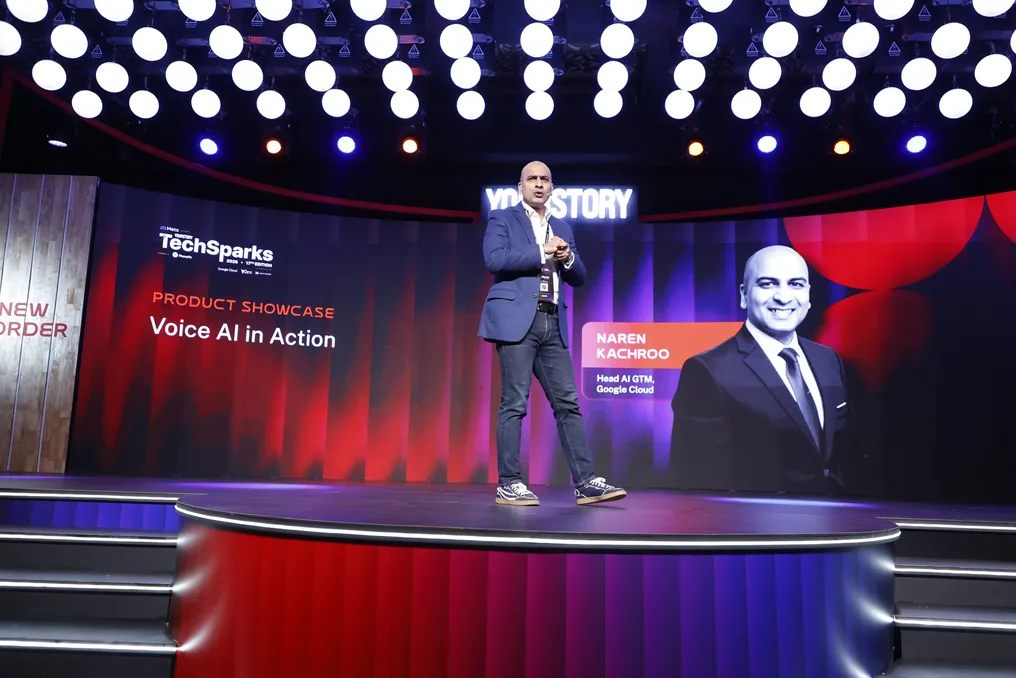
Naren Kachroo from Google Cloud presented the development of voice AI at the TechSparks 2026 conference
Read more
yourstory.com

Naren Kachroo from Google Cloud presented the development of voice AI at the TechSparks 2026 conference

Naren Kachroo, Head of Sales and GTM AI at Google Cloud, stated that the most valuable artificial intelligence is that which can completely fulfill the assigned task. He emphasized that value is created only when the task is truly completed using AI.

At the TechSparks 2026 event, during a product demonstration titled 'Voice AI in Action,' Kachroo showcased Google's latest voice models, customer use cases, and a live demo developed for small businesses. His main point was that voice is becoming the primary way people interact with AI, and this transition will happen in India using local languages and accents.

Kachroo noted that the industry has moved away from the concept of generative AI solely as a question-and-answer tool. He explained that the focus has shifted to AI that has access to data, tools, and capabilities allowing it to act on behalf of a person.

Google recently introduced Gemini 3.8 Live and Gemini 3.8 Live Extended Thinking. The Gemini 3.8 Live model can recognize and switch between 97 supported languages within a single conversation. Kachroo explained how enterprises can choose between these two models.

The Gemini 3.8 Live model is suitable for simpler tasks related to dialogue and agent functions, such as voice chat with basic tool calling. Meanwhile, Extended Thinking is designed for dialogues requiring deeper reasoning, context switching, and multi-step execution. He also mentioned that Extended Thinking costs more per token.

Both models are 'voice-to-voice' models, processing speech as both input and output within a single system. For developers who only require one part of this process, Google also offers separate models for text-to-speech, speech-to-text, and live translation.

Kachroo reported that the latest Gemini model for text-to-speech showed high results in internal Google tests using Indian languages, accents, and tonality. He conducted a series of short demonstrations to show the spectrum of possible use cases.

In the first example, the Shopify assistant, Sidekick, helped a seller step-by-step connect a domain through the Shopify admin panel. In the second example, a voice agent booked a table for eight people at a restaurant. During the call, the caller asked if cake was allowed, shared a photo from Google reviews to check if the dish was vegetarian, and requested information about other vegetarian options before confirming the reservation. This second scenario required the agent to track context across several turns of dialogue, remember preferences, and perform multiple tool calls, which, according to Kachroo, perfectly matches Extended Thinking.

He also demonstrated Live Avatar, which combines Gemini's live voice with real-time video generation and lip synchronization, allowing users to see an animated face instead of just hearing a voice. Google recently made Live Avatar available to businesses through Gemini Enterprise, watermarking the generated audio and video content with the invisible SynthID watermark. Citi served as a pilot client: its Citi Sky assistant, built using Google DeepMind's real-time avatar technology and the Gemini Live API, helps wealth management clients in the US make decisions, such as regarding certificate of deposit redemption.

Kachroo noted that Gemini 3.8 Live has the lowest cost per turn among comparable models, while Extended Thinking sets industry standards for speech-to-speech conversion quality. Google stated that Extended Thinking scored 82.6 on the Speech-to-Speech Quality Index from Artificial Analysis, the highest score.

He clarified that the low price is due to Google managing the entire stack itself—from TPU chips and infrastructure to the models and applications—passing on the resulting efficiency to customers. This allows Google to offer both a high-quality model and a more economical workhorse.

As examples of voice AI use cases, Kachroo cited two clients: Autotrader, which uses this technology for buying and selling used cars, and Equal AI, an Indian startup whose assistant answers and processes calls before the user picks up.

The central element of the session was a live demonstration of an assistant for micro, small, and medium-sized enterprises (MSMEs), which Kachroo's team developed in about a day. This is a large potential market: according to the MSME ministry, over 78 million enterprises are registered on the government's Udyam portal as of February 2026. Kachroo warned beforehand about one risk: he launched the demo via mobile hotspot after being unable to connect to the hotel network.

The demonstration involved a fictional protective gear manufacturing company and its owner, Rajesh, who had just received about 500 helmets. While interacting with the assistant, Rajesh asked how many potential clients he had for helmets. The assistant found two: a construction company in Mumbai needing 500 helmets, and a hardware store in Agra needing 50. Rajesh instructed the assistant to discard the smaller order, send a commercial proposal to the Mumbai buyer, and call him to close the deal. He set one condition: the price must remain above 400 rupees per helmet, and the assistant could place the order without further approval. The assistant then called the buyer and negotiated in Hindi. Kachroo noted that the assistant maintained context from the internal conversation with Rajesh during the external call, acted on behalf of the company, and closed the deal.

This end-to-end process, according to Kachroo, is the direction of voice AI development. He believes that with the 3.8 Live models, enterprises can now integrate voice agents into their processes that autonomously perform tasks. Kachroo added that this assistant could conduct the same conversation in Tamil, Telugu, Malayalam, Kannada, Marathi, and other languages. He stressed that this is important because the Indian consumer is increasingly leaning towards voice interaction. Gemini Live now supports over 25 Indian languages and dialects. According to the IAMAI-Kantar Internet in India 2024 report, 98% of India's 886 million active internet users consumed content in Indian languages, and one in five used voice commands to go online.

Tencent's Hyra 2.0 research agent independently creates tools for proteins, mathematical proofs, and chips
Read more
pandaily.com

Tencent's Hyra 2.0 research agent independently creates tools for proteins, mathematical proofs, and chips

Tencent Hunyuan has released Hyra 2.0, the second version of its autonomous research agent, which was presented on November 2nd. Unlike Hyra 1.0, which focused on solving individual tasks, such as resolving the sum versus difference exponent problem using the Hy3 model, the new version is designed to create reusable research tools. The results and corresponding code are available in the GitHub repository under the Apache 2.0 license.

Hyra 2.0 functions as a three-level system consisting of general, mission, and worker agents. These agents are coordinated through a common research board and a persistent task queue. A specialized worker agent verifies results, agents maintain multi-level memory, and a general knowledge base summarizes learned lessons into applicable skills.

Tools Created by the System

Tencent has introduced a range of tools developed by this system. Among them is HyInv—a protein reverse folding model with 1.96 million parameters. This model operates 57 times faster than ProteinMPNN, demonstrating better structural correspondence and capable of designing 128 sequences in just 50 milliseconds.

The HyPLM-Flash protein language model was also presented, possessing 650 million parameters and trained on 726 billion tokens. It proved to be the fastest among 12 compared models, ranking third on average across 35 tasks, processing about 130,000 residues per second on a single H20 processor.

The HyFF force field family, which includes five variants with parameters ranging from 2.3 million to 1.2 billion across 83 elements, sits on the Pareto front of accuracy and speed compared to 16 other models. Tencent claims that their Largo model shows the lowest energy error—0.364 meV per atom—and this complex was able to simulate a 60,000-atom aquaporin system over 100 nanoseconds.

Achievements in Mathematics and Quantum Computing

In the field of mathematics, the HyProver component achieved two results. It solved Petty's conjecture on equilateral sets in five-dimensional space, raising the maximum solved dimension from four. Regarding Yau's circle action hypothesis, the GitHub description presents a counterexample for the unbounded case—a closed seven-dimensional manifold that is not simply connected; meanwhile, the simply connected version remains an open problem.

In the area of quantum error correction, HyQEC discovered the code [[488,123,22]], which, according to Tencent, surpasses the previous leader by approximately 48% in the qLDPC metric.

Robotics and Chips

Furthermore, Hyra designed a simulated robotic arm mechanism that was 28.6% faster than the reference design. On the open XiangShan RISC-V processor, the agent increased the SPECint2006 score by 5.79% per gigahertz while increasing the area by only 0.3% and detecting ten errors. Tencent reports that Hyra is now being used to train subsequent Hy series models.

It is important to note that all presented results belong to Tencent and have not yet undergone independent review.

Popular