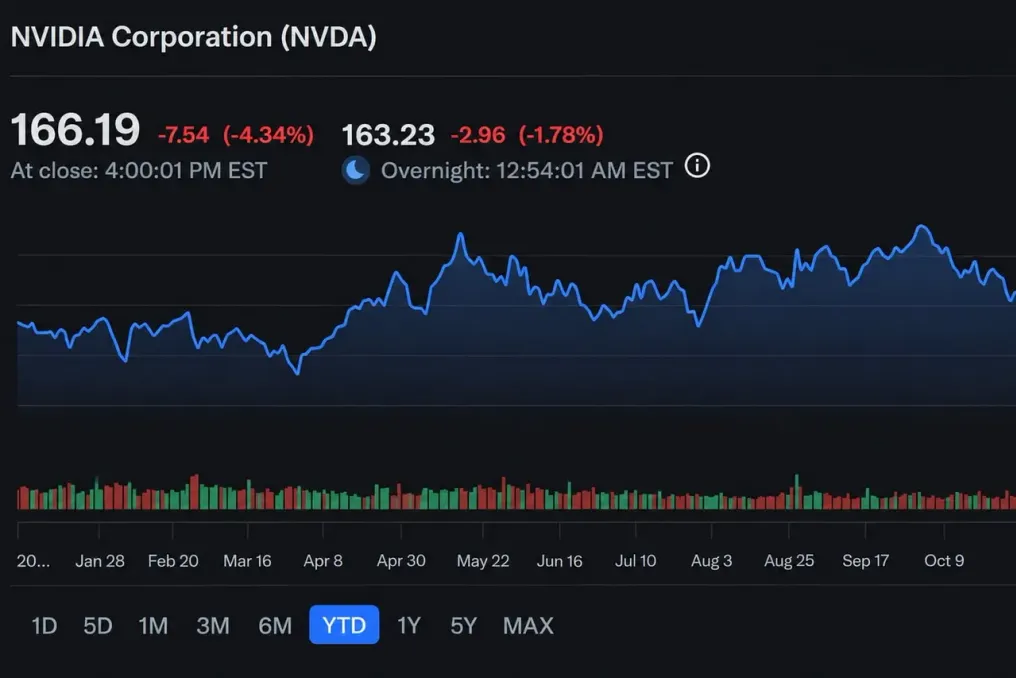
Jensen Huang's immediate resignation from Nvidia's leadership resulted in a drop of up to 12% in the company's shares at the opening of the American market on Thursday. This event also generated instability in the technology sector and pressured major Wall Street indices.
Around 10 am New York time, securities continued to decline, losing more than 6% after a partial recovery. The founder's departure occurs during a crucial period for the artificial intelligence (AI) industry, especially considering the expected IPO of Anthropic in the following week.
In the absence of a formal succession plan, Nvidia appointed its long-time chief financial officer to assume provisional leadership. This change followed a series of reports about Huang's personal life, which involved a relationship with a subordinate executive and an affair with Alice Huang, described as a supposed Chinese spy.
The executive himself confirmed on Sunday that he had been unfaithful to his wife. This admission came after the Financial Times published an article on Saturday about an alleged extramarital affair. A source cited by NBC News suggested that the woman involved could be a Chinese spy, although this allegation has not been confirmed as fact.
The repercussion of these news coincided with a sharp devaluation of Nvidia's shares. The company registered a loss of approximately US$ 830 billion (equivalent to about R$ 4.61 trillion) in market value, falling below US$ 4 trillion (R$ 22.2 trillion), a level not seen since 2025.
The company's importance in the sector was highlighted by Huang in a Bloomberg interview in October, when he stated: 'We are probably the only AI company in the world that works with all the AI companies in the world.'
The crisis also raised concerns about possible restrictions on the semiconductor sector. Huang, who was close to President Donald Trump, led a corporation whose activity is seen as essential for the advancement of artificial intelligence.
Prior to the executive's departure, JPMorgan analysts had already warned about the growing risk of more restrictive regulations for shipping chips to China, including indirect routes. The bank maintains the expectation that Nvidia's team will maintain its leading position in the segment but warned that operational failures could generate new problems.
Market pressure was intensified by Nebius' results. The cloud computing startup exceeded financial expectations, but its projections ultimately disappointed investors, causing its shares to fall almost 20%. Simultaneously, competitor CoreWeave retreated 10% after a strong rise recorded on Wednesday.
The performance of these two companies reflects apprehension about the costs of infrastructure necessary for AI development. Building data centers demands tens of billions of dollars, while uncertainty persists about when investments in systems, equipment, and processing capacity will begin to yield returns.
This scenario gains greater relevance with the expectation that Anthropic will conduct its Initial Public Offering (IPO) the following week, with the potential to exceed US$ 1 trillion (R$ 5.55 trillion).
On Thursday, the technology sector showed the worst performance among S&P 500 segments. The negative pressure also affected major indicators of the American market and its component suppliers.