The Indian motorcycle manufacturer TVS officially started its operations in Brazil this Thursday, the 12th, introducing four new models to the national market. These models include the NTorq 125, Raider 125, Apache RTR 160 4V, and Apache RTR 200 4V. Availability for purchase or rental is guaranteed through collaboration with the Brazilian company Mottu, which will also commercialize the Indian vehicles under its own brand. For those who opt for direct sales from TVS, they will need to wait until January.
Currently, vehicle acquisition can be done through the Conquiste Plan, which offers rental with a purchase option from Mottu under 48-month contracts and requires a deposit, or through cash payment. The already known Sport 110i remains available for purchase.
Return to Brazil and Sales Structure
TVS resumed its presence in Brazil by leveraging a long-standing partnership with Mottu, utilizing the dealership network already established by the brand in the country. The companies reported that the current infrastructure comprises over 500 points of sale and 168 units dedicated to service and support. Maintenance will be conducted by these workshops, which will have mechanics trained by the manufacturer and a local parts stock.
The Conquiste Plan does not require credit analysis or a guarantor, and it covers documentation and IPVA tax. It is contracted via an application, allowing immediate pickup of the motorcycle at the nearest branch. At the end of the 48 months, the customer has the option to purchase the vehicle according to the contractual terms. This model is similar to leasing, a common practice in the North American retail sector, and has been used by automobile manufacturers for some time.
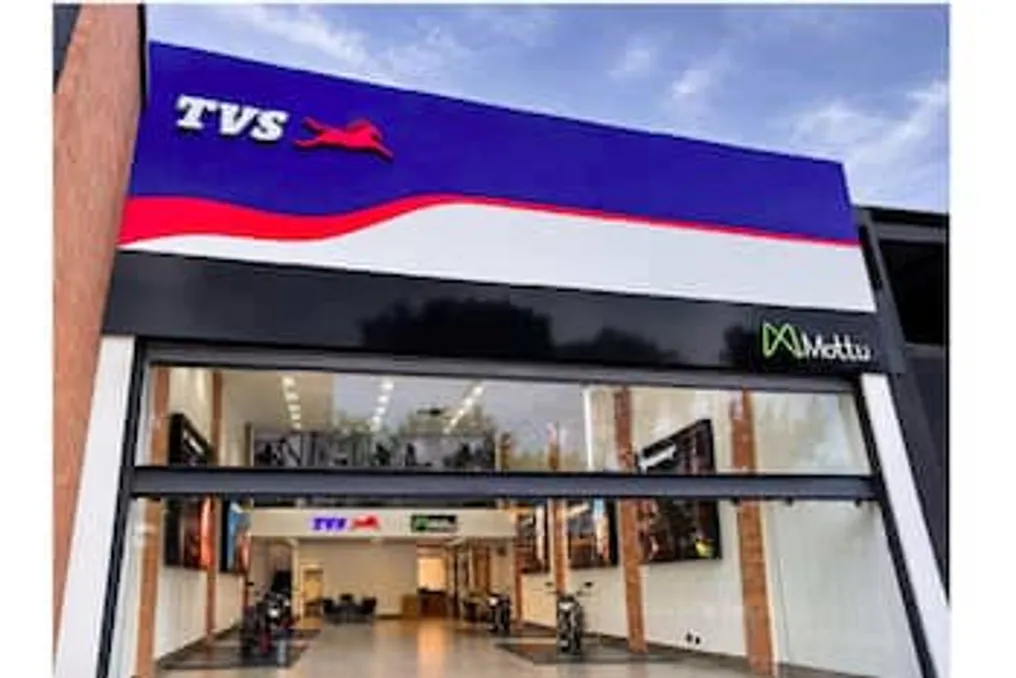
Direct sales, whether cash or installment payments up to 24 times on the card, are scheduled to begin in January 2027 at TVS-Mottu stores. Until that date, renting is the only way to obtain a new TVS. Despite this, the brand already has visibility in the country, having inaugurated its first concept store at Avenida dos Bandeirantes, 1747, in Vila Olímpia, São Paulo, which features a 149 m² showroom within a total area of approximately 250 m².
Technical Details of Launched Models
The NTorq 125, the most affordable model among the new releases, uses a 124.8 cm³ single-cylinder engine with three valves, air-cooled, and a CVT transmission. It generates 10.2 hp at 7,000 rpm and produces 1.11 kgf.m at 5,500 rpm, showing a fuel consumption of 40 km/l in the WMTC cycle. This scooter offers two riding modes, Street and Race, a digital dashboard with SmartXonnect connectivity (which mirrors phone data via Bluetooth), an LED headlight with DRL, and a 22-liter under-seat compartment with a USB port. Its braking system combines a 220 mm front disc and a 130 mm rear drum, with CBS, but lacks ABS. The wheels measure 12 inches.
The Raider 125 serves as the brand's entry point. Its 124.8 cm³ engine with electronic injection delivers 11.4 hp at 7,500 rpm and 1.2 kgfm at 6,000 rpm, equipped with a five-speed gearbox. In Eco mode, TVS records a fuel consumption of 51 km/l in the WMTC cycle. It has two riding modes, Eco and Power; in Eco mode, the start-stop system shuts off the engine at idle to optimize fuel. Other features include a digital dashboard with a trip computer, gear indicator, shift light, Full LED headlight with analog turn signals, a USB port near the dashboard, and a more comfortable split seat for the passenger. The rear suspension allows five levels of preload adjustment, and the wheels are 17-inch alloy wheels. The brakes consist of a 240 mm front disc and a 130 mm rear drum, with combined braking, but also without ABS.
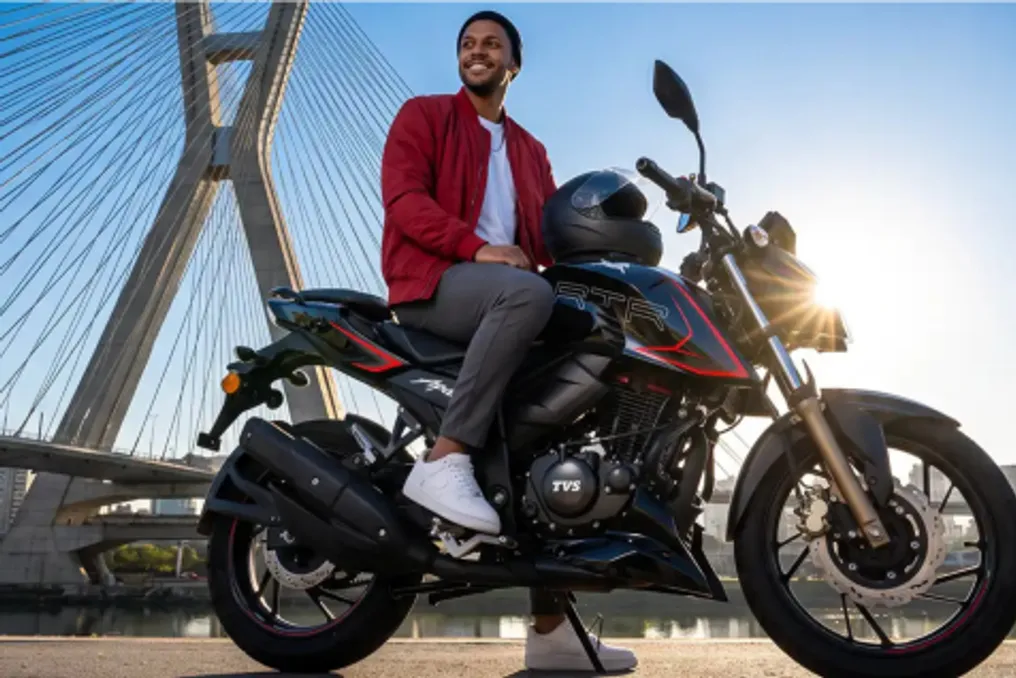
The first sport motorcycle uses a 159.7 cm³ four-valve engine, air-cooled and equipped with an oil radiator. It produces 17.6 hp at 9,250 rpm and 1.5 kgfm at 7,500 rpm, with a five-speed gearbox and a fuel consumption of 36 km/l in Urban mode (WMTC). This model features three riding modes—Sport, Urban, and Rain—with a top speed limited to 103 km/h in Urban and Rain modes. The brakes already have discs on both wheels (270 mm and 200 mm), with ABS active only on the front. The rear suspension is monoshock and offers seven preload adjustment positions. The package is complemented by LED lighting, a digital dashboard, and SmartXonnect connectivity.
At the top of the debut line, the Apache RTR 200 4V features a 197.8 cm³ four-valve engine, air-cooled and with an oil radiator, generating 20.8 hp at 9,000 rpm and 1.76 kgfm at 7,250 rpm. Its declared consumption is 37 km/l in Urban mode (WMTC). The five-speed gearbox incorporates a slipper clutch, which minimizes rear wheel lock-up during abrupt downshifts. The brakes are 270 mm front disc and 240 mm rear disc, and it is the only one of the four to have ABS on both wheels, offering the complete system. It also features three riding modes, adjustable levers in three positions, Full LED headlight, digital dashboard, and SmartXonnect.
The four models cover distinct price ranges, with a difference of R$ 5,700 between the cheapest and the most expensive. The NTorq 125 is the only automatic and meets daily urban needs, standing out with its 22-liter storage compartment. The Raider 125 targets the economy-focused consumer, presenting the lowest declared consumption, start-stop, and split seat, but without ABS, costing R$ 16,500. The Apache RTR 160 4V has a bolder design and delivers almost double the power of the Raider for an increase of R$ 2,400, although it only has ABS on the front wheel. Being larger, its comfort for the passenger is lower, making it ideal for deliveries and urban agility. Meanwhile, the Apache RTR 200 4V is the most complete in the group, being the only one with ABS on both wheels and a slipper clutch, justifying the R$ 2,000 difference compared to the 160, positioning it as a safer option for travel and leisure.
The manufacturer also announced that the Apache motorcycles will come with a dedicated USB port for the Brazilian market.
History and Future Expansion
TVS is not new to Brazil; the brand was present in the market between 2010 and 2024, operating through a partnership with Dafra, during which over 40,000 motorcycles were sold. Now, after years with Mottu, TVS has decided to establish a permanent presence, planning to set up its own production line in the Manaus Industrial Pole (AM).
Martín Corsunsky, Vice President and Head of Business for TVS Motor Company for Latin America, confirmed domestic production in Manaus. The factory is projected to reach about 110,000 units by the end of 2026 and anticipates reaching 130,000 annual motorcycles by 2027. Operations will begin in several cities in 2026, including Belo Horizonte, Brasília, Campo Grande, Cuiabá, Curitiba, Fortaleza, Goiânia, Manaus, and São Paulo. In the first quarter of 2027, Belém, João Pessoa, Maceió, Porto Alegre, Recife, Salvador, São Luís, and Teresina will join, and the remaining capitals should receive the commercial structure throughout the year.
This expansion will be carried out in collaboration with Mottu, involving the modernization of existing units and the progressive opening of exclusive dealerships, with three planned for 2027, initially focusing on the Southeast and Central-West regions.