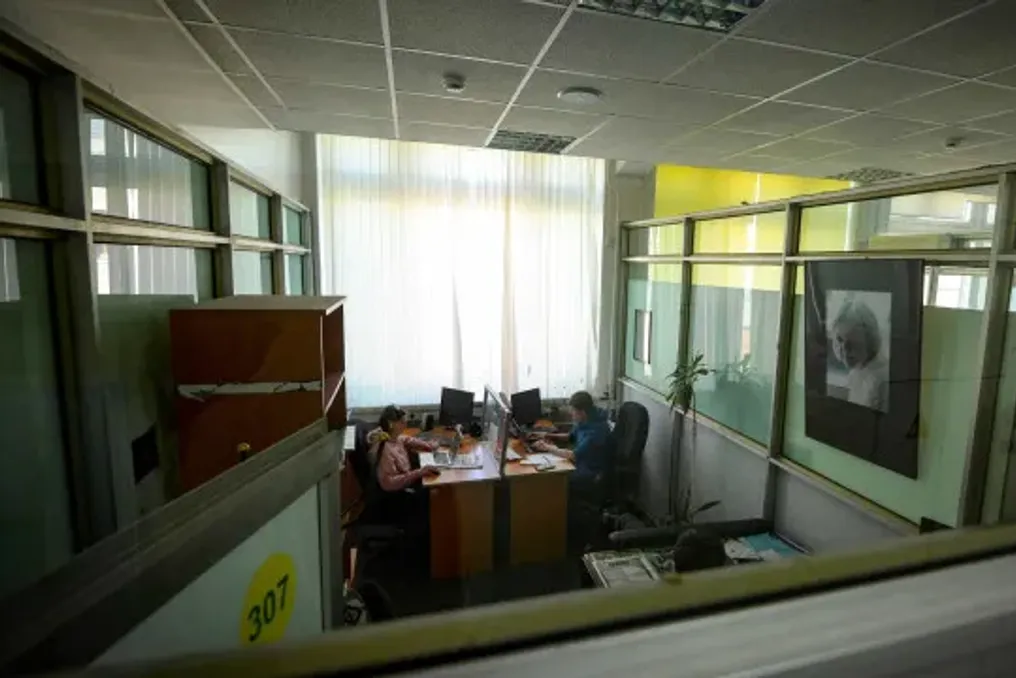
The independent Russian newspaper Novaya Gazeta has officially ceased operations, holding its final editorial meeting and vacating its premises after the closure was announced last month, which occurred under pressure from the Kremlin.
As shown in images published by the Russian media Ostorozhno Novosti, the newspaper's director Sergey Sokolov was seen removing portraits of journalists who died in the line of duty from the wall, including Anna Politkovskaya.
Dmitry Muratov, one of the newspaper's founders and a Nobel Peace Prize laureate in 2021, was also present during the collection and organization of the last documents, according to an AFP photographer.
Editorial members then went outside, holding copies of the newspaper. A sign reading 'Novaya Gazeta lived here' was placed on the exterior wall of the building.
In a joint statement, the United Kingdom and Finland, which jointly lead the Coalition for a Free Press—a network comprising about 50 member states—called on Russia to cease repression against independent media.
These two countries, co-chairs of the Coalition for a Free Media, emphasized that 'the closure of the newspaper is a sad sign of the ongoing pressure on independent journalism in Russia.'
London and Helsinki also accused the Russian authorities of further using repressive legislation to restrict press freedom, amid journalists facing arrests, persecution, and political imprisonment.
Expressing solidarity with journalists working both in Russia and in exile despite these conditions, both countries demanded 'the immediate and unconditional release of all political prisoners, including all illegally detained journalists.'
The Coalition for a Free Press, established in 2019, has 51 member countries, including Portugal.
Novaya Gazeta, founded in 1993 with the support of the last Soviet leader Mikhail Gorbachev, covered many sensitive topics, such as crimes of the Russian army, elite corruption, the Wagner Group, and persecution of homosexuals in Chechnya.
The newspaper paid a high price for this commitment: six of its journalists or staff members died, including Anna Politkovskaya, who documented war crimes in Chechnya and was killed in Moscow in 2006.
Dmitry Muratov, the former director of the newspaper, told AFP at the end of October that the closure is part of a 'giant military campaign' being conducted by the Kremlin since the full-scale Russian invasion of Ukraine.
Since 2022, Novaya Gazeta has lost its publication license, while many journalists and editors have faced pressure, arrests, and searches.
In September, the publication was also classified as a 'foreign agent'—a designation used by Russian authorities to suppress dissent.
In response to questions about the closure of Novaya Gazeta on Tuesday, Kremlin spokesman Dmitry Peskov called it a 'normal cycle of change,' stating: 'It would be a mistake to say that the era of Russian independent media is coming to an end. Russian media is very diverse and develops in a highly competitive environment.'