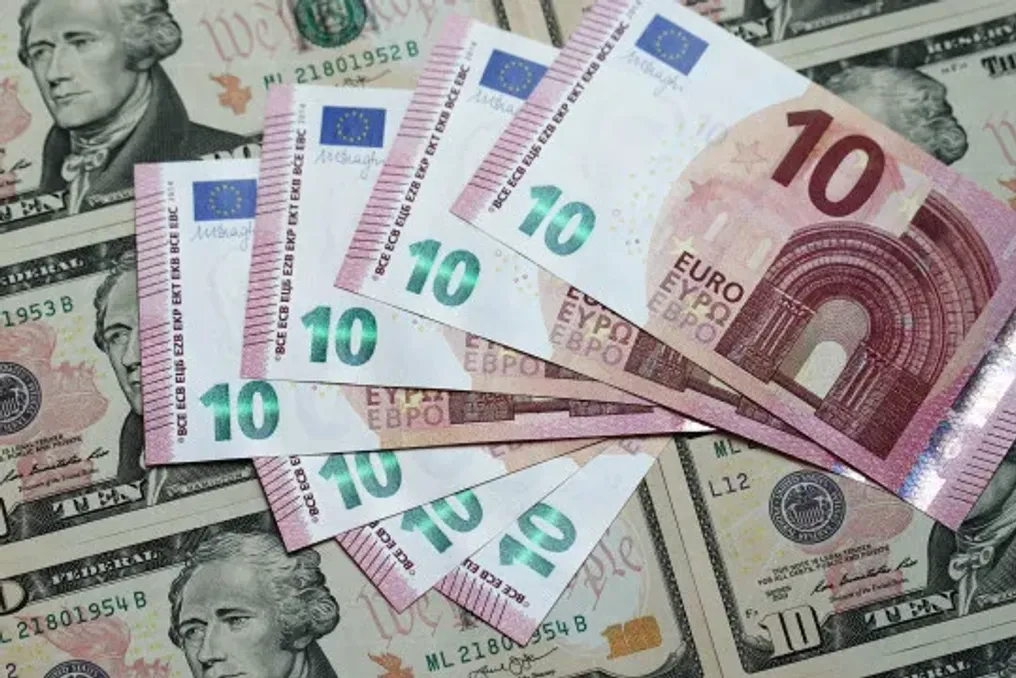
The euro registered a fall against the dollar for the third consecutive session. This movement occurred on the same day that the President of Russia maintained his firm position regarding the necessary demands to end the conflict in Ukraine.
At 6:00 PM Lisbon time, the euro was trading at $1.1047, compared to $1.1093 recorded at the same time last Wednesday. Furthermore, the euro also showed depreciation against the British pound and the Japanese yen.
The European Central Bank (ECB) set the euro's reference exchange rate at $1.1081. During the current session, the European currency fluctuated within the range of $1.1053 to $1.1102.
The President of Russia remained inflexible in his demands to finalize the war in Ukraine during a meeting held in Moscow. He met with envoys from his American counterpart, Steve Witkoff and Jared Kushner.
Vladimir Putin met with representatives of Donald Trump for more than two hours. This meeting took place after negotiations held in Abu Dhabi on Tuesday and Wednesday.
Moscow is promoting conversations focused on European security, using the model of the 'Yalta and Potsdam' conferences, which took place in 1945 between the Soviet Union and Western powers regarding the division of post-war Europe.
Kyiv and its European partners oppose any reallocation of spheres of influence between the United States, Russia, and China. Their main objective in the negotiations is to bring an end to the war that has lasted almost five years.
Zelensky had stated on Wednesday, upon arriving in Dublin, that there could be a 'window of opportunity' for a ceasefire before 2027. However, Putin reinforced to the American envoys the conditions imposed by Russia regarding the territories it claims to annex, as reported by the French agency AFP.
He also emphasized that any movement of foreign troops in Ukraine would be interpreted as a 'continuation of the war.' Currently, Russia controls just over 19% of Ukrainian territory and seeks to annex four Ukrainian regions it does not fully control since 2022: Luhansk, Donetsk, Zaporizhzhia, and Kherson, which has been rejected by Kyiv and the international community.
Putin classified the possibility of mobilizing external forces in Ukraine as 'absolutely unacceptable,' a measure requested by Kyiv as a security guarantee against the resumption of the conflict. The Russian offensive in Ukraine, launched in February 2022, caused great destruction in the country and resulted in hundreds of thousands of deaths on both sides, constituting the bloodiest confrontation in Europe since World War II (1939-1945).