The year 1989 was a significant milestone for the Brazilian automotive industry, as it introduced an entirely new vehicle to the national market, unlike mere derivatives of existing sedans, vans, or pickups.
The Chevrolet Kadett emerged as a phenomenon comparable to the Fiat Uno, launched in 1984. Its modern and unusual design generated both surprise and great appreciation. The sporty GS version, packed with comfort and technology features such as a trip computer and rear suspension leveling, was quite impressive. Its superior finish and aesthetics made the Gol, its main competitor, seem like an outdated and inferior vehicle in terms of comfort and overall appearance.
However, the Kadett was not the only highlight of 1989; a blue Gol attracted a lot of attention, competing on equal footing. This Volkswagen compact, designed to have the performance of a mid-sized car, received a two-liter engine, identical to the one used in the brand's larger family car.
The expectation for high performance was immense, but the vehicle actually delivered satisfactory results. Although it did not repeat the extreme accelerations announced by the manufacturer, its performance was robust enough to surpass all other national cars, including the Kadett GS.
Nevertheless, the Gol GTi transcended the mere enhanced look of the Gol GTS and the more powerful engine. By initiating the era of electronic injection in Brazil, the Gol GTi fundamentally changed the prevailing driving rules. The carburetor, which required meticulous maintenance and was frequently mentioned by drivers, gave way to the more efficient and simplified control of electronic injection as the technology matured.
The Gol GTi inaugurated a new phase of modern driving, whose benefits are evident today, in 2026, with the ease of starting the car and driving without failures or sputtering. After this innovation, Fiat introduced the multi-valve cylinder head and the turbo, and the rest of the industry continued to evolve, adapting to the pioneering innovations in the market, already influenced by advanced imported car technologies.
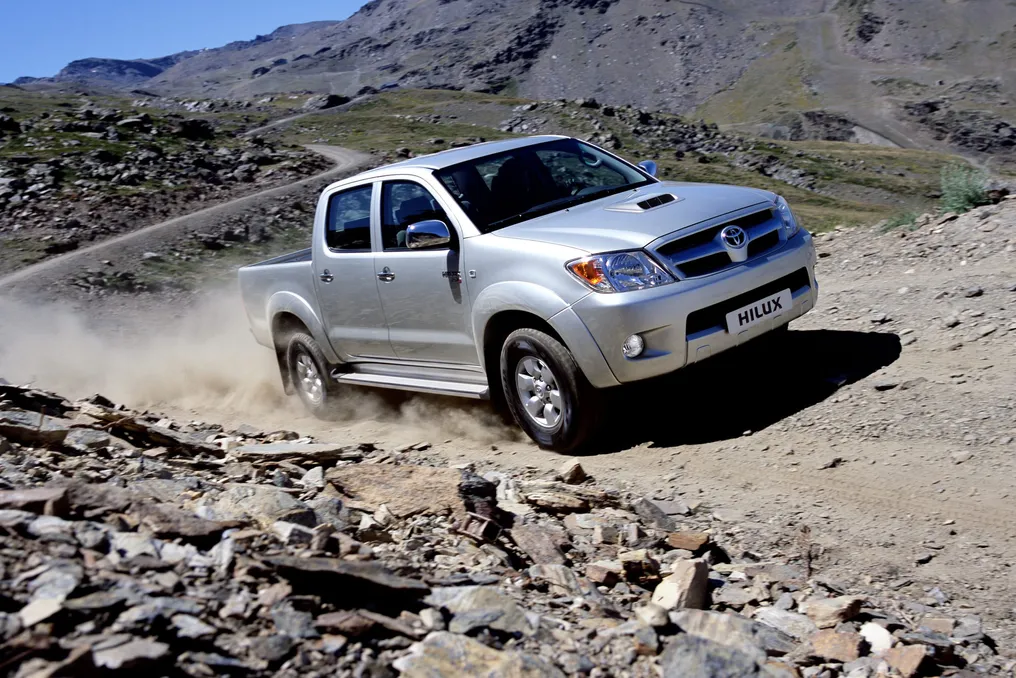
Although this history is known, it is relevant to revisit the fundamentals before analyzing another electronic era, although generally less impactful, but crucial for a specific niche: mid-size pickups. In this segment, there was an equivalent to the 'Gol GTi', a vehicle intended to redefine the standards of its category and guide the evolution of subsequent mid-size pickups. As suggested in the title, this truck is the 2005 Toyota Hilux.
Mid-size trucks in 2005 and the Hilux
Legislation is probably one of the most important transforming factors in the automotive industry. Naturally, all manufacturers seek to create more beautiful, better, more powerful, and more profitable products, as a well-received car generates abundant revenue. However, this success must comply with legal requirements, especially environmental ones.
It is unnecessary to judge whether such measures are positive or negative, or whether they stem from sincere concerns or less noble interests, given that the nature of these regulations is complex, involving economic aspects. However, it is necessary to consider the scenario if the world had followed the path of the 70s, without restrictions on pollutant emissions.
Returning to the topic, the environmental requirements of Proconve L4 forced pickups that emitted large volumes of black smoke to change. Mechanical injection via injection pump was gradually replaced by electronic management and the Common Rail direct injection system.
The 'rail' system is named so because it resembles the shape of a musical instrument, due to the tube that receives diesel from a high-pressure pump. The pressurized fuel is distributed to the injectors through this tube, with the electronics controlling the timing, duration, and amount of diesel for each nozzle. Furthermore, the system allows for pre-injections and post-injections in the same engine cycle, with the former being responsible for smoothing combustion and reducing noise. The finer atomization of diesel aids in reducing smoke and pollutants, classifying the engine as a 'clean' diesel and compliant with the new, stricter environmental standards.
The manufacturer that first introduced this technology and made a good impression would gain an early advantage with the pickup public. It became clear that the era of electronic pickups was inevitable, generating fierce competition among the first to adopt the new technology.
The first pickup in this new group with common rail electronic injection, displaying the 'Electronic' badge on the tailgate, was the Ford Ranger, launched in February 2005. Externally, nothing indicated the new heart besides the mentioned stickers and the '3.0' signaling the new displacement. The Power Stroke 3.0 Electronic replaced the old mechanical Maxion/International HS 2.8, which was a popular model among enthusiasts of the time, as it surpassed the MWM of the S10 and Nissan Frontier by 3 hp, a highly praised engine, despite having a certain delay in power delivery before 1,800 rpm.
The difference of 3 hp between engines of similar displacement may seem insignificant, but the sector was experiencing intense commercial dispute, where any advantage was amplified by brand marketing. The 135 hp of the Maxion engine were raised to 163 hp in the 3-liter MWM International. It is important to note that the Power Stroke differs from the Sprint in architecture, number of valves, and injection systems.
With 163 hp, the Ranger received a major benefit: the engine was larger and significantly more powerful than those of its competitors. The increase in torque, smooth operation, and efficiency provided by the electronics elevated the utility vehicle to a new level.
To illustrate the quality of this new Ranger, the author reports participating in the Mercosur Rally in 2005, invited by Quatro Rodas magazine. Ford provided three Rangers for the event: two electronic ones, a novelty, and one 2.8-liter mechanical one. Witnessing the performance of the electronic Ranger with experienced Rally Paris-Dakar pilots, he could confirm its strength on the roads.
The pickup easily overtook traffic, maintained acceleration on inclines even when loaded, and exhibited high speed on any surface, whether dirt or asphalt. On a long descent on a dirt road, the speedometer registered 190 km/h (probably more than 170 km/h actual), and the driver enjoyed the high-speed driving. During the most difficult dirt sections, the 2.8 Ranger was preferred for offering more constant torque. He observed that the electronics behaved more like a car than a rustic truck, being quieter and delivering power at higher revolutions.
In a direct comparison, on flat terrain near Buenos Aires, a double-cab S10 2.8 reached about 180 km/h on the dashboard (just over 160 km/h on GPS), a good result for a diesel utility vehicle from over twenty years ago, but considerably inferior to the performance of the new Ranger.
Calling it a 'new Ranger' might be an exaggeration, as externally it maintained the traditional mid-size pickup design, and the cabin preserved the basic dimensions of the model introduced in the country in the 90s. The interior was simple and dated. However, since competitors also did not offer more space, these limitations were little noticed, and the Ranger, thanks to its mechanical improvement, became the desire of most Brazilian pickup owners.
This dominance, however, was brief. Less than a month later, the seventh-generation Toyota Hilux was launched, a completely new model in terms of external design, internal space, and overall behavior compared to existing mid-size pickups.
Its engine was unprecedented and, naturally, already electronic. The 3.0-liter D-4D had the same displacement and power as its main rival's engine: 163 hp. The torque was 35 kgfm, slightly below the Ford's 38.7 kgfm, which was the only disadvantage of the Hilux. In all other aspects, it was a technological leap: the design was aligned with the expectations of the new millennium, leaving the 90s behind. The interior silence, the rear seat space, and the dynamic behavior (which at the time was superior to all) recalled a large luxury sedan. The rear doors of the 2005 Hilux demonstrate this advantage, with wide and smooth panels and generously sized windows in height and width, highlighting the superior space and comfort for the driver and passenger.
Besides the modern aesthetics, a differential of the Hilux was the availability of an automatic transmission in the top-of-the-line SRV version. Although Mitsubishi already offered this option in the L200 Sport since 2003, Toyota improved the experience with a peculiar gear selector, similar to that of Mercedes-Benz, with a serrated path and positions defined on side steps. With a little adaptation, the driver perceived the gear or function just by touch, without needing to look at the lever or dashboard. This represented a big difference compared to the long and firmly engaging, but somewhat rough, levers of other manual pickups, offering car comfort in urban traffic.
It is no wonder that the advertising slogan was 'Total Revolution', and this phrase was not an exaggeration. Behind the wheel, the pickup charmed with its excellent ergonomics and updated dashboard; the engine was exceptional, with the soft whistle of the turbo being the predominant sound of the four-cylinder engine.
}, {