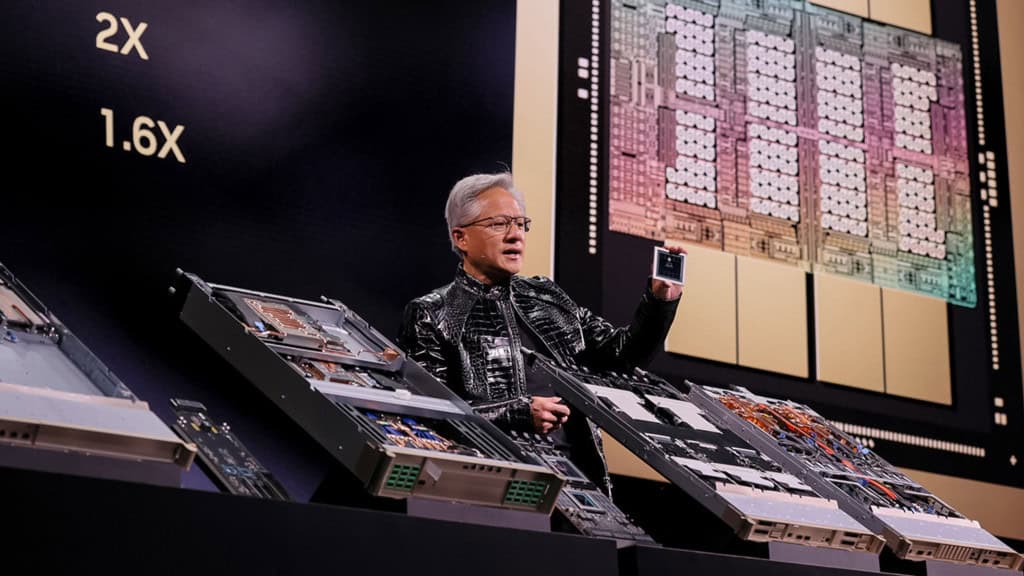
Jensen Huang's departure from Nvidia's leadership introduces a period of uncertainty that goes beyond a simple succession at the chip manufacturer. This change directly affects the maintenance of commercial and financial connections essential to sustaining the expansion of artificial intelligence, given that the executive played a crucial role in organizing investments among companies in the sector.
This move occurs at a critical time, where semiconductor suppliers, cloud service providers, and AI developers rely on large financial injections to increase the infrastructure needed both to train and operate AI models.
Nvidia's relevance in the market extends beyond the mere commercialization of processors; the company integrates a vast ecosystem of agreements and investments with corporations that require computational power to create artificial intelligence solutions. In this scenario, AI laboratories and cloud providers depend on infrastructure equipped with the manufacturer's chips, making commercial commitments and investments fundamental to enabling new facilities.
Huang was directly responsible for building these relationships. His work encompassed not only defining Nvidia's technological strategy but also coordinating with clients and partners who drive demand for its products. Thus, the executive's departure raises doubts about the company's ability to maintain this pace of coordination.
The challenge does not lie solely in developing the next chips, as Nvidia has technical teams and a product roadmap that do not depend exclusively on its founder. The real question is how the company will manage to preserve the network of agreements, investments, and operations that links the various actors in the AI market.
One aspect of great attention is the concept of circular financing. This model involves situations where companies that provide technology or infrastructure also invest in their customers or offer guarantees that aid in financing the acquisition of their own goods and services. This dynamic can accelerate the construction of data centers and expand computational capacity while establishing financial ties between interdependent entities to achieve their growth objectives. However, if there are revisions to commitments or delays in new investments, the impacts could propagate throughout the entire production chain.
Agreements and announcements involving companies such as OpenAI, CoreWeave, and Anthropic demonstrate the magnitude of resources mobilized to expand AI infrastructure. The continuity of these projects is tied to available funding, equipment availability, and confidence in future demand.
Although Huang's resignation does not imply the cancellation of these commitments, it adds a new variable to investor analysis: who will take over the role of articulating business in a sector where one company's investment decisions can shape the plans of many others?
The initial reaction of the stock market reflected investor apprehension. Nvidia's shares fell by more than 12% in early trading on Thursday (12), a move that could subtract about US$ 500 billion (approximately R$ 2.78 trillion) from its market value. In contrast, AMD and Broadcom showed increases of 2% and 5%, respectively.
Colette Kress, the CFO, will assume provisional management while the company evaluates potential replacements, both internal and external, for the definitive leadership. Nvidia will also need to prove its ability to safeguard its commercial strategy and the relationships established by Huang.
Recent financial results provide a solid operational base, with the company reporting US$ 96.2 billion (about R$ 533.9 billion) in revenue last quarter. Nevertheless, upcoming results, scheduled for November 17, will be monitored not only for sales figures but also for indicators related to demand, deliveries, and new investments.
Therefore, the success of the transition will be measured by Nvidia's ability to maintain its position within the AI infrastructure chain. More than simply finding a new CEO, the company must demonstrate that the business ecosystem built under Huang's management can continue without depending on his direct presence.