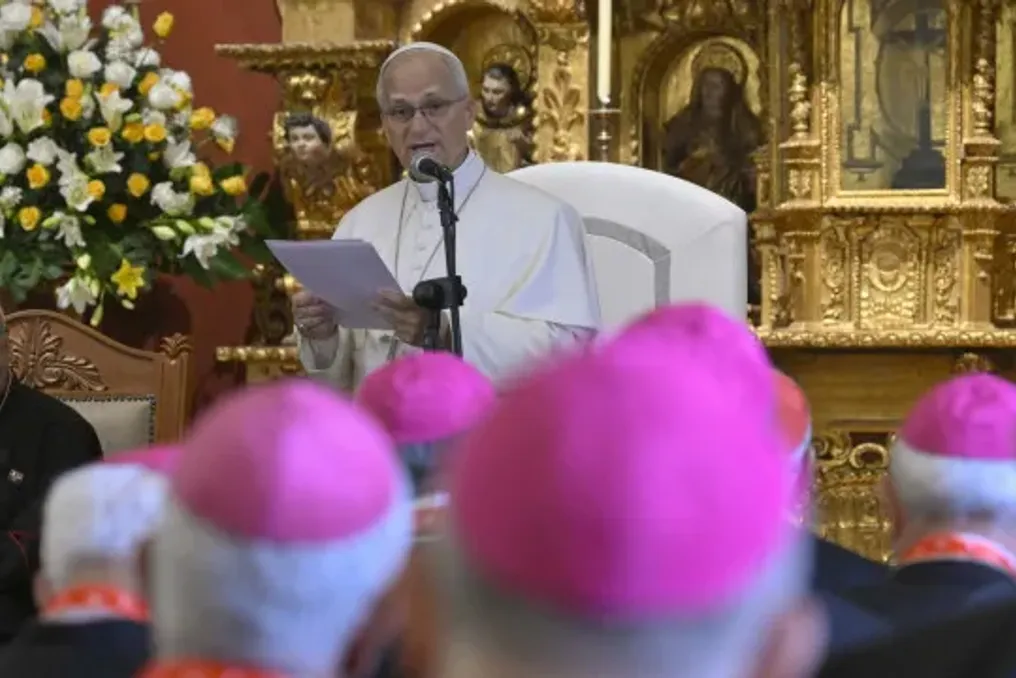
The Pope requested that Peruvian bishops address abuse cases with principles of truth, justice, forgiveness, reparation, and a growing commitment to promoting a culture of prevention and protection for the most vulnerable against these crimes.
During a speech delivered in the chapel of the Archbishop's Palace of Lima, on the second day of his stay in Peru, Leo XIV referenced Peruvian saints, such as Saint Martin de Porres and Saint John Macías. He used these examples to emphasize the importance of recognizing Christ in the humblest individuals.
The Pope stressed that through these saints, it is possible to learn that charity begins with simple gestures and attentive listening, remembering that the value of any person should not be measured by their prestige, origin, or social position.
He dedicated part of his speech to the issue of abuses perpetrated by members of the clergy or within the ecclesiastical environment, describing it as a reality that generated great suffering. This was the first time during his trip to South America that he mentioned such offenses.
Leo XIV argued that the response to this situation must mirror the conduct of Jesus, demanding truth, justice, forgiveness, reparation, and a continuous effort to create a protective culture for the weakest against these acts. To illustrate this mission, he compared it to the arduous 'Inca Trail,' an ancient route that traverses the Andean region.
The Peruvian Church has not yet released detailed reports on the scope of child sexual abuse cases within its ranks, which prevents knowledge of precise numbers, even after years of scandals that shook the institution.
One high-profile case was that of the Sodalicio de Vida Cristã, an ultra-conservative Catholic organization based in Peru. This entity was dissolved by Pope Francis in January 2025, following investigations related to sexual, physical, psychological, and financial abuses.
Leo XIV plans to hold a meeting in Lima with abuse victims, similar to what he did in Argentina, which may take place on the day of the visit. However, there is no information about who will participate or who selected these people, according to clarification from the Italian Episcopal Conference.
In contrast, a database provided by the North American organization Bishop Accountability indicates that in recent decades, at least 77 priests, religious, and consecrated laypeople of the Peruvian Catholic Church have been publicly accused of alleged sexual abuse against minors.
The Vatican commissioner responsible for investigating and liquidating this former Sodalicio, as well as other associated entities, reported that there are over 100 abuse complaints committed in the Sodalicio, aiming to compensate the victims.
As of April 2025, the Sodalicio de Vida Cristã reported compensating 98 instances of abuse, totaling approximately 6.5 million dollars. Of these, 37 were sexual abuses—20 involving adults and 17 minors aged 11 to 17—while the other 61 cases involved physical or psychological aggression, abuse of authority, or serious violation of the internal code of conduct.
At the Lima cathedral, when addressing the challenges facing Peru, the Pope also condemned the persistence of a 'machista mentality' and violence against women in society. Leo XIV lamented the continuation of a machista mentality manifested in paternal absence in the family, in abuse, and in violence directed at women.
The leader of the Catholic Church, who recently underwent surgery to remove a pulmonary nodule diagnosed as cancer, arrived in Peru on Wednesday. He is carrying out the final stage of an intense 12-day journey through South America, which has already included stops in Uruguay and Argentina.
During his six-day visit to the country, the Pope will visit Chiclayo in the north before proceeding to Cusco in the Andean region and Pucallpa in the Amazon, where he will meet with representatives of indigenous communities.