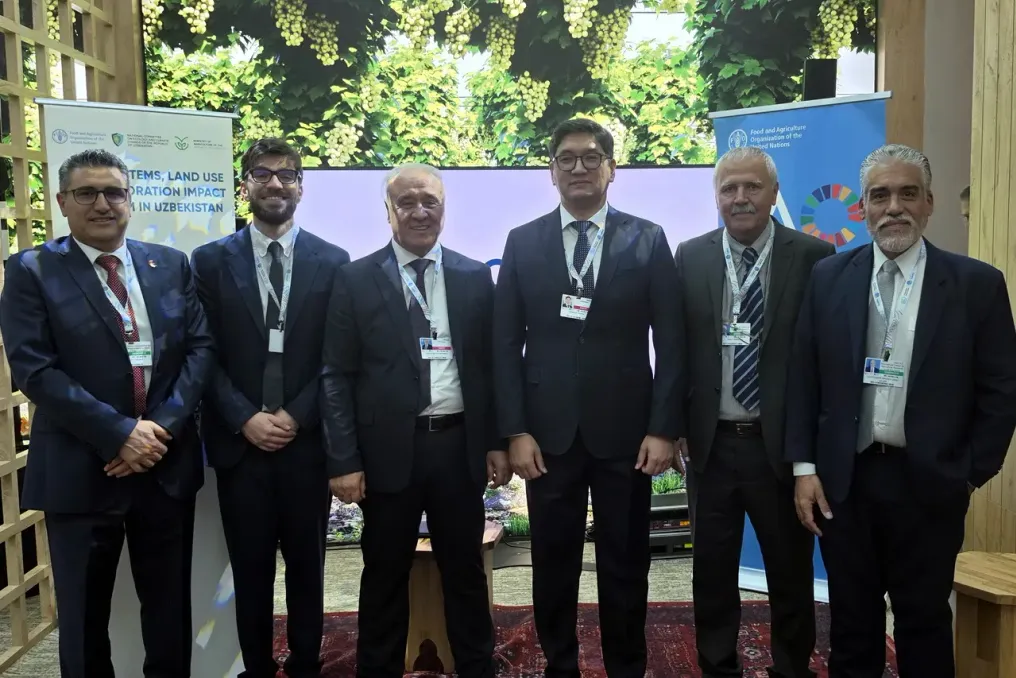
The Food and Agriculture Organization of the United Nations (FAO) demonstrated Uzbekistan's experience in climate-resilient agriculture, water resource management, and the reclamation of degraded lands at the 31st United Nations Climate Change Conference (COP31).
The results were presented at two parallel events in the Uzbekistan Pavilion, with a special focus on the FOLUR Uzbekistan project, which aims to promote sustainable farming methods and enhance the capacity of farms to adapt to water scarcity and climate change.
Both sessions were opened and moderated by Sherzod Umarov, Assistant Representative of FAO in Uzbekistan. He emphasized the importance of international cooperation and knowledge exchange for implementing effective agro-technologies that suit regional conditions.
The first session presented achievements related to the implementation of soil conservation technologies and sustainable land use practices. Aziz Nurbekov, National Coordinator of the project, reported that the initiative provided direct support to 320 beneficiaries. The activities included the application of zero tillage, crop diversification, and water-saving technologies.
Sherzod Nizamov, head of the FOLUR Uzbekistan project team, noted that the area cultivated using soil conservation methods has increased from the initial 60 hectares of demonstration plots in six districts to approximately 4,940 hectares.
Field studies also showed improved water infiltration when using new methods. The infiltration rate with zero tillage reached 27 mm per hour, compared to 16 mm per hour with traditional farming.
The second session was dedicated to practical solutions for water shortage and land restoration. One example was a pilot project to create an artificial ice reservoir, known as Ice Stupa, in the village of Sarchashma, Shahrisabz district, Kashkadarya region. Over a period of about 20 days, this structure accumulated about 800 cubic meters of water in the form of ice. The collected water provided an additional supply for about 60 households during periods of water scarcity.
Another initiative concerned land restoration in the Oksov district, Kamashi district. Approximately 16,000 seedlings were planted over an area of 90 hectares, with a survival rate of approximately 80%.
Monitoring demonstration plots using rainwater harvesting systems showed that different engineering solutions yield varying results. On stone terraces, the survival rate of almond seedlings and shrubs reached 88%, while on semi-circular catchment bunds, the survival rate of some plant species reached 95%.
Participants also discussed ways to improve the efficiency of the dairy sector and expand access for small producers to markets. Behruz Shukurov, an expert on the dairy value chain, presented the results of a survey of 105 households across three districts. The study identified issues related to milk collection, cooling, and transportation.
In Yangibazar district, all 35 surveyed households stated their willingness to participate in a specialized collection center or milk cooperative, provided the necessary infrastructure is established.
The results presented at COP31 highlighted practical opportunities for implementing climate-resilient agricultural methods in Uzbekistan. The FOLUR project demonstrates how combining soil conservation techniques, more efficient water resource management, and land restoration can contribute to increasing the resilience of rural communities to the effects of climate change. The FOLUR Uzbekistan project is funded by the Global Environment Facility (GEF) and implemented by the National Committee of Uzbekistan on Ecology and Climate Change, the Ministry of Agriculture, and FAO.