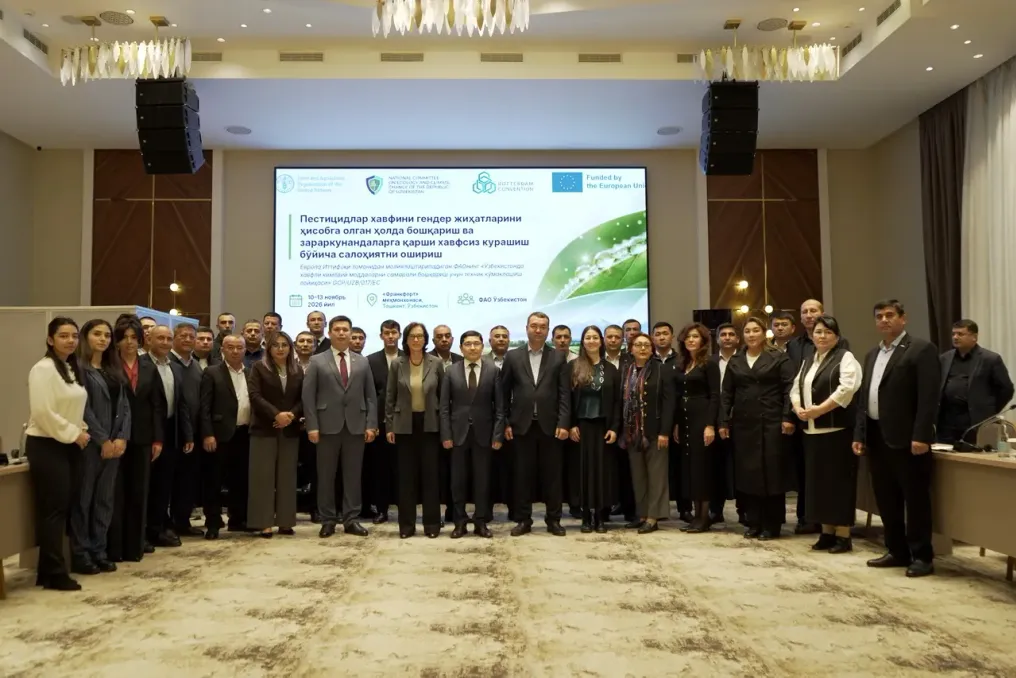
FAO (Food and Agriculture Organization of the United Nations) is organizing a four-day training program in Tashkent from November 10 to 13 to enhance the safety of pesticide use in Uzbekistan, with a focus on gender risks.
The program is conducted jointly with the Secretariat of the Rotterdam Convention and gathers about 45 representatives from state bodies, scientific and educational institutions, agricultural consulting services, and the private sector. This initiative is supported by a project funded by the European Union.
The training addresses the differences in how men and women in agriculture are exposed to pesticides, as well as their access to information, protective equipment, and advisory services.
According to FAO's National Gender Profile of Agriculture for 2025, women constitute over 43% of the agricultural workforce in Uzbekistan, while men control over 93% of agricultural land. Furthermore, it is estimated that men receive advisory services in this field twice as often as women.
These data indicate inequality not only in access to resources but also to professional knowledge. As a result, some women directly engaged in agriculture may not receive information on safe chemical handling through standard channels.
Pesticide exposure is not limited to people applying chemicals; risks also exist for workers entering treated fields and family members dealing with potentially contaminated work clothes.
An FAO study covering Azerbaijan, Kyrgyzstan, Tajikistan, and Turkey showed that decisions on pesticide use are predominantly made by men, while women and children are also exposed to these substances. The shortage of personal protective equipment remains a common problem for both men and women.
Therefore, the training covers not only the technical requirements for pesticide application but also working conditions, task distribution, and access to safety information among different groups in rural communities.
The program in Tashkent combines discussions on the gender aspects of pesticide management with practical tools that can be applied when working with farming communities. Participants study FAO's approach to gender-sensitive pesticide risk management, the results of biopesticide trials, and the role of Farmer Schools in promoting integrated pest management.
Other topics include safer alternatives to hazardous pesticides, personal protective equipment, and policies for protecting the health of agricultural workers. The practical part includes FAO's role-playing game called 'Acting Against Risks.' This tool helps rural communities identify potential pesticide hazards, assess differences in vulnerability between men and women, and collaboratively develop possible solutions.
After group sessions, participants will go to the Pakhtakor district in the Jizzakh region to apply their knowledge while working with local farmers. This field exercise aims to test the approach in real conditions and identify obstacles to its implementation at the community level.
Following the practical work, participants are expected to discuss how this approach can be integrated into agricultural consulting services, farmer training programs, Farmer Schools, and university education.
The training aligns with the Gender Strategy of the Ministry of Agriculture of Uzbekistan for the period 2025–2030, developed with technical support from FAO. This initiative comes amid the modernization of Uzbekistan's agricultural sector, where efforts to increase productivity are accompanied by improving working conditions, expanding professional opportunities for rural communities, and reducing environmental harm.
Integrating gender aspects into pesticide management expands the scope of environmental safety measures. The goal is not only to reduce potential soil and water contamination but also to prevent health risks for people directly or indirectly involved in agricultural production.
FAO headquarters representatives, Nadia Coriale and Flavio Grassi, who are conducting the training, stated that men and women face pesticide-related risks to different degrees. They emphasized that reducing these risks requires ensuring that everyone working in agriculture has access to appropriate information, training, and services.
The initiative is supported by the FAO project 'Technical Assistance for Proper Management of Hazardous Chemicals,' funded by the European Union. The project has a budget of 3.9 million euros and aims to reduce environmental degradation in Uzbekistan by improving pesticide management, strengthening chemical regulation, and promoting sustainable agricultural practices.
One of the expected outcomes of the training is the formation of a group of specialists capable of independently conducting pesticide safety seminars for farmers and rural communities. Participants' recommendations will also be taken into account when determining priority measures for the National Action Plan.
The long-term impact of such initiatives will depend on how consistently the acquired knowledge is applied by agricultural enterprises and farms. This requires moving from one-off information campaigns to systematic work, including regular consulting services, accessible training, better access to personal protective equipment, and wider adoption of safer agricultural technologies.
Given the significant share of women in Uzbekistan's agricultural workforce, this approach holds both social and economic significance. Reducing health risks for workers, improving the safe use of chemicals, and promoting sustainable agricultural practices can contribute to the long-term sustainability of the agricultural sector.