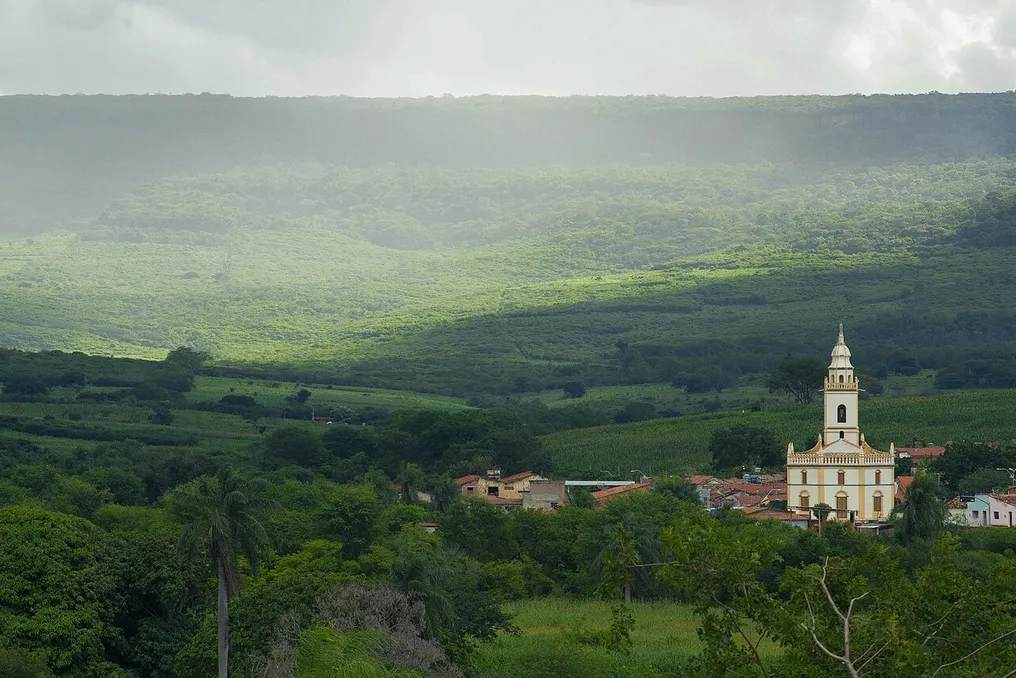
The Chapada do Araripe, also known as Serra do Araripe, is a notable and little-explored destination in Northeast Brazil, located south of Ceará, on the border with Pernambuco and Piauí. This region, the birthplace of composer Luiz Gonzaga, who was born in Exu (on the Pernambuco side of the chapada), presents a unique landscape: an extensive green plateau that contrasts with the typical semi-arid environment of the sertão.
This unusual water characteristic is due to the structure of the mountain range, which acts like a sponge. The sedimentary rocks on top of the chapada, such as those from the Exu Formation, have high permeability, absorbing rainwater and releasing it through numerous springs, streams, and mineral sources along the slopes, which justifies the nickname 'Oasis of the Sertão.'
Although it spans territories in Ceará, Pernambuco, and Piauí, the highest concentration of tourist spots is found in the Cariri area of Ceará, encompassing cities such as Barbalha, Crato, Juazeiro do Norte, and Missão Velha. This location exhibits a diversity of ecosystems, ranging from Caatinga and Cerrado landscapes to vestiges of the Atlantic Forest. Furthermore, it houses the first National Forest of Brazil, FLONA Araripe-Apodi, established in 1946.
For those traveling by air, the main arrival point is the Cariri Regional Airport – Orlando Bezerra de Menezes, located in Juazeiro do Norte, approximately 30 km from the Chapada, and which receives direct flights from major centers such as São Paulo, Brasília, Fortaleza, and Recife. However, the most recommended advice is to explore the mountain range by car, which provides greater freedom to visit the geosite areas scattered across the municipalities of the Cariri.
Access routes vary depending on the origin: starting from Fortaleza, the route via highways BR-116 and CE-293 takes about 7 hours and covers approximately 500 kilometers. From Recife, the trip to the Cariri, following BR-232 to Salgueiro and then PE-585, requires about 8 hours and covers about 600 kilometers. For those leaving Teresina, the route via highways BR-316 and BR-230 has a distance of approximately 570 kilometers and takes about 8 hours.
Among the natural and cultural highlights of the Chapada do Araripe, the Colina do Horto Geosite stands out, located in Juazeiro do Norte. This complex is both touristic and religious, featuring the statue of Father Cícero, 27 meters high, the Living Museum of Father Cícero, and the Church of Bom Jesus do Horto, notable for its modernist architecture.
Other natural attractions include the Horto Cable Car and a trail leading to the Holy Sepulchre. This last section is 2.6 kilometers long and offers a breathtaking panoramic view of the Cariri Valley.
For those interested in paleontology, the Plácido Cidade Nuvens Paleontology Museum in Santana do Cariri is essential. Linked to the Regional University of Cariri (URCA), this museum is internationally recognized and holds a vast collection of dinosaur, pterosaur, fish, insect, and prehistoric plant fossils.
In the Araripe Basin itself, specifically in the limestone layers, fossils of great scientific value have been discovered, including records that helped identify the oldest flower ever cataloged on the planet.
Additionally, the Mirante do Caldas Environmental Complex (CAMC) and the Riacho do Meio Geosite, both located in Barbalha, are only 3 kilometers apart, at the foot of the Chapada. The CAMC offers various ecotourism options, such as cable car rides, visits to the butterfly house, and environmental education activities. Riacho do Meio attracts visitors with its ecological trails and crystal-clear water sources.
Near Riacho do Meio, it is possible to walk along trails that pass by springs and reach Pedra do Morcego. This point not only impresses with its natural beauty but also preserves a local historical fact: the rock formation served as a refuge for the Bando dos Marcelinos, a group of cangaceiros active in the region alongside Lampião during the 1920s.