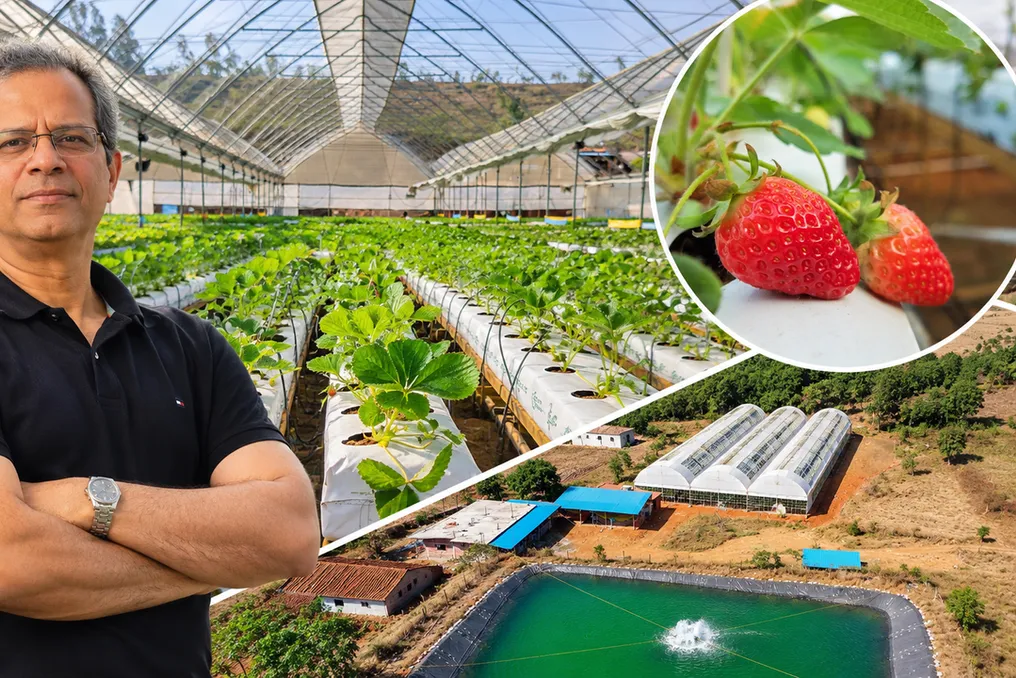
After a failed harvest, 57-year-old farmer Ketan Sodha decided to extend the strawberry growing season by abandoning traditional methods and creating a soilless system in Mahabaleshwar.
Traditional strawberry cultivation in Mahabaleshwar is seasonal because open field cultivation cannot withstand summer heat and monsoon rains. However, Ketan Sodha, who started farming only in 2016, sought a way to extend this season.
Ketan, who comes from a business family in Mumbai and had no agricultural experience, holds a BCom degree from the University of Mumbai. Before 2016, he connected landowners in Maharashtra with buyers. The situation changed after demonetization, which slowed down his previous business, forcing him to look for a new direction, and he decided to focus on strawberries in Mahabaleshwar.
Today, his enterprise, Berry Fresh Agrotech LLP, operates a soilless polyhouse in Mahabaleshwar capable of supporting 19,500 strawberry saplings. The farm produced about 8,000 kg of fruit, generating an income of 44 lakh rupees.
The beginning of this journey was marked by a poor harvest from 5,000 plants and the training of the Mumbai farmer in the basics of agriculture.
Working with agricultural lands, Ketan often traveled across Maharashtra, including routes towards Goa via Paladpur and the foothills of Mahabaleshwar. For someone accustomed to Mumbai, Mahabaleshwar felt like a completely different world compared to hot, humid, and crowded Mumbai.
His initial interest in strawberries arose around 2012–2013. After his land business slowed down in 2016, he acquired 5,000 saplings from a local farmer and attempted to grow them himself. The first year was a disaster, but he did not give up.
In 2017, he increased the number of plants to 10,000, and the results were different: he began producing more fruit than many traditional growers around him who had been cultivating strawberries for decades. His name became known in the region, and some farmers started approaching him for partnerships.
By 2019, he entered into a partnership and began growing strawberries on nine acres. By the 2020–21 season, his operation expanded to nearly 40 acres across three plots, and he also worked with imported planting material and developed his own nurseries. Nevertheless, the weather remained an insurmountable challenge.
Rain Spoiled His Efforts
Although Mahabaleshwar is known for its strawberries, traditionally this crop is grown in open fields, making the plants vulnerable to any weather conditions. Ketan repeatedly faced this problem during traditional cultivation. Unexpected rains would arrive in November and early December when the harvest peaked, potentially setting back crops by 15–20 days.
He noted that sudden rainfall causes numerous issues requiring recovery and fungicide treatment. Furthermore, traditional strawberry cultivation halts with the arrival of summer and monsoons.
This prompted him to consider how changing the growing environment could help extend the season instead of leaving the harvest at the mercy of the weather.
In 2021–22, he visited Italy, Spain, Egypt, and Turkey. He met with nursery owners and hydroponic farmers, and consulted with experts from Israel, the UK, New Zealand, Australia, and the USA. He returned with a wealth of information, but also with an important realization: a system that works perfectly in another country cannot be blindly copied in India.
He began developing a model adapted to the conditions of Mahabaleshwar. The company Berry Fresh Agrotech LLP was registered on October 14, 2022. Although he was already engaged in traditional cultivation with local farmers, his soilless plantation began in November 2024.
Before implementing the new systems, he spent about three and a half months searching for suitable land, despite years of work in the region. He eventually leased two acres and built a 1,500 square meter greenhouse designed for 19,500 strawberry saplings where soil was not used.
The Soilless Strawberry Farm
Inside the greenhouse, the plants grow in coconut coir—a medium made from coconut husks. Traditional fields use the same soil year after year, increasing the risk of soil-borne diseases. Growing in coconut coir reduces this risk.
The plants are cultivated under a retractable roof in an open greenhouse. The spraying system helps control growing conditions. The farm is located at an altitude of about 1,400 meters, giving the plants a natural advantage even when temperatures rise sharply in the plains.
Water supply is managed through an automated fertigation system that simultaneously delivers water and nutrients, providing each plant with approximately 75 ml of nutrient solution over 24 hours. The farm also collects and stores rainwater, pre-treating it with ozone. This allows for water management, reducing dependence on external sources or groundwater.
The combination of soilless media, precise nutrition, controlled environment, and milder temperatures allows Ketan to maintain strawberry growth during periods when traditional cultivation ceases. He emphasized that the true innovation lies not in one trick, but in eliminating all the variables that previously forced traditional farmers to stop.
He does not disclose some aspects of the process, calling them lessons learned from years of experimentation and practical work, many of which resulted from solving problems that arose for him.
When Everything Had to Be Rebuilt
Initially, he expected specialized suppliers to provide most of the necessary technology for the farm. However, several systems required repair and calibration. Completing the greenhouse construction took over six months, and the automation and irrigation systems also demanded significant attention. Even finding suitable hydroponic-grade fertilizers proved difficult.
Ultimately, he and his team began testing, repairing, and setting up pipes, valves, sensors, controllers, and irrigation lines themselves. He explained that they started this journey to grow strawberries, not to become experts in greenhouse construction, irrigation, automation, and fertigation. By understanding their systems, they can solve problems independently without waiting for specialists to arrive.
The total installation cost amounted to a seven-figure sum, although he did not disclose the exact figure. He viewed the first structure as a platform for experimentation and learning, rather than an asset for immediate return on investment.
Testing 19 Varieties for Indian Conditions
Ketan is among only 12–15 farmers in India involved in importing strawberry planting material. Berry Fresh is currently testing 19 strawberry varieties from countries such as Florida, Spain, Italy, Uruguay, and Japan, and added a variety from the Netherlands this season. Since different varieties react differently to climate and diseases, and vary in yield, taste, and quality, he aims to determine which varieties are best suited for India to make superior planting material available to other farmers. He is also exploring the possibility of obtaining exclusive rights to certain foreign genetic materials for India as part of business expansion.
From Crop Failure to 44 Lakh Rupees Revenue
The current setup has a capacity of 19,500 plants and operates at about 90 percent capacity. From January 2024 to December 2025, Ketan reports an average yield of 408 grams per plant and a production of about 3.2 kg per square meter. According to Berry Fresh data, the enterprise harvested about 8,000 kg of strawberries and generated revenue of approximately 44 lakh rupees through both business-to-business (B2B) and business-to-consumer (B2C) sales.
Strawberries are sold at a price ranging from approximately 400 to 600 rupees per kilogram, depending on the client and order. About 60 percent of sales go to B2C, and 40 percent to B2B. Clients are distributed across Mumbai, Mahabaleshwar, Delhi, Bhopal, Ahmedabad, Indore, Udupi, and Goa. Sales are conducted without a comprehensive digital marketing campaign, as Ketan does not maintain social media; clients primarily find him through word-of-mouth.