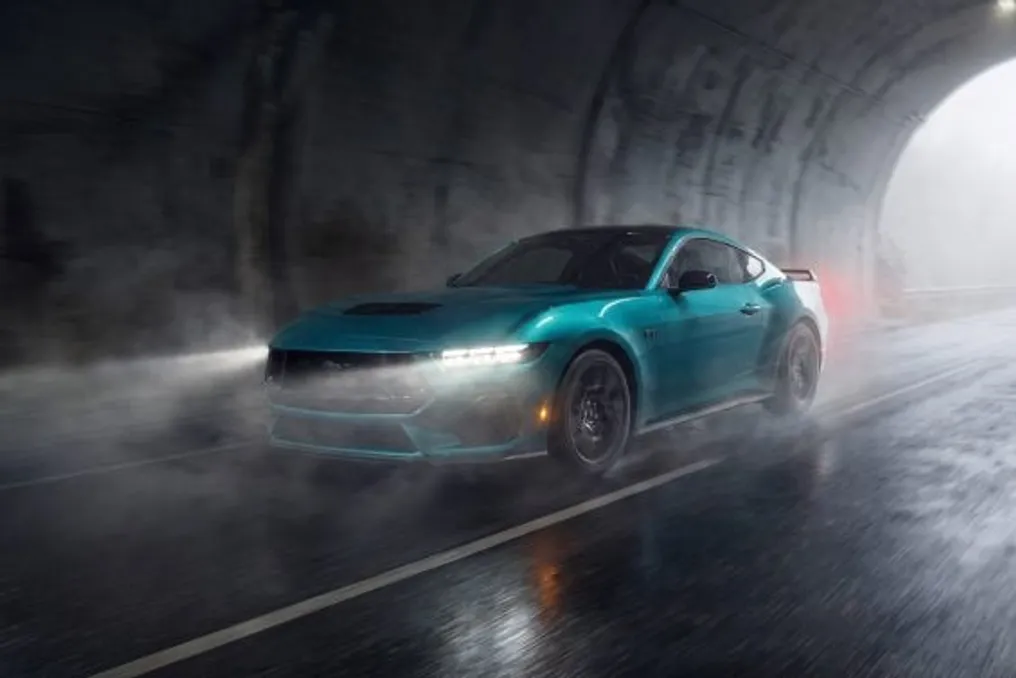
The prospect of having an enthusiast in 2026 is seen as a challenge, considering that Subaru will end the sale of its boxer engines in Europe and Porsche has confirmed that there will be no new generation of the 718 with an internal combustion engine. In this scenario, Ford announced the return of the Mustang Cobra, apparently equipped with a naturally aspirated V8 engine and a manual transmission, characteristics typical of a good muscle car.
This move signals that the coming years will be crucial for the future of combustion-powered sports cars. Regulatory decisions will be influenced by market behavior, public demand, and the willingness of manufacturers to meet this need. In short, the availability of new models with a classic profile, internal combustion engine, and manual gearbox will depend on consumer desire and industrial readiness, being affected by both sales and sectoral pressure regarding emission reduction targets.
These choices, in turn, will guide manufacturers in planning customized versions for those who value the sound of a pure engine, without electrical assistance, and manual gear control via clutch and H-shifter.
Beyond the current situation, Ford's decision to revive the Cobra name for a new Mustang offers a chance to revisit the meaning of this designation. When citing the iconic Mustang versions, references inevitably arise to the classics of the 1960s and, to a lesser extent, the following decade, such as the Shelby GT500 and GT350, the Mustang Boss 302, 351, and 429, or the Mach 1, which marked the end of the first generation of the Mustang.
However, the Cobra versions do not enjoy the same prestige or reverence. This may be linked to age; the initial Mustang models were already revered at the turn of the millennium, with the launch of the fifth generation strengthening its status as an icon. The fourth generation took longer to be considered classic, and the arrival of the fifth generation in 2004, with its retro style, ended up overshadowing its immediate predecessor.
Nevertheless, with the sixth generation now mature and more than thirty years after the first SVT Cobra, it is believed that Ford did right by reviving the surname. This is due not only to its rich history but also because Cobra symbolizes a time when Ford understood that a good Mustang did not have to be just a reflection of the past, nor that the best Mustang had to necessarily be the most powerful in the line.
The trajectory of the Cobra predates the automobile itself. The name referred to Shelby, as Carroll Shelby's first successful project was his own Cobra, equipped with a Ford V8 engine. Subsequently, the two companies united to create the Mustang Shelby GT350 and GT500. This collaboration with Shelby was fundamental in Ford's history during the 1960s and 1970s, culminating in the GT40 project and its successes at the 24 Hours of Le Mans.
In 1968, the first Mustang 428 appeared with a Cobra Jet V8 engine, a seven-liter engine producing 335 hp, which was used until 1973, the last year of the first generation of the Mustang, gaining notoriety with the Mach 1 used in the original '60 Seconds' version in 1974.
Later, in the infamous Mustang II, the Cobra II name first appeared in 1976 (there was no 'Cobra I'). This model is rarely remembered because, as a result of the 70s oil crisis, the Mustang II had low enthusiast appeal, offering four-cylinder or a heavy and weak 2.8-liter V6 producing 115 hp engine options.
Even with Ford's efforts to link it to past glories, including emblems and functional aerodynamic elements, the car was unconvincing. In the following years, subtle engine improvements and the introduction of the 4.9-liter Windsor V8 producing 142 hp came with the nickname King Cobra, but these were not enough to spark the same fervor among muscle car fans as they felt for the Shelbys, nor did they guarantee the survival of the second-generation Mustang, which was discontinued in 1978.
It wasn't until 1991, with the founding of the Special Vehicle Team (SVT), that the Mustang received proper attention again. Treated as an SVT division, this new unit consisted of a small group of engineers and product specialists tasked with developing limited-production models aimed at an audience seeking something beyond daily use. The intention was to concentrate internal expertise and give them autonomy to create vehicles with their own identity, without relying exclusively on external tuners or aesthetic packages.
The first result of this initiative was displayed at the 1992 Chicago Auto Show, alongside the F-150 Lightning pickup truck. Although they were products with distinct proposals, both shared the same philosophy: taking a known Ford and optimizing its most relevant aspects to transform it into a high-performance vehicle. The Mustang SVT Cobra debuted on the streets in 1993, in the last year of the Fox Body chassis.
Its engine was the traditional 5.0L V8 with in-block camshafts, but it received GT-40 cylinder heads, a specific intake manifold, a dedicated camshaft, roller rockers, and larger injectors. The result was 235 hp at 4,600 rpm and 38.7 kgfm of torque at 4,000 rpm, a notable improvement over that year's Mustang GT. Furthermore, the five-speed manual gearbox received reinforced components to support the additional performance.
The Cobra's innovation was not limited to the engine. SVT modified the suspension, shock absorbers, and sway bars, and installed 17-inch wheels—the first of this diameter on a production Mustang—equipped with wider Goodyear tires. The braking systems were also upgraded, featuring dual-piston front calipers and discs on all four wheels. Regarding the suspension, instead of merely adopting a stiffer geometry than the GT, the springs and front sway bar were even softer, a choice intended to keep the tires firmly adhered to the asphalt in curves and increase control on uneven surfaces.
SVT's philosophy was clear: the goal was not just to make the Mustang faster in a straight line or create a car with impressive specifications, but rather to develop a more balanced package, capable of utilizing the extra power without forcing the driver to constantly correct the rear axle's reactions. Although the Cobra maintained a solid rear axle, it already demonstrated greater consideration for dynamic behavior.
In the same year, SVT developed an even more extreme version: the Cobra R. Only 107 units were manufactured, all intended for competition-focused customers. This model eliminated items such as air conditioning, radio, and rear seats, and received specific suspension components, more robust brakes, and an oil cooling system. Its limited production and track focus helped establish a tradition that would accompany the Cobra name in the following years.
The new generation of the Mustang, launched in 1994, continued the project. Although the body was completely redesigned, the Cobra retained the 5.0L V8, now producing 240 hp. This version received upgraded brakes, 17-inch wheels, and wider tires, along with specific suspension tuning. A convertible version was also made available, which served as the basis for the thousand replicas of the 1994 Indianapolis 500 support car.
In 1995, SVT replicated the Cobra R concept but advanced further: instead of the 5.0L, the track special used a 300 hp 5.8L V8, coupled with a five-speed Tremec manual transmission. 250 units were produced, all white, with reinforced suspension, larger brakes, an expanded fuel tank, and a simplified interior. Although homologated for road use, its primary purpose was to compete in production car categories in the United States.
The most significant transformation occurred in 1996. That year, Ford abandoned the old 5.0L V8 and implemented the new modular 4.6L engine, which equipped the Mustang GT. For the Cobra, this engine received dual overhead camshaft heads and four valves per cylinder, in addition to an all-aluminum construction. Power rose to 305 hp, accompanied by 40.8 kgfm of torque. There was a substantial difference compared to the GT's 215 hp, and this changed the nature of the car: instead of relying solely on low-revving torque, the new V8 thrived at high RPMs, delivering its performance more gradually.
The next generation, introduced in 1999 with the New Edge styling, may have been the most crucial in solidifying the Cobra's reputation as a Mustang capable of tackling corners vigorously. The 4.6L engine received new heads and began generating 320 hp, but the major novelty lay in the suspension: for the first time, a production Mustang used independent rear suspension. Previously, even in the most powerful versions, the Mustang relied on the traditional solid axle—a simple, economical, and robust solution suitable for the initial 'popular sportscar' proposal, but which imposed limitations on cornering behavior, especially on uneven terrain.
The independent suspension of the 1999 Cobra helped reduce abrupt reactions, improved tire contact with the ground, and made the car more predictable. In contemporary tests, Car and Driver magazine highlighted the new setup's ability to control the rear's most unstable tendencies, recording 0.88 g of lateral acceleration in the skidpad test.
However, not everything went as planned. The advertised power for the 1999 model did not match the actual performance delivered by the vehicles, forcing Ford to suspend sales and correct the already manufactured units. This problem had a major impact, leading SVT not to offer a conventional Cobra the following year; instead, the public received only a new R version, which ended up becoming one of the most special Mustangs in the entire lineage.
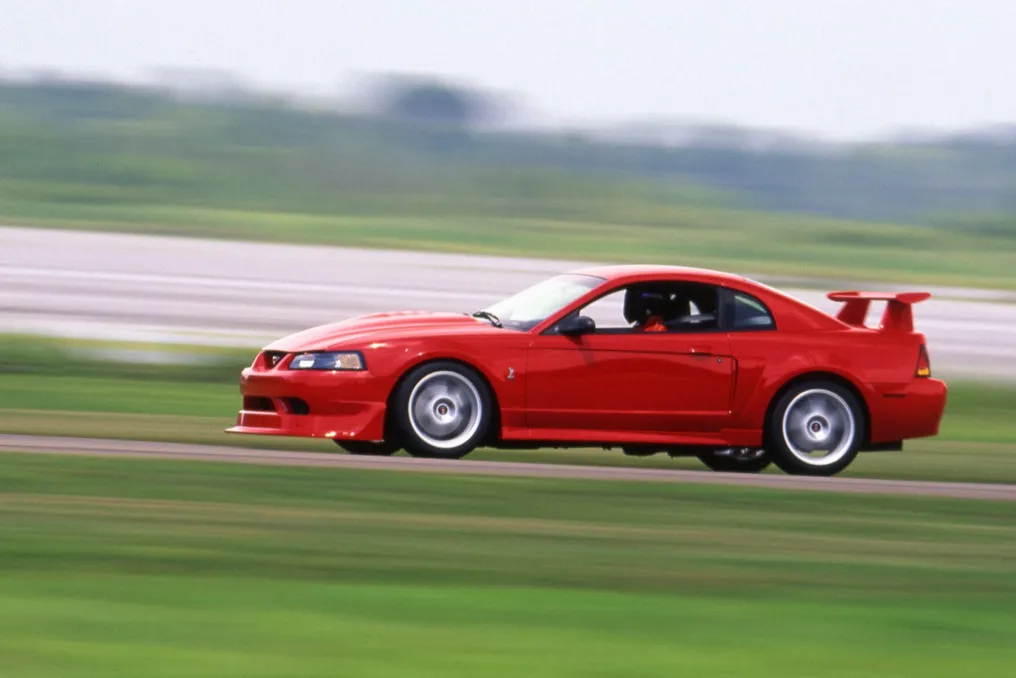
The 2000 Cobra R was essentially a competition car licensed for the road. Its engine was a 5.4L DOHC V8 with 32 valves, derived from the Modular family, capable of producing 385 hp and 53.2 kgfm of torque. The six-speed manual transmission was unprecedented in a production Mustang. The car also featured specialized suspension with Bilstein shocks and Eibach springs, 13-inch Brembo front brakes, and competition tires. Like previous Cobra Rs, comfort items were completely neglected: there was no air conditioning, sound system, or rear seats.
Production was limited to 300 units, and the data released by Car and Driver helps explain its importance. The model achieved 1.02 g in the lateral acceleration test, stopped from 112 km/h to zero in only 48.8 meters, and demonstrated extremely predictable (in a good way) behavior on the track. During a 24-hour endurance test, the publication also emphasized the stability of the assembly and the capacity