Joint Economic Committee of Iran and Armenia Signs Cooperation Document to Expand Trade
Read more
Tehran Times
www.tehrantimes.com

Joint Economic Committee of Iran and Armenia Signs Cooperation Document to Expand Trade

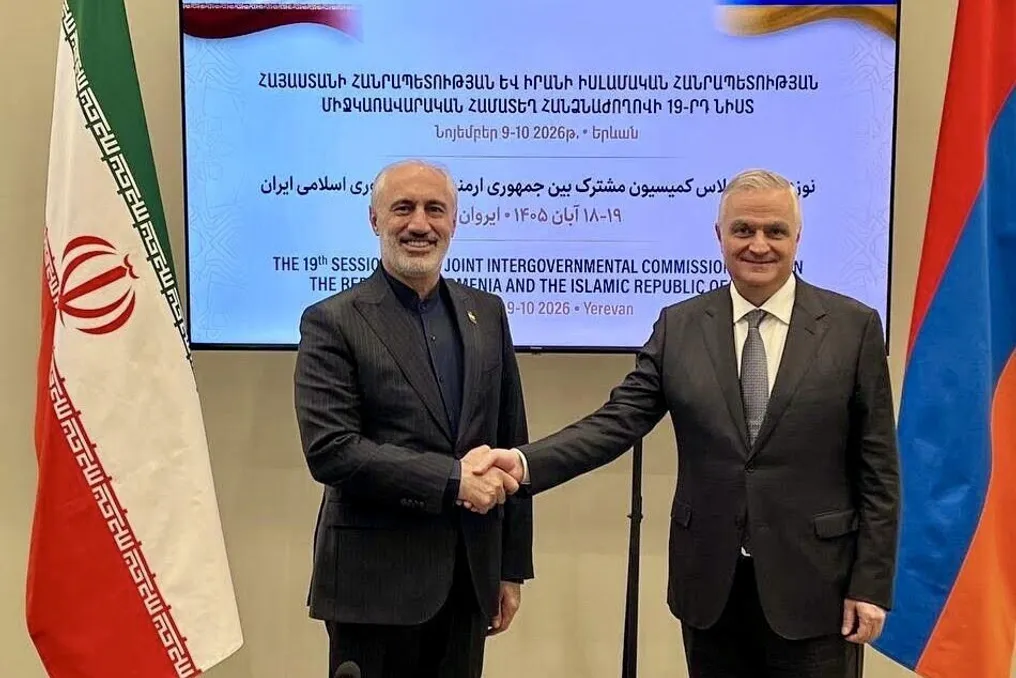
A document on cooperation was signed at the 19th meeting of the Joint Economic Committee of Iran and Armenia, during which Tehran and Yerevan emphasized the need to develop trade ties and economic relations.

According to IRNA, the 19th meeting was held in Yerevan. The document was signed on November 10 by Seyed Hamid Pourmohammadi, Vice President and Head of the Iranian Planning and Budget Organization, and Mikheil Grigoryan, Deputy Prime Minister of the Republic of Armenia.

The main areas of the 19th meeting document include developing interaction between the two states in the fields of transport, energy, infrastructure, and cultural cooperation.

During the signing ceremony, Seyed Hamid Pourmohammadi thanked the Armenian government for organizing the event, as well as all participants of the specialized committees for their efforts. He stated that 'both countries strive to expand relations.'

He added that cultural and social ties between the peoples serve as a foundation for strengthening economic ties between Iran and Armenia. During his visit to Armenia, Pourmohammadi met with economic figures in Yerevan and noted that relations between Iran and Armenia are in a very favorable state, and the governments of both countries are focused on developing these ties.

To facilitate trade between Iran and Armenia, it was decided that the Islamic Republic of Iran will build an additional bridge in addition to the existing bridge across the Aras River. Studies have been conducted, and construction is expected to begin next month.

Pourmohammadi also reported that to improve the route between the countries, in addition to the Tabriz–Norduz highway, the Jolfa–Norduz route is on the agenda and will be ready by the end of the year. Furthermore, the area of both countries' border terminal will be increased, and several hectares will be added to its territory by next year to improve terminal services.

The Head of the Planning and Budget Organization mentioned that to solve the problem of fuel for trucks at the border, a station for Iranian trucks was moved twenty kilometers further from the border to avoid queues. A suitable station for Armenian trucks will also be provided within the next six months.

Emphasizing that the Iranian side is taking many measures to improve operations, he noted that numerous customs procedures are being carried out at the Iranian border, demonstrating Iran's determination to achieve results.

Pourmohammadi also reported negotiations with the director of the Jolfa Free Zone to create a border platform for serving traders.

Currently, 300 trucks cross the Norduz border daily, but Iran aims to increase this number to 500 trucks. He also noted traders' complaints about long queues, business card issues, difficulties with currency obligations settlements, and customs matters. Pourmohammadi assured that he would personally oversee the resolution of any problems reported by the Iranian ambassador in Armenia in this area.

The Vice President concluded that thanks to the measures being taken, the Norduz border will be recognized as the most important and busiest land trade border of Iran within one to one and a half years.

The Vice President and Head of the Planning and Budget Organization, who led the Iranian delegation to the Tehran–Yerevan Joint Economic Committee, met with Mikheil Grigoryan, Deputy Prime Minister of Armenia, during his trip to Armenia, and discussed the development of bilateral relations.

During this meeting, the parties exchanged views on a number of issues related to regional connectivity and noted that strengthening stability, developing economic relations, and eliminating communication barriers will open up new opportunities for the countries of the region.

Mgher Grigoryan, Deputy Prime Minister of the Republic of Armenia, emphasized political trust between Armenia and Iran, an economic agenda based on mutual interests, and a common desire to expand cooperation, which forms a solid foundation for elevating bilateral relations to a new strategic level.

The parties also highlighted the high potential for further development of trade and economic ties between Armenia and Iran, and expressed satisfaction with the growth in trade turnover in recent years.
Similar stories

Joint Economic Committee of Iran and Armenia Holds Meeting in Yerevan to Expand Cooperation
Read more
www.tehrantimes.com

Joint Economic Committee of Iran and Armenia Holds Meeting in Yerevan to Expand Cooperation

The 19th meeting of the Joint Economic Committee of Iran and Armenia took place in Yerevan, during which eight specialized committees were formed. The parties are negotiating to expand cooperation in the fields of trade, transport, and energy.

According to Mehr News Agency, citing the Iranian Organization for Planning and Budget, Seyed Hamid Pourmohammadi, head of this organization, arrived in Yerevan leading a high-level delegation to participate in the 19th meeting. He noted that the Republic of Armenia's approach to the Islamic Republic of Iran has been consistent, especially during the 'Ramadan War' and the '12-Day War.'

The head of the Organization for Planning and Budget emphasized that eight working committees were established at this meeting. Their task is to promote the development of joint interaction in areas such as infrastructure, customs, trade, culture and art, healthcare, industry, mining, and technology.

He added that the work of these committees began on Monday and will continue until the day after tomorrow afternoon, after which a document on joint cooperation between the two countries will be signed.

Pourmohammadi highlighted the importance of developing transport infrastructure between the two states. He reported that work is currently underway to complete the road from Jolfa to Norduz in Iran, and Iranian contractors have taken on the implementation of the Norduz-Yerevan route in Armenia. Plans also include the construction of a new bridge over the Arax River, the development of border terminals, and increasing the customs capacity of both countries to facilitate movement and trade.

Furthermore, the official representative mentioned the simplification of freight traffic and the increase in tourists from Iran and Armenia as important topics of discussion. He stated that developing economic and border cooperation can contribute to increased trade turnover and strengthen ties between the countries.

An expansion of energy partnership was also announced. Pourmohammadi noted that Iranian contractors are laying an electrical transmission line from Armenia to Iran, and they hope for the swift completion of this project. An additional opportunity for bilateral cooperation in the energy sector is the supply of necessary petroleum products to Iran from Armenia.

Regarding Armenia's mining and industrial capacities, the head of the Organization for Planning and Budget noted that cooperation in the fields of mining, industry, trade, and technology is one of the topics discussed at the specialized commission meetings, and both countries can expand interaction by utilizing mutual opportunities.

Pourmohammadi also mentioned a planned meeting with Nikol Pashinyan, Prime Minister of Armenia. During this meeting, key issues of bilateral cooperation, the results of the work of the specialized committees, and ways to strengthen relations are planned to be discussed. Special negotiations will also continue with the Deputy Prime Minister and head of the Armenian joint committee.

Emphasizing the friendly and historical ties between Iran and Armenia, the head of the Organization for Planning and Budget concluded that due to their common civilizational and cultural heritage and long-standing neighborhood, the two countries have significant potential for developing cooperation, and he hopes that the commission's results will lead to practical agreements and encouraging news for the economies and traders of both countries.

Earlier, at the beginning of October, a meeting was held between the Deputy Minister of Transport and Urban Development of Iran and the Head of the Road and Transport Maintenance Organization, as well as a delegation from the Republic of Armenia, with the participation of the Deputy Minister of Infrastructure and Territorial Administration of Armenia, at the Norduz border terminal.

According to IRNA, citing the Road and Transport Maintenance Organization, a joint meeting was held at the Norduz border terminal to expand trade and logistics links between the Islamic Republic of Iran and the Republic of Armenia, and to maximize the transport, transit, and infrastructure potential of both countries. Participants included Reza Akbari, Deputy Minister of Transport and Urban Development and Head of the Road and Transport Maintenance Organization, and a delegation from the Republic of Armenia, represented by the Deputy Minister of Infrastructure and Territorial Administration of Armenia. The main focus was on developing transport and transit cooperation, strengthening the role of the countries in regional transit routes, and eliminating existing obstacles. Issues regarding increasing border crossing capacity, improving service levels at official crossings, facilitating the movement of commercial fleets, and strengthening logistical infrastructure and border territories were reviewed and discussed.

Coordination meeting held within the framework of the 4th Permanent Iran-Africa Economic Summit
Read more
www.tehrantimes.com

Coordination meeting held within the framework of the 4th Permanent Iran-Africa Economic Summit

A coordination meeting was held in Tehran dedicated to the fourth permanent Iran-Africa Economic Summit. The head of the Iranian Trade Promotion Organization defined the key requirements for utilizing the potential of the Iran-Africa Summit to develop Iran's exports to African markets.

According to an IRNA report from the Iranian Trade Promotion Organization, Hamid Padash, Deputy First Vice President for Coordination and Supervision in Economy and Infrastructure, Mohammad Ali Dehghan Dehnavi, head of the Iranian Trade Promotion Organization, Mohammad Sadegh Kannazadeh, Deputy for Commercial Services of the Iranian Trade Promotion Organization, as well as representatives from various state institutions and the private sector, attended the meeting.

Mohammad Ali Dehghan Dehnavi characterized the holding of this summit as a national program and a strategic choice. He noted that an African headquarters has been formed, and this issue is among the priority tasks of the First Vice President. Therefore, it is expected that the planned events will be conducted with the dignity of the country, and the groundwork will be laid for a strong Iranian presence and the utilization of Africa's trade opportunities.

Dehghan Dehnavi emphasized that companies must have a clear plan for participation in the event that aligns with their capabilities and mission. He added that before holding the summit, organizations must deliberate and plan their participation and methods of utilizing this opportunity. Furthermore, he stressed the need to involve experts who possess sufficient technical information and skills in conducting negotiations and concluding trade contracts during the event.

In Dehghan Dehnavi's opinion, participation in such an event must be accompanied by a clear economic and trade mission, as the ultimate goal is to achieve economic benefits for the entire country, not merely sending a large number of companies to the summit. Consequently, if an organization does not have a clear plan for utilizing the upcoming opportunity, it should reconsider its approach to participation.

The Deputy Minister of Industry, Mining, and Trade, speaking about the role of development organizations in supporting private sector firms, stated that large companies and development organizations are expected to play a supportive role rather than focusing exclusively on their own direct participation. In other words, they should accompany smaller and capable private companies. These organizations must also consider their social responsibility and the mission of industrial development to promote the emergence of companies that lack real export potential and activity in the African market.

The head of the Iranian Trade Promotion Organization particularly highlighted the necessity of effective work by the National Development Fund and banking system in developing trade with Africa. He noted that the presence of the National Development Fund and Bank at the summit would be effective if it leads to facilitating financing and creating conditions for the presence and activity of companies in African markets.

In conclusion, the head of the Iranian Trade Promotion Organization emphasized the special responsibility of each participating organization. He stated that every department, institution, organization, and economic firm must have a clear plan and strategy for utilizing the opportunities of this event in accordance with its mission. It was expressed hope that through the participation and support of all organizations, the event could be held with the dignity of the country and the potential of the summit maximally utilized for developing Iran's trade and economic ties with the African continent.

Popular