The Iranian Minister of Economic Affairs and Finance and the Turkish Minister of Trade discussed ways to develop economic and trade interaction, as well as simplifying the transportation and transit of goods and services, and eliminating existing obstacles at the common border.
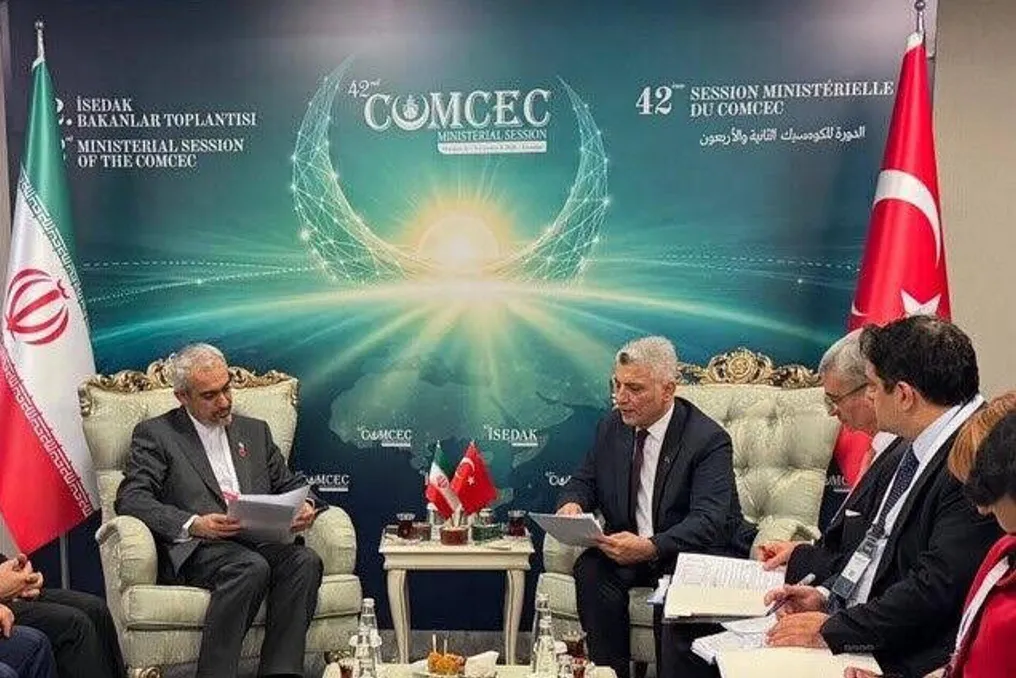
During the meeting, Seyed Ali Madanizadeh, Minister of Economic Affairs and Finance of the Islamic Republic of Iran, met with Ömer Bolat, Minister of Trade of the Republic of Turkey, where the importance of strengthening customs and border cooperation between the two states was emphasized.
The parties reached an agreement to establish a joint working group and hold regular meetings of directors of border customs administrations. The purpose of these meetings is to review, monitor, and resolve executive and operational issues.
A key area of discussion was facilitating truck movement and developing a schedule for the transit of goods and services between the countries. Participants also highlighted the need for 24-hour operation of border customs posts to increase throughput, reduce truck downtime, and accelerate trade processes.
Particular attention was paid to the situation at the Bazargan border and existing problems in this important trade crossing. The current plan of the Turkish side for modernizing and repairing customs offices and its impact on goods transit and transport movement was also discussed. Both sides stressed the need for coordination to ensure the unimpeded passage of cargo and prevent disruptions in trade flow.
Issues regarding the activation and effective use of the potential of other common borders for passenger and truck movement, as well as the management and facilitation of sensitive goods, were also raised. The parties insisted on maximizing the capacity of border crossings and establishing the necessary coordination to optimize movement at these borders.
During the negotiations, the formation of a joint working group for free trade and industrial zones of the two countries was discussed. In this area, the parties emphasized the importance of accelerating the review of documents and proposals related to this working group and preparing for its commencement of activities.
Furthermore, the issue of problems and obstacles faced by Turkish companies in Iran was considered, and emphasis was placed on the need to track and resolve the issues of these companies, as well as creating suitable conditions for the continuation and development of their economic and investment activities.
In conclusion, the ministers of Iran and Turkey, emphasizing the significance of economic and trade relations, called for the continuation of dialogue, strengthening coordination between executive and customs bodies, and implementing agreements through joint mechanisms to promote trade, develop transit, and expand economic cooperation.
In the first half of the current Iranian calendar year (from March 21 to September 21), trade between Iran and Turkey reached 7.914 billion US dollars, demonstrating a growth of 10.3%. Meanwhile, Iran's exports increased by 56.1%, and Turkey ranked first among Iran's export destinations, while imports decreased.
According to a report by Mehr News Agency, the analysis of Iran's foreign trade for the first six months of 1405 showed that the volume of trade with Turkey grew from 7.173 billion US dollars in the same period last year to 7.914 billion US dollars, representing an increase in trade of approximately 741 million US dollars.
This growth occurred against the backdrop of an overall decrease in the volume of Iran's foreign trade: if the total volume in the first half of 1404 was about 54.666 billion US dollars, it was 41.798 billion US dollars in the same period this year. Thanks to this, Turkey's share in Iran's total foreign trade increased from 13.1% to 18.9%.
The increase in Turkey's share is due not only to the growth in bilateral exchanges but also to the decrease in Iran's trade volumes with other partners.
One of the key aspects of Iranian-Turkish trade in the first half of the year was the change in the structure of exchanges in favor of Iranian exports. In the first half of 1404, Iran's imports from Turkey accounted for 61.7%, and exports to Turkey accounted for 38.3% of the total bilateral trade volume. However, in the same period of 1405, the share of Iranian exports rose to 54.1%, while the import share fell to 45.9%.
Export details show that the value of goods sent from Iran to Turkey increased from 2.744 billion US dollars in the first half of last year to 4.284 billion US dollars in the first six months of the current year, representing an increase of about 1.54 billion US dollars and a growth of 56.1%. This figure was achieved against a backdrop of a roughly 25% decrease in Iran's total exports, while exports to Turkey significantly increased, contrary to the country's general trend.
Moreover, the weight of exported goods to Turkey increased from approximately 5.057 million tons to 7.172 million tons, indicating a growth of 41.8%. The average customs value per ton of exported goods also rose from approximately 543 US dollars last year to 597 US dollars.
Comparing these figures shows that the main contribution to the growth in export value to Turkey came from the increase in the volume of exported goods; it is estimated that about three-quarters of the growth in export value is related to the increase in the weight of goods, and the remaining part is due to the increase in the average unit value of exports.
On the other hand, Iran's imports from Turkey decreased in value in the first half of 1405. The import value dropped from 4.429 billion US dollars in the first six months of last year to 3.63 billion US dollars in the same period this year, corresponding to a decrease of approximately 799 million US dollars or 18%.
However, the analysis of the weight of imported goods shows a different picture of import trends. The weight of imports from Turkey not only did not decrease but also increased from approximately 3.626 million tons to 3.81 million tons, meaning the import weight increased by 5.1%. Simultaneously with the increase in weight and decrease in import value, the average customs value per ton of imported goods also decreased from approximately 1222 US dollars to 953 US dollars. This difference indicates that the decrease in import value does not necessarily mean a reduction in the volume of imported goods or a uniform drop in prices for products; changes in the composition of imports, including an increase in the share of heavier goods with lower unit value, can contribute to a decrease in the average cost per ton.
The combined growth in exports and decrease in imports resulted in Iran's trade balance with Turkey becoming positive in the first half of the current year, after showing a significant deficit in the first half of last year. According to published statistical data, in the first half of 1404, Iran had a trade deficit of 1.685 billion US dollars with Turkey; however, in the same period of 1405, the situation changed, and the trade balance of the two countries reached a surplus of 654 million US dollars.
Thus, Iran's trade balance with Turkey improved by approximately 2.339 billion US dollars. Of this improvement, about 1.54 billion US dollars is attributed to the increase in exports, and about 799 million US dollars to the decrease in imports. Consequently, the growth in Iranian exports is considered the most important factor in turning the trade deficit into a surplus in trade with Turkey.
Changes in bilateral trade between Iran and Turkey have also affected Turkey's position among Iran's export markets. In the first half of 1404, Turkey ranked fourth among Iran's export destinations after China, Iraq, and the United Arab Emirates; however, in the first half of the current year, thanks to the increase in exports to Turkey and the decrease in exports to the three other major destinations, Turkey rose to the first place among Iran's export destinations.
According to customs statistics, the value of Iran's exports to China decreased by 52.5%, to the UAE by 49.4%, and to Iraq by 30%. Conversely, Iran's exports to Turkey increased by 56.1% and reached 4.284 billion US dollars. As a result, Turkey's share in Iran's total exports increased from 10.6% in the first half of last year to 22% in the first six months of the current year.
Of course, the rise in Turkey's ranking is not limited only to the growth of exports to this country; the decrease in exports to other major destinations also played a role in changing this ranking, which once again emphasizes the importance of diversifying export markets and maintaining access to the Turkish market.
Overall, Turkey ranked second among Iran's trading partners in terms of foreign trade turnover. In the first half of 1405, the UAE ranked first with a volume of 8.982 billion US dollars, and Turkey followed with 7.914 billion US dollars, while China ranked second and third respectively with a volume of 7.808 billion US dollars. The gap between the volume of Iran's trade with Turkey and China was only about 106 million US dollars, so relatively small changes in exchanges in subsequent periods could change the positions of these two countries.
In the import sector, Turkey remains the third source of imports for Iran after the UAE and China.
Analysis of Iranian-Turkish trade customs data shows that Bazargan customs is the most important point for registering exports to Turkey. In the first half of 1405, out of the total volume of Iran's exports to Turkey amounting to 4,284,020,000 US dollars, 1,643,630,000 US dollars was registered at Bazargan customs. Accordingly, Bazargan ranks first among export customs with a share of 38.3%.
Following Bazargan are Tabriz customs with 293,880,000 US dollars, Lamerd Special Economic Zone with 285,470,000 US dollars, Rafsanjan Special Economic Zone with 266,860,000 US dollars, and West Tehran customs with 180,520,000 US dollars. These five customs offices accounted for a total of 58.1% of the value of Iran's exports to Turkey, while the share of the remaining customs offices amounted to 1,795,660,000 US dollars, equivalent to 41.9%.
In the import sector, the largest source of import registration from Turkey is the Imam Khomeini Port Special Economic Zone with a volume of 724,800,000 US dollars. Next are Bazargan customs with 433,720,000 US dollars, Tehran customs with 348,380,000 US dollars, Imam Khomeini Airport Free Zone with 329,850,000 US dollars, and Mazandaran-Amirabad Free Zone with 228,650,000 US dollars. The total value of imports registered in these five customs offices amounts to about 2,065,400,000 US dollars, equivalent to 56.9% of Iran's total imports from Turkey. The remaining customs offices registered 1,566,570,000 US dollars, accounting for 43.1% of imports.
Differences in the weight and value of imports registered in various customs offices also indicate that the composition of imported goods is not uniform across different customs points; for example, the import value registered at Imam Khomeini Airport is high compared to its weight, whereas at Imam Khomeini Port, the weight of imported goods is higher.
Overall changes in Iranian-Turkish trade in the first half of 1405 indicate the strengthening of Turkey's position in Iran's foreign trade; however, an analysis of statistical details shows...
38.3%