War in Iran leads to projected reduction in global fossil fuel emissions in 2026
Read more
Super Abril
super.abril.com.br

War in Iran leads to projected reduction in global fossil fuel emissions in 2026

The conflict in Iran has caused an unexpected change in global carbon dioxide (CO2) emission forecasts for 2026. For the first time since 2020, a decrease in emissions from the burning of oil, gas, and coal—the main drivers of climate change—is expected. The Global Carbon Budget estimates this reduction at 0.4%.

Before the war began, experts predicted a slight increase in emissions. However, the near-total blockade of the Strait of Hormuz, a route through which one-fifth of the world's consumed oil and liquefied natural gas passed, caused fuel prices to rise drastically in Europe and the United States, while Asia faced supply issues.

This scenario led to a drop in oil and gas consumption. Globally, emissions generated by oil use are expected to fall by almost 2% this year, and natural gas emissions are expected to decline by about 0.3%. Conversely, CO2 emissions from coal burning tend to grow by approximately 0.6%, driven mainly by increased consumption in India.

The report also points out that part of this reduction is attributed to the progress of clean energy; over the last decade, 40 nations have managed to reduce their emissions while experiencing economic growth. These countries include the United States, Australia, New Zealand, South Korea, the United Kingdom, Japan, and several European Union members.

For the year 2026, the study projects that CO2 emissions generated by fossil fuel consumption will reach 38.2 billion tons. If this estimate is confirmed, the global figure will mark a difference compared to the average of the last ten years, a period during which annual CO2 emissions increased by an average of 0.9%.

Despite this outlook, the authors emphasize that a decrease motivated partly by geopolitical instability does not constitute a sustainable climate strategy.

The Global Carbon Budget report was released as a preprint in the journal Earth System Science Data this Tuesday (10), along with an article in Nature Climate Change, and is scheduled to be presented at COP31 in Antalya, Turkey, later this week.

Among the largest emitters, the forecast indicates a 0.9% reduction in annual CO2 emissions in China, 1.3% in the United States, 1.5% in the European Union, and 1% in Japan. On the other hand, annual CO2 emissions from India are expected to increase by 4.4%. In the rest of the planet, the drop is expected to be 0.7%, mainly influenced by the decrease in oil emissions.

However, these figures represent only a part of the overall picture. Due to increased peat fires and forest degradation in Southeast Asia—phenomena exacerbated by El Niño-related droughts—total global CO2 emissions, considering all sources, are expected to show a slight increase this year. The report indicates that the volume will rise from 42.8 billion tons in the previous year to a record 43.3 billion tons.

The remaining carbon budget, which is the amount of CO2 that can still be released before global warming exceeds 1.5°C above pre-industrial levels, has been reduced to 150 billion tons, equivalent to less than four years of emissions at the current rate. In September, the United Nations (UN) had already issued a warning about the high probability of exceeding this limit.

The study also emphasizes the role of cleaner energy sources. With growing global energy demand, sources such as solar and wind energy are gaining relevance, responding to about two-thirds of the demand increase, alongside electric vehicles.

Nevertheless, the report concludes that this growth is not yet fast enough to generate a lasting drop in global CO2 emissions from fossil fuels. The authors believe that such a drop may occur in the coming years but advocate for the need to further accelerate the implementation of solar, wind, batteries, and electric vehicles.

Similar stories

Iran conflict aids in carbon emission reduction, but environmental challenges persist
Read more
olhardigital.com.br

Iran conflict aids in carbon emission reduction, but environmental challenges persist

Projections indicate that global carbon dioxide (CO₂) emissions from the burning of fossil fuels are expected to decrease by 0.4% in 2026. Initially, this forecast suggests progress in addressing climate change. However, a significant portion of this reduction is linked to a worrying factor: the effects of the conflict involving Iran on the international oil market.

This estimate is part of a new report released by the Global Carbon Project this Tuesday (10th). The study points to a change compared to the trend observed between 2019 and 2025, a period when global CO₂ emissions from fossil fuels showed an average annual growth of 0.8%.

Although the expansion of solar and wind energy sources contributes to the decrease, it alone does not justify the total result. Furthermore, the increase in oil prices, a direct consequence of the Middle East conflict, has encouraged both companies and consumers to reduce consumption of this fuel.

The Global Carbon Budget predicts that the combustion of fossil fuels will result in the production of 38.2 billion tons of carbon dioxide in 2026. Despite this expectation of reduction, global energy demand continues to rise. Although renewable sources and electric vehicles cover almost two-thirds of this increase, they are not yet evolving fast enough to ensure a continuous long-term decline in emissions.

Another problematic point lies in land use modification. Emissions related to practices such as deforestation are expected to add about 500 million tons compared to the previous year. Consequently, the concentration of CO₂ in the atmosphere should reach 427.7 parts per million (ppm) in 2026, a level 54% higher than recorded before the Industrial Revolution.

Glen Peters, a professor and researcher at the CICERO International Climate Research Center, stated to IFLScience that an emission reduction in just one year does not constitute a definitive peak if it is not the result of structural changes. The researcher emphasizes that although the expansion of solar panels, wind turbines, batteries, and electric cars helps reduce emissions in several countries, these transformations are still insufficient to guarantee a sustained global decline.

James Renwick, a professor of physical geography at Victoria University of Wellington (New Zealand), also assesses that the projected reduction is strongly tied to the war in Iran. He argues that when considering land use changes, total global emissions are likely to increase in 2026. This scenario is comparable to other temporary declines seen historically, such as during the Covid-19 pandemic, the 2009 financial crisis, and the energy crisis of the 1970s. In all these instances, the decrease was linked to extraordinary events, and not necessarily to a permanent transformation of energy systems.

The full study was published in the scientific journal Nature Climate Change.

Report indicates carbon emissions will decrease this year due to oil crisis, not clean energy transition
Read more
www.aajtak.in

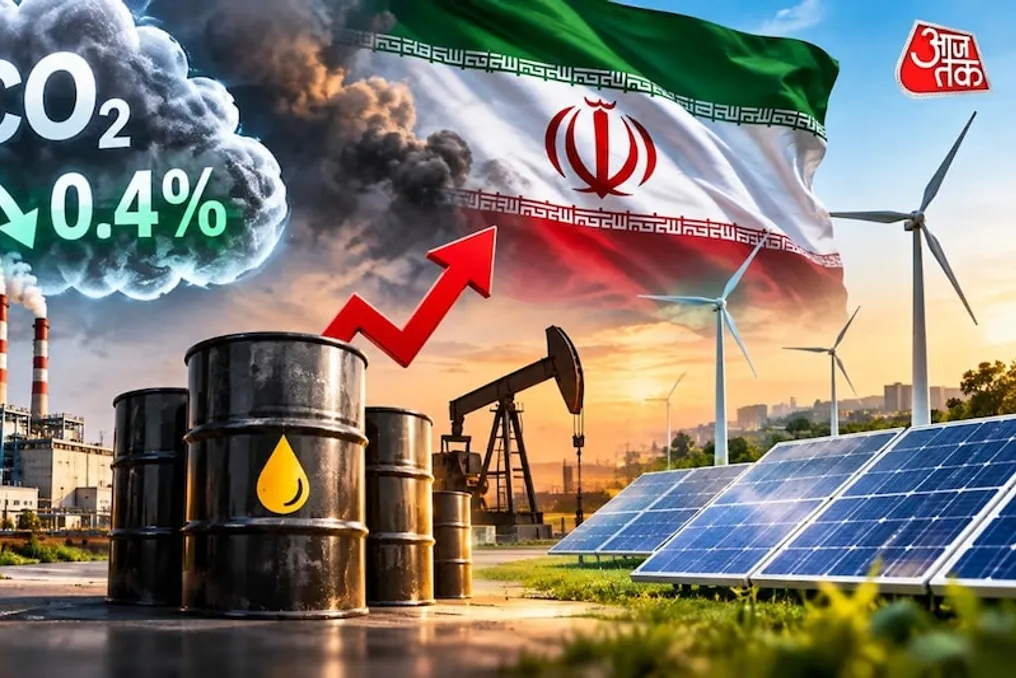
Report indicates carbon emissions will decrease this year due to oil crisis, not clean energy transition

According to the Global Carbon Budget report, global carbon emissions are showing a downward trend this year. It is projected that carbon dioxide pollution, resulting from the burning of fossil fuels, will decrease by 0.4 percent by 2026, reaching 38.2 billion metric tons.

Experts who prepared the report, comprising 140 researchers, emphasize that this reduction is attributed not to countries' gradual shift towards renewable energy sources, but rather to the consequences of the recent oil crisis. The military actions between the USA, Israel, and Iran, and their impact on the oil market, played a major role in this.

The sharp rise in oil prices led to a slowdown in demand for fossil fuels. The high cost of oil forces both the population and industry to reduce consumption, which in turn leads to a decrease in the volume of burned fuel and a reduction in carbon emissions. Scientists note that this drop is the result of a temporary shock, not a sustainable shift toward clean energy.

When oil prices increase, many companies and governments reduce their consumption. Although there is an increase in interest in alternative sources in some areas, the main effect is precisely the reduction in demand. The Global Carbon Budget assesses global carbon emissions annually.

Current forecasts clearly show how significantly geopolitical events can influence climate data. The conflict involving Iran caused concerns about oil supplies, leading to a price surge. Consequently, consumption has decreased in several regions, and a slight drop in emissions is expected.

Although this decrease may seem like good news, specialists warn that it is not a long-term solution. If prices normalize, demand may rise again, and emission levels could return to previous figures. The transition to clean energy, such as solar, wind, and other renewables, is still happening slowly. Therefore, this decrease cannot be considered a major victory in achieving climate goals.

The report draws an important conclusion that the pace of clean energy adoption in countries is currently insufficient for a significant reduction in emissions. Events like the oil shock provide only temporary relief, whereas a more serious approach is needed for long-term reduction of dependence on fossil fuels.

Achieving the goals of the Paris Agreement and other climate objectives requires continuous and deep emission reductions. A 0.4 percent decrease seems small, but it points in the right direction, provided measures are further strengthened. Overall, the global level of carbon emissions remains very high, and the figure of 38.2 billion tons is not considered sufficient to prevent climate change.

Scientists have repeatedly stated the need for a sharp reduction in emissions to limit temperature rise to 1.5 degrees. The relief gained from the oil crisis may prove temporary. The future will be more sustainable if countries increase investment in clean energy and reduce dependence on coal and oil.

Currently, the Global Carbon Budget forecast once again highlights the close link between geopolitics and climate. Fluctuations in the oil market affect not only the economy but also the Earth's temperature.

Renewables and conflict in Iran reduce global CO2 emissions, reports study
Read more
noticiasaominuto.com

Renewables and conflict in Iran reduce global CO2 emissions, reports study

A new report indicates that global carbon dioxide (CO2) emissions from fossil fuels are expected to decrease by 0.4% in 2026. This reduction is attributed both to the advancement of renewable energies and the conflict in Iran.

However, the Global Carbon Budget report warns that 38.2 billion tons of CO2 will still be emitted this year. The study observes that despite the continuous growth in global energy demand, two-thirds of this increase is being met by the expansion of solar and wind energy, in addition to the growing use of electric vehicles.

Nevertheless, the document highlights that the growth of clean energy sources is not considered 'fast enough' to ensure a 'lasting reduction' in CO2 emissions from fossil fuels.

Corinne Le Quéré, a researcher at the University of East Anglia in the United Kingdom, stated in a press release that 'clean technologies are making a real difference in reducing global emissions.' She added that greater acceleration could alter the course of global emissions in just a few years.

The report also points out that oil-related carbon emissions should fall by 1.9%, which is likely a 'short-term' reaction to the energy crisis caused by the war in Iran. Despite this decline being positive, Pierre Friedlingstein, director of the Global Carbon Budget, emphasized in a note that 'a reduction driven partly by geopolitical crises does not constitute a sustainable climate solution.'

Additionally, the study projects that emissions resulting from land-use changes, such as deforestation, will increase from 42.8 billion tons in 2025 to 43.3 billion tons this year, representing an increase of 1.2%.

Based on this data, more than 140 international scientists involved in preparing the report concluded that the amount of CO2 that can be emitted before global warming reaches 1.5 degrees Celsius is 150 billion tons, which is equivalent to 'less than four years of emissions at the current rate.'

In this context, Professor Julia Pongratz, from Ludwig Maximilian University of Munich (Germany), advocated in a press release for the need to 'expand CO2 removal to achieve greenhouse gas neutrality.' She explained that although afforestation and reforestation remove considerable volumes of CO2, these gains are often outweighed by emissions caused by deforestation, and that new carbon sequestration methods are still very limited, requiring immediate action on all fronts.

Among the conclusions, the Global Carbon Budget highlighted China as the 'most active' country in implementing carbon sinks and clean energy, being responsible for 32% of CO2 from fossil fuels. The report states that half of the global emissions avoided thanks to renewable energy and electric vehicles are concentrated in China, which also records the largest carbon absorption through reforestation and afforestation.

The document forecasts a 0.9% drop in Chinese emissions in 2026, while electricity production from renewable sources 'continues to grow strongly.' However, it also draws attention to a 0.3% increase in coal-related emissions. In contrast, India is expected to see its emissions grow by 4.4%, a rate higher than the annual average growth rate of 3.5% observed over the last decade. The European Union (-1.5%), the United States (-1.3%), and Japan (-1%) are expected to maintain a downward trajectory. For the rest of the world, the Global Carbon Budget anticipates a 0.7% reduction in 2026, possibly due to rising oil prices and global supply restrictions.

Popular