Independent EHT Data Analysis Confirms Black Hole's Historical Photograph
Read more
Olhar Digital
olhardigital.com.br

Independent EHT Data Analysis Confirms Black Hole's Historical Photograph

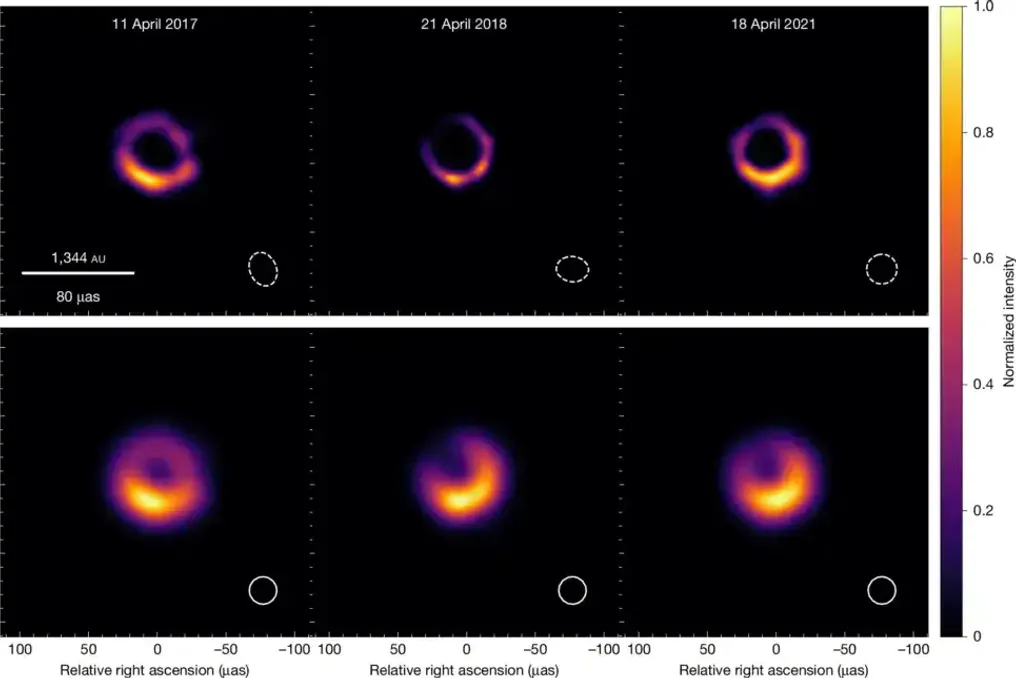
A recent independent analysis of the data used to create the first image of a black hole in 2019 has confirmed the presence of a bright ring-like structure around the dark region. These findings were published on November 11 in the scientific journal Nature.

The study largely aligns with the initial conclusions of the Event Horizon Telescope (EHT), but it leaves open questions regarding the distribution of luminosity and the methods used for image reconstruction.

The international EHT collaboration presented the first image of a black hole shadow in 2019. The recorded structure was a glowing ring around the central dark zone, consistent with Albert Einstein's predictions from general relativity.

To obtain this image, the project combined simultaneous observations from radio telescopes located on different continents. These instruments function as a single virtual telescope with a resolution comparable to an Earth-sized antenna.

Nevertheless, the reconstruction process faces limitations. Since radio telescopes do not cover the entire surface of the planet, gaps in observations arise that must be compensated for using mathematical methods and computational models. The choice of these methods can influence the final result.

It is this aspect that raised doubts about the original image. Starting in 2022, astrophysicist Junichiro Makino from Kobe University in Japan and his colleagues began challenging the EHT's conclusions. By applying one of the methods used by the collaboration, but with different assumptions, the team obtained an image where the radio emissions appeared concentrated in an irregular structure rather than clearly forming a ring.

In response to these discrepancies, Samuel Lai, an astrophysicist from the Australian Centre for Scientific and Industrial Research (CSIRO), and his co-authors developed their own methodologies to re-examine the data. Their results generally matched the data presented by the EHT in 2019.

According to Nithyanandana Thyagarajan, a CSIRO astrophysicist and co-author of the study, different models used to guide the neural network can lead to slightly different reconstructions. He explained: 'Depending on your prior model, you may follow slightly different paths.'

Despite these differences, the researcher noted that the new group also discovered a ring-like structure.

However, Makino continues to question the results obtained. One of the differences noted by the researcher relates to the placement of the brightest points around the central structure, which changes depending on the reconstruction method used. He stated: 'If both methods are mathematically sound, it is difficult to understand why this happens.'

Thus, the new analysis confirms the general existence of a ring-like structure but does not establish definitive confirmation of all image details. The distribution of luminosity remains one of the areas of disagreement among different reconstructions.
Similar stories

US Physicists Simulate Black Hole Using Matter Waves Trapped by Light
Read more
nplus1.ru

US Physicists Simulate Black Hole Using Matter Waves Trapped by Light

Physicists working in the USA have developed a Fabry–Pérot resonator that allows for an exchange of roles between light and matter. Thanks to this experiment, it was possible to record the exponential accumulation of energy around specific trajectories in spacetime.

The researchers found that isolated stationary points corresponding to these trajectories function as horizons for both black and white holes. The experimenters confirmed their observations by comparing them with a theoretical model that considers stroboscopic evolution.

The results obtained may find applications in various fields, including signal compression, multiplexing, and resonator cooling processes. The details of this study were published in the scientific journal Physical Review Letters.

Underwater telescope tests Einstein's laws using neutrino analysis
Read more
olhardigital.com.br

Underwater telescope tests Einstein's laws using neutrino analysis

One of the fundamental principles of Albert Einstein's theory of relativity states that the laws of physics are the same for all observers, regardless of their motion. However, researchers from the international KM3NeT collaboration used a telescope installed in the depths of the Mediterranean Sea to test whether this rule applies under all circumstances.

The team analyzed 5,828 atmospheric neutrino candidates and found no signs of violation of the so-called Lorentz invariance. Despite the negative result, the study established new experimental limits for possible changes in the laws of physics, including unprecedented constraints on two types of these particles, according to information from the EurekAlert portal.

Lorentz invariance is central to Einstein's theory of relativity. Nevertheless, some theoretical proposals aimed at reconciling gravity with quantum physics suggest that this principle may not hold under all conditions.

One such hypothesis considers the possibility that spacetime, usually considered a continuous structure, might consist of extremely small and discrete units. If this were the case, some fundamental properties of physics could exhibit differences under certain conditions.

Neutrinos are particularly interesting particles for studying this possibility. They interact weakly with matter and can traverse vast distances, including passing through the Earth. A key characteristic is their ability to change from one type to another during transit, known as neutrino oscillation, which includes three flavors: electron, muon, and tau.

The probability of these transformations can be predicted with high accuracy by existing physical models. If observations show discrepancies with predictions, it could indicate the existence of unknown phenomena, including possible violations of Lorentz invariance.

To search for these deviations, researchers used data from KM3NeT/ORCA, a neutrino detector located in the depths of the Mediterranean Sea. The analysis covered 1.4 years of observations conducted with only six detector blocks, which was done in the early stages of equipment construction. The team compared the energy and arrival direction of registered neutrinos with theoretical predictions. A total of 5,828 atmospheric neutrino candidates, formed when cosmic rays interact with the Earth's atmosphere, were analyzed.

The results revealed no violations of Lorentz invariance. Nevertheless, the data obtained allowed for the establishment of stricter bounds on the intensity of certain effects capable of altering the behavior of these particles. One of the main achievements was the first determination of direct limits for possible differences related to muon and tau neutrinos, as well as oscillations between these two flavors.

Even using only a small part of the planned structure, KM3NeT/ORCA was able to achieve results comparable to those of long-term experiments such as IceCube and Super-Kamiokande. The detector continues to expand, and researchers hope that an increase in data volume will allow them to study even weaker effects. The collaboration also plans to extend the analysis to KM3NeT/ARCA, another detector in this structure designed to study much higher-energy neutrinos coming from distant astrophysical sources.

These particles can be particularly useful because some possible effects of Lorentz invariance violation become more apparent at high energies and over large distances. Currently, there is not enough astrophysical neutrino data accumulated for such an analysis with ARCA.

Popular