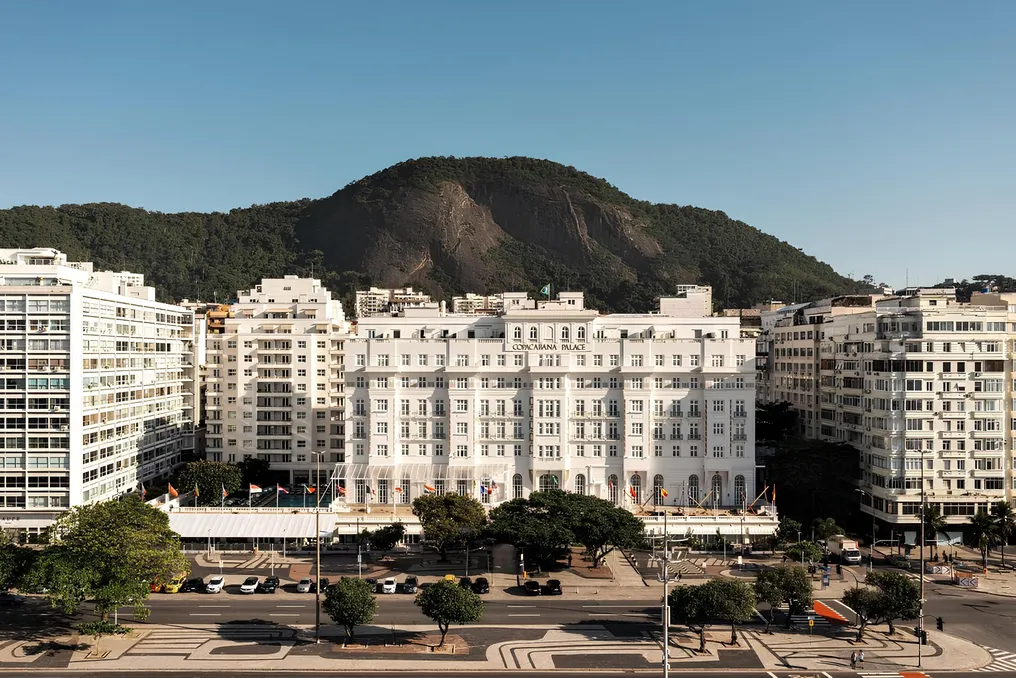
The iconic Copacabana Palace, part of the Belmond chain, was reopened last Thursday (5th) with the opening of the Pool Building, following a complete renovation that lasted 19 months. This building, dating back to 1948, had its capacity reduced from 96 to 68 units, all configured as suites with private balconies.
In addition to the new accommodations, a renewed pool area, the hotel's first exclusive bar, a contemporary Italian restaurant, a Brazilian handicraft boutique, and five floors dedicated to wellness have been added.
Copacabana Palace has a history of success, being a near-undefeated winner of the Best Travel and Tourism Award, having won the Best Hotel title 17 times in its 21 years of awards.
Renovation Details and New Offerings
The Pool Building was initially conceived to accommodate guests staying in Rio de Janeiro for extended periods and, for many years, was known only as an annex. The decision to renovate this building was announced in 2023, shortly after the hotel's centenary.
With this reopening, Copacabana Palace totals 208 rooms and suites: 68 in the Pool Building and 140 in the main body. Most of the new suites offer views of the pool or Copacabana Beach, with rates starting from R$ 5,000, plus taxes. The 68 suites accommodate two to five people and, in most cases, include a separate living room; some units allow connecting, which facilitates stays for larger groups and families.
The accommodation offering has been expanded with six new categories, including the Carioca Suite, a two-bedroom penthouse located on the 11th floor, offering views of Christ the Redeemer and Sugarloaf Mountain. Two-bedroom suites of 165 m² with sea and pool views are also available.
Design and Culinary Experiences
The decor reflects inspirations from Brazilian artists and materials. The architectural project was developed by Ivan Rezende, who also collaborated on the restoration of the Copacabana Palace Theater in 2021. The design blends reclaimed wood from Amazon riverbeds, stones from various regions of the country, and furniture aligned with Brazilian modernism, highlighting chairs by Sérgio Rodrigues and marquetry by Maqueson Pereira da Silva.
Xylography artist Ciro Fernandes contributed works inspired by Brazilian flora and fauna to the living rooms, and the carpets replicate patterns from the Juruá River and the colors of the Acre vegetation.
The pool received a new bottom design, inspired by Atlantic waters, replacing the old geometric pattern with more fluid and organic shapes. Next to it, Copa Bar opened, the hotel's first exclusive bar, whose counter measures almost ten meters and offers a drink menu focused on Brazilian mixology, with options such as caipirinha and Rabo de Galo.
In the food sector, the hotel maintains the Pérgula restaurants (with Brazilian classics) and MEE (pan-Asian cuisine). Cipriani, which operated for 30 years, has been replaced by Lumio, a new establishment focused on contemporary Italian cuisine. Lumio's kitchen remains under the direction of Nello Cassese, a Michelin-starred Neapolitan chef who had placed Cipriani on the Latin America’s 50 Best Restaurants list in 2023. Lumio offers a unique tasting menu for 38 evening guests, combining references from Southern Italy and Rio de Janeiro, accompanied by wine pairings from a cellar with over 400 labels, selected by sommelier Ed Arruda.
Wellness and Luxury Partnerships
The wellness area has been significantly expanded, forming the Copa Wellness Club, composed of five floors dedicated to physical activities, relaxation, and aesthetic care. The big news is the Dior Spa Copacabana Palace, the first of the French brand in Latin America, featuring six treatment rooms and a Maison product store.
The hotel is now the only one in Rio de Janeiro to offer the La Collection Privée perfume line, created by Francis Kurkdjian, and the L’Or de Vie skincare line, developed with extracts from Château d’Yquem wine. The collaboration between Dior and Copacabana Palace dates back to 1961, when Marc Bohan presented a Haute Couture collection in the hotel gardens, and now deepens with treatments created in partnership with dermatologist Maria Bussade, founder of Bussade Health.
The fitness structure includes a modernized gym with Technogym equipment, an area for Brazilian jiu-jitsu, and a Pilates studio. There is also a thermal area equipped with saunas, including an infrared version, bathing, and an ice fountain. Additionally, the complex features the Juice Bar, which serves functional bowls and juices with local ingredients, a barbershop, a Beauty Lounge, and the Ará salon, managed by stylist Amadeu Marins.
The Copacabana Palace Boutique, dedicated to national handicrafts, has been introduced and is curated by Maria Fernanda Lima. The store displays pieces from various Brazilian regions and techniques, including works by artists involved in the interior design project, such as Maqueson Pereira da Silva. Approximately 70% of the collection is focused on fashion and accessories, featuring brands such as Marina Bitu, Flavia Madeira, and Sertão Encantado.
History of the Pool Building
To understand the trajectory of the Pool Building, one must revisit the origin of Copacabana Palace. The hotel was inaugurated in 1923 through the initiative of then-president Epitácio Pessoa and financed by Octávio Guinle. The initial project was executed by the French architect Joseph Gire, who was inspired by the Negresco hotels in Nice and Carlton in Cannes.
Twenty-five years later, in 1948, a new edifice was erected. Designed by Wladimir Alves de Souza, the Pool Building adopted a modernist language with Art Deco influences. Its construction occurred during a period when outdoor lifestyle was gaining popularity among Cariocas, specifically designed to host guests with longer stays in the city.