A week ago, OpenAI raised $11 billion at a valuation of $1.25 trillion, demonstrating the continued influx of capital into the artificial intelligence sector. However, this week market attention shifted to Mercor, which successfully closed a Series D funding round, raising $750 million.
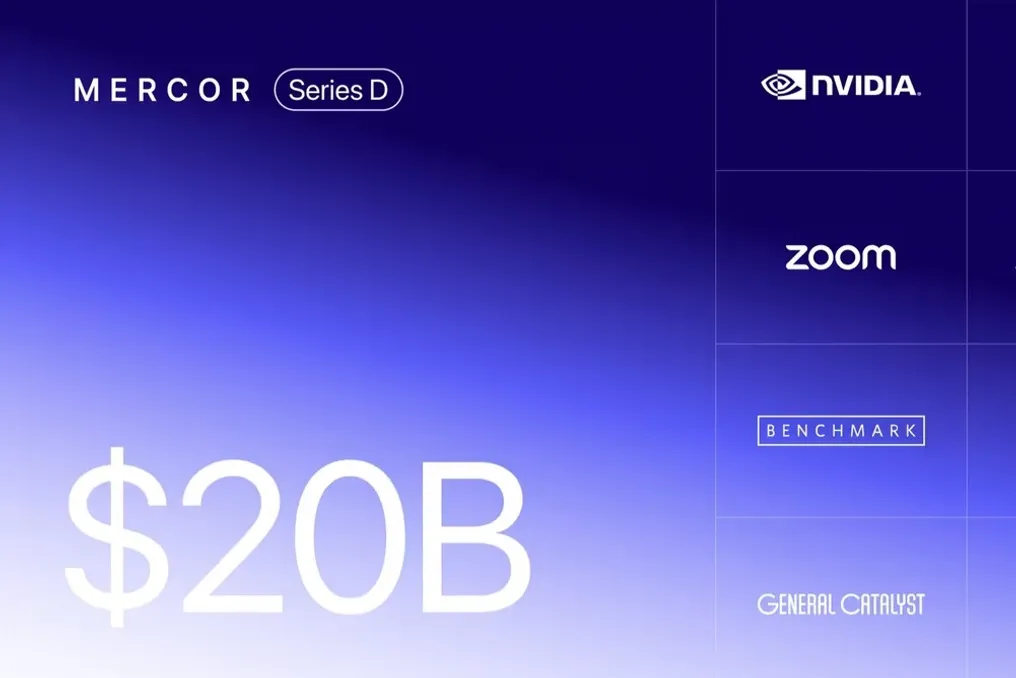
Under the terms of the deal, the San Francisco-based startup is now valued at $20 billion, representing a doubling of its worth compared to just over a year ago. The capital raised will be used to train AI systems to perform any task while compensating real people for instructions on executing practical operations.
The round was announced on November 10th. Although the lead investor was not disclosed, the list of major participants included Benchmark, Felicis, General Catalyst, Sapphire Ventures, NVIDIA, Salesforce, and Zoom. Other investors included the Apollo fund, G Squared, StepStone Group, and XTX Ventures, as well as some funds derived from employee stock option offerings.
Mercor previously raised $350 million in October 2025 when its valuation was $10 billion. In a short period of 13 months, the company increased its market value to $20 billion.
Mercor was founded in 2023 by three friends: Brendan Fudi, Adarsh Hiremath, and Surya Midha. Initially, the company was conceived as an AI-powered recruitment solution, but the founders discovered a larger problem within the AI industry.
Human experts are critically important for creating and testing AI models, including specialists such as lawyers, doctors, bankers, and engineers. Mercor connects these experts with laboratories that require their expertise.
Today, the company claims to have a network of over 5 million experts across more than 800 professions in the United States. As of July 2026, it reports annual revenue exceeding $2 billion. It should be noted, however, that this is the total billed amount, and contractors receive a significant margin.
As Fudi notes, 'AI can only be as useful as the human brain behind it.' Until recently, Mercor's main clients were cutting-edge AI labs. The new funds are intended to expand the company's services to the business community.
The plan is simple: Mercor develops custom tests based on a specific company's workflows. These tests demonstrate the model's performance using the company's own data. The results are then used by Mercor for further model training. Hiremath explains that this is important because 'a model might score highly on a public benchmark but fail.'
Every business has its unique characteristics and rules. This is why Mercor acquired Deeptune earlier this year. The Deeptune team spent two years restoring hundreds of corporate applications. Now users can practice with these copies using AI agents without affecting real systems.
AI agents are approaching the point of taking over business processes. The main question is whether they can function. Nevertheless, investors have doubled down. The market for training AI on all tasks is rapidly developing, and Mercor aims to take a leading position.