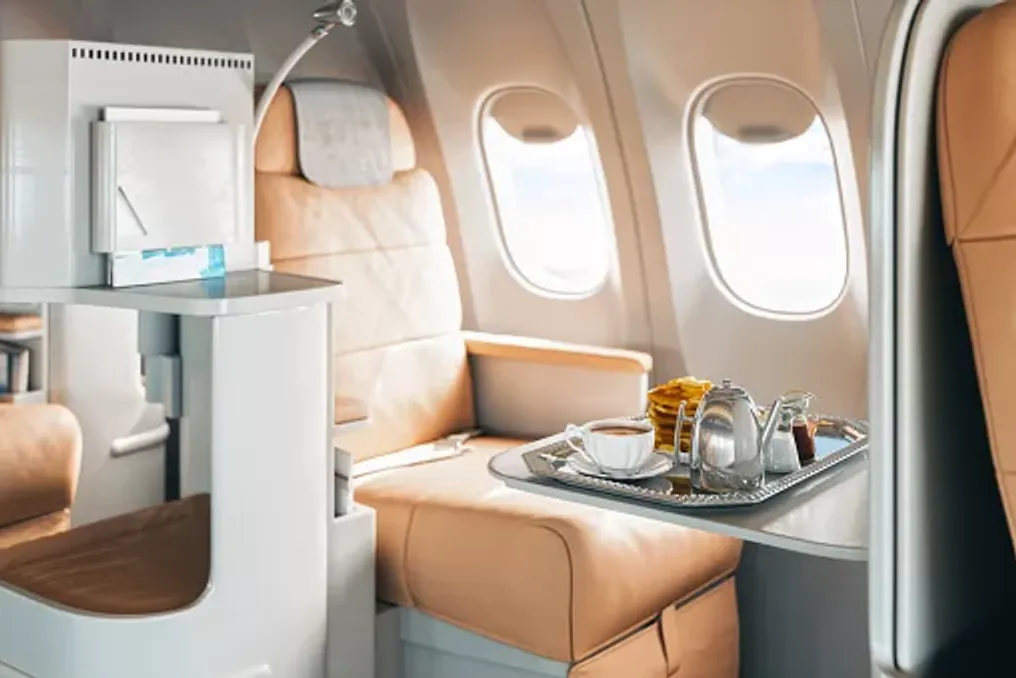
Airlines are increasingly investing in enhanced premium travel experiences, introducing more spacious seating, improved onboard catering, and exclusive airport lounges, as they seek new ways to attract passengers and increase profits.
The aviation industry is looking for new solutions to improve flight comfort: from economy class seats that convert into sleeping berths to first-class cabins equipped with double beds. However, the increased focus on premium offerings may lead to a reduction in the number of standard economy seats on some aircraft.
According to a Euronews report citing the AFP agency, airlines are expanding their focus beyond traditional business and first-class offerings to attract passengers willing to pay more for enhanced comfort, convenience, and additional services.
This shift occurs against the backdrop of rising aviation fuel prices, which puts pressure on the profitability of air carriers and makes high-margin travel products increasingly attractive to the industry.
Expert Opinion on Premium Class Profitability
Volodymyr Bilotka, a professor at Purdue University specializing in aviation economics, told AFP that a business class cabin can occupy the same space as about four standard economy seats while generating five or six times the revenue.
American Airlines has already demonstrated growth in this market: its premium revenue increased by 18.5% year-over-year in the last quarter, outpacing the growth rate of the main cabin revenue. Furthermore, the airline reported that premium products account for approximately half of its ticket revenue, despite occupying only about 30% of available seats.
The growth in premium travel is particularly noticeable in the United States, where, according to the industry publication Skift, the number of premium seats on domestic flights has increased by 33% since 2020.
United Airlines has more than doubled its premium seat capacity between 2015 and 2026 and continues to introduce new features to enhance passenger journeys. One upcoming addition is the Relax Row, expected to launch in 2027. This concept will allow economy class passengers on selected Boeing wide-body aircraft to convert a row of three seats into a sofa-like space for sleeping or relaxing during long-haul flights.
The airline has also announced a new Economy Plus option that will allow passengers to avoid sitting next to anyone in the middle seat. This service is expected to launch on select routes by the end of 2026.
Meanwhile, JetBlue has introduced BlueFirst, a new domestic first-class service, in response to growing interest in more comfortable flights.
Enhancing Passenger Experience Goes Beyond Seating
For some airlines, improving passenger service quality is not limited to seat arrangement. Delta Air Lines has invested in its Delta One offering by implementing enhanced dining, premium wines, and larger entertainment screens.
The onboard menus were developed with the participation of Simon Halston, chef at The Elephant restaurant in Torquay, England, a Michelin-starred establishment, and sommelier award winner Andrea Robinson. The airline plans to introduce this service on its new Airbus A350-1000 aircraft, which will feature approximately 150 premium seats alongside 161 economy seats.
Ekrem Dimbiloglu, Delta's Chief Officer of Strategy and Inflight Experience, told Euronews that the share of premium seats has changed significantly over the past two decades. He suggested that eventually, premium seats could account for up to 70% of the seating capacity on some of the airline's flights.
Airport experiences are also becoming part of the competition, as carriers invest in upgrading and creating new lounges. Additional industry benefits include free Wi-Fi and the ability to choose meals before boarding.
Expansion of the Premium Segment Among Global Carriers
The pursuit of premium service is not limited to American carriers. British Airways announced in October that the upper deck of its double-decker Airbus A380 would be entirely dedicated to premium seating, while Singapore Airlines recently announced an investment of 1.4 billion euros to modernize its long-haul cabins.
Singapore Airlines' modernization will improve first, business, premium economy, and economy classes. Notable additions include a 203 cm long and 152 cm wide double bed in first class, designed for traveling companions.
Some airlines have pushed the premium class concept even further by launching flights without traditional economy seats. Carriers focused exclusively on business class, such as BeOnd and La Compagnie, serve clients seeking a more luxurious flying experience.
The British company Jet2 has also announced a new charter service with a specially equipped Boeing 737-800NG featuring 76 business class seats.
The expansion of premium seats reflects a broader shift in how airlines allocate resources to passengers. According to consulting firm Cirium, premium seats now account for 19% of the total capacity on 42 flights belonging to three major global airline alliances and Middle Eastern carriers. This figure is up from 17.1% in 2019.
While these figures indicate continued investment in premium travel, this trend may also change the traditional economy class experience. As airlines dedicate more cabin space to passengers willing to pay more and offer extra services, travelers may encounter fewer standard economy seats on certain routes. At the same time, passengers who cannot afford business or first class may pay an extra fee for minor upgrades, including more legroom, preferred seating, and other onboard amenities.
For airlines, this strategy provides an opportunity to increase revenue per flight. For travelers, it can mean more choice regarding the level of comfort they are willing to pay for.