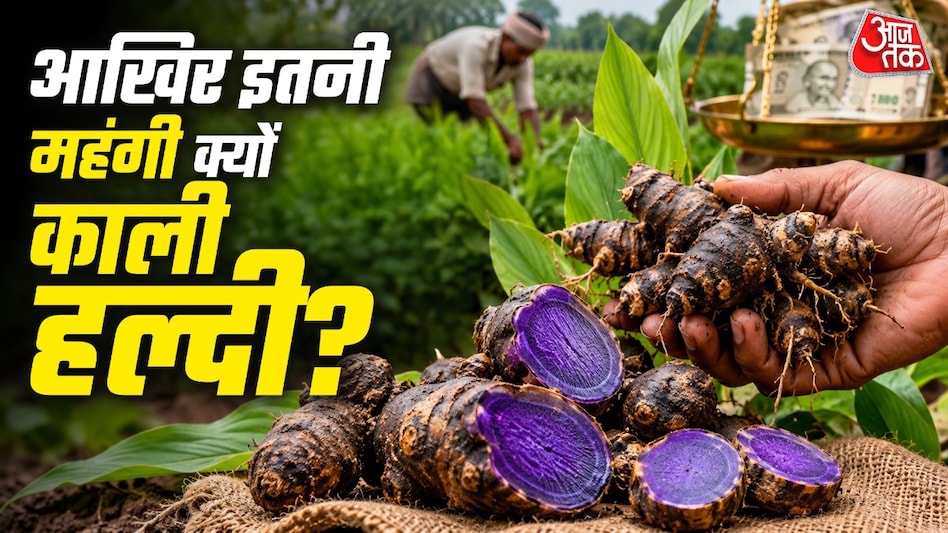
The market often features regular yellow turmeric, but black turmeric has a deep blue-black color inside and can cost significantly more than the regular variety. In some areas, its price ranges from 500 to 2000 rupees per kilogram, and on online platforms, it can be even higher. This factor is generating growing interest among farmers who view cultivating black turmeric as a good source of income. The question arises as to why black turmeric sells for so much and whether a single plant can yield thousands of rupees.
Black turmeric is called Black Turmeric, and its scientific name is Curcuma caesia. It belongs to the same family as ginger and regular turmeric. Its characteristic feature lies in the rhizomes that grow underground. Although it may look like regular turmeric externally, a cross-section reveals a blue-black or dark purple color, and the aroma differs from the usual. While yellow turmeric is primarily used in food as a spice and coloring agent, black turmeric is utilized in traditional medicine, certain Ayurvedic products, cosmetics, and scientific research because it contains various natural chemical compounds that are being studied.
The main reason for the high price of black turmeric is its limited availability. Unlike the mass cultivation of regular yellow turmeric, the cultivation of black turmeric is not yet widespread, and the number of farmers engaged in this is limited. Another important factor is demand. It is used in the production of traditional medicines, cosmetic goods, and for research, which sustains a constant demand for high-quality rhizomes. Furthermore, the price depends on the quality of the rhizomes, humidity level, size, purity, and whether the turmeric is dried or fresh, causing its cost to vary across different locations.
It was expected that the price of black turmeric would be between 500 and 900 rupees per kilogram, but in some places, it is sold for up to 2000 rupees per kilogram.
To understand the potential income from growing black turmeric, one must know the yield. Typically, preparing the harvest takes 8 to 9 months. After this, the underground rhizomes are dug up. The amount of turmeric a single plant yields depends on the seed variety, soil type, weather, irrigation, and care, so there is no guarantee of uniform yield. It is important to understand that the weight of fresh and dried rhizomes differs, and the farmer must account for this difference when calculating profit.
Suppose a farmer harvests 100 grams of fresh black turmeric from one plant. If a buyer is willing to pay 500 rupees per kilogram, the value of that plant's harvest would be about 50 rupees. However, if the same farmer manages to find a buyer at a price of 2000 rupees per kilogram, 100 grams of turmeric would be worth 200 rupees. Nevertheless, this is only an example calculation, not a guaranteed profit, as the 2000 rupees per kilogram price is not available to every farmer; it is often associated with special quality, limited volume, or a specific buyer. Additionally, the farmer's expenses include costs for seeds, fertilizers, irrigation, labor, digging, and packaging, so it cannot be assumed that every plant will bring in hundreds of rupees solely due to the high market price.
Black turmeric is grown not from seeds, but from fragments of its rhizomes. Farmers dig up the rhizomes from the ground and plant them in the field, from which new plants subsequently emerge. Soil suitable for this crop is one that does not retain water but maintains necessary moisture. When preparing the field, it is recommended to mix well-rotted manure compost. According to agricultural information, the planting distance is approximately 30x30 centimeters. The optimal time for planting is considered mid-April in northeastern India, while in other regions, the period before the monsoon season may be suitable. During the growth of the crop, maintaining soil moisture through necessary irrigation and regularly weeding are crucial.
It takes about 8–9 months for black turmeric to fully mature. When the leaves of the plants begin to turn yellow and wither, farmers proceed to dig up the rhizomes. After extraction, the rhizomes are cleaned of soil. They are then either sold fresh or cut into small pieces for drying. Drying leads to a significant reduction in weight, so prices for fresh and dried black turmeric cannot be directly compared.
Farmers can contact companies that produce Ayurvedic products, herb traders, wholesale spice dealers, and certain cosmetic firms to sell black turmeric. The Khari Baoli market in Delhi is also among the major markets for herbs and spices.