17 billion soums allocated in Samarkand for the development of playgrounds and courtyards
Read more
Podrobno.uz [uz]
podrobno.uz

17 billion soums allocated in Samarkand for the development of playgrounds and courtyards

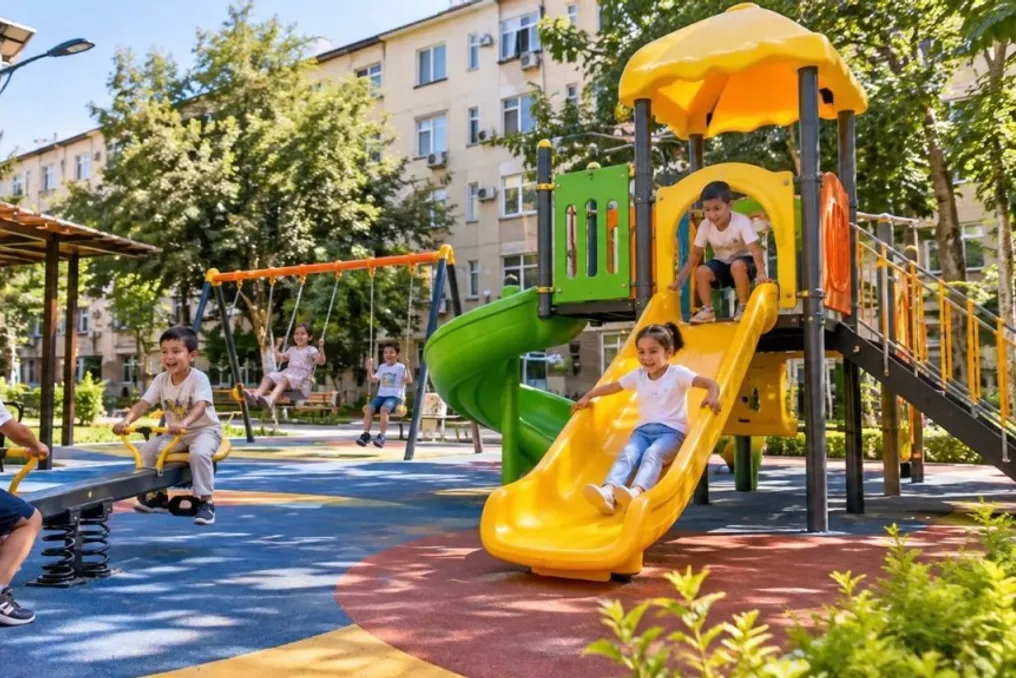
In Samarkand, Samarkand region, it is planned to create 34 new playgrounds equipped with play complexes. These playgrounds will be equipped with solar-powered lighting. 17 billion soums from the republican budget have been allocated for the modernization of courtyard areas and related infrastructure.

Each of these play areas will be furnished with more than twenty types of playground equipment. The project includes not only the installation of swings and slides but also the laying of 1,170 linear meters of irrigation systems, the concreting of 21 thousand square meters of pedestrian paths, and the construction of public toilets.

An example of such a project is already available in the 'Geologlar' mahalla in Samarkand.

Additionally, changes to the appearance of residential quarters are planned in Tashkent. It is planned to move vehicular roads and parking zones outside multi-story buildings to use the freed-up space for creating children's and sports grounds, green areas, and recreation spots.

Similar stories

Karakalpakstan to allocate $100 million and hundreds of billions of soms for infrastructure renewal
Read more
podrobno.uz

Karakalpakstan to allocate $100 million and hundreds of billions of soms for infrastructure renewal

A large-scale project is planned in Karakalpakstan to renew both social and communal infrastructure. $100 million has been allocated for the development of cities and districts within the framework of the World Bank program, and additional funds from the local budget are also provided for repairing schools, hospitals, improving the condition of mahallas, and modernizing water supply systems.

These measures are enshrined in a new decree by the President of Uzbekistan, Shavkat Mirziyoyev. According to the plan, by February 1, 2027, Nukus, as well as the centers of the Amudaryo and Berun districts, should be included in the second stage of the World Bank program titled 'Comfortable and Sustainable Cities for Life in Uzbekistan.' The financing will be directed towards developing both social and industrial infrastructure, based on already achieved results.

Additional financial resources are set aside to support infrastructure projects that contribute to economic growth and job creation in various districts. Furthermore, 15 billion soms will be used to transform the 'Karakalpakstan' mahalla in the Kungrad district according to the principles of the 'New Uzbekistan' program.

A significant portion of the funds will come from Tashkent. The capital budget and the Tashkent City Development Fund will allocate an additional 100 billion soms for improvement works, landscaping, major repairs, and construction in the 'Nur' and 'Elobod' mahallas located in the 23rd microdistrict of Nukus.

Another 160 billion soms has been reserved for the development of the social sphere in Karakalpakstan during 2026–2027. These funds will go towards renovating kindergartens and schools, modernizing medical institutions, including updating 30 elevators and 20 sanitary and hygienic facilities, as well as improving the infrastructure of small industrial zones in the Amudaryo and Khodjayli districts.

Special attention is paid to the development of agriculture and the water supply system. In 2027, 135 billion soms are planned to be allocated for concreting canals in the Turtkul and Bozatau districts, as well as for constructing three water management structures and drilling 22 artesian wells. Another 100 billion soms is designated for developing an area of 7.5 thousand hectares in the Bozatau district.

In addition, by the end of 2027, local authorities, in collaboration with invited foreign experts, must develop a spatial development strategy for Karakalpakstan. This strategy envisages improving the quality of transport links between settlements and their integration into international economic routes. Plans were previously announced for the construction of a new residential area, Nukus City, in Nukus, designed for 50 thousand residents.
Uzbekistan will strengthen requirements for using domestic products in large investment projects
Read more
podrobno.uz

Uzbekistan will strengthen requirements for using domestic products in large investment projects

Uzbekistan plans to expand the norms regarding the use of locally produced goods in large-scale investment projects that receive tax incentives or access to inexpensive state resources. These requirements will now apply to projects valued over $10 million.

Furthermore, manufacturers of electrical equipment will be facilitated in participating in the construction of energy facilities. This decision was made following an instruction from President Shavkat Mirziyoyev on November 9.

Currently, in energy projects implemented under the public-private partnership model, the share of domestically produced goods must reach at least 25%, and 70% for cable products. It is planned that similar standards will also be extended to other large state-supported investments.

During the meeting, issues related to manufacturers of substations, transformers, high-voltage cables, and electrical cabinets were also raised. These companies offer clients not only the equipment but also installation services. However, when participating in tenders through the 'Shaffof Qurilish' system, they are subject to criteria similar to those established for standard building construction.

According to the head of state, the current rules do not reflect the specifics of energy structures and create unnecessary difficulties for highly specialized contractors. Consequently, the president ordered the creation of a special platform within the 'Shaffof Qurilish' system within one month specifically for energy projects to adapt contractor requirements to the peculiarities of electrical equipment installation and construction.

These changes are expected to allow domestic enterprises to participate more actively in large investment initiatives, independently providing necessary equipment and carrying out installation work for the projects. It should be noted that the Agency for Industrial Cooperation and State Procurement was previously established in Uzbekistan.

Area along the Chirchik River in Tashkent's Sergeli district is planned for improvement
Read more
podrobno.uz

Area along the Chirchik River in Tashkent's Sergeli district is planned for improvement

A proposal has been put forward in Tashkent's Sergeli district to implement a large investment project covering an area of 100 hectares located along the Chirchik River. This project aims for the comprehensive development of the territory, including supporting production, trade, services, and tourism, as well as creating public recreation areas for city residents.

Public Discussion of the Project

The proposed project resolution from the capital's hokimiyat has been submitted for public discussion. The initiative affects the lands of the mahallas 'Farogatl' and 'Kuruvchilar'. According to the information provided, pedestrian zones, fountains, and equipped children's and sports playgrounds are planned for the coastal sections. Additionally, the placement of mobile trade points is being considered.

In addition to improving the condition of the riverbank, the project also aims to stimulate entrepreneurial activity. Objects related to production, trade, and services are planned for placement in this area, which should contribute to the economic growth of the district and attract capital investments.

The period for public discussion of this project has been extended until November 20. Currently, final deadlines for work execution, the total funding volume, or a list of potential investors have not been established; the document may be adjusted after analyzing the received proposals.

It is worth noting that previously, Tashkent also presented the 'Daryo Boyi Business City' project, which covers a 24-kilometer stretch of the Chirchik River. This previous plan envisioned the formation of residential and business quarters, the development of public spaces, improvement of the transport system, and landscaping of territories adjacent to the river.

Popular