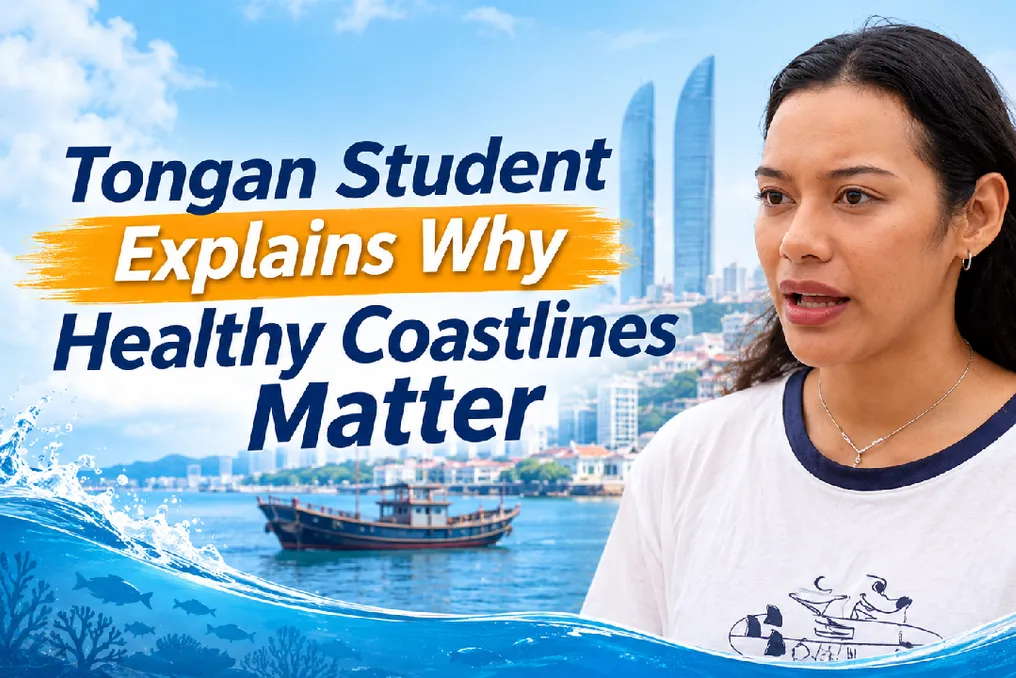
Tongan Student Explains the Importance of Healthy Coastlines for Ecology
Read more
CGTN
cgtn.com

Tongan Student Explains the Importance of Healthy Coastlines for Ecology

Healthy coastlines perform numerous functions that go beyond simply separating land and sea. They serve as natural buffers, provide breeding grounds and food for marine life, prevent terrestrial pollutants from entering the ocean, and contribute to carbon sequestration.

These ecological functions were highlighted by Megan Kolo Ki Holeva Gimmi Green of Tonga, a postgraduate student in marine biology and pharmacology. She spoke during World Ocean Week 2026 in Xiamen, located in Fujian Province, southeastern China.

In this coastal city with a rich maritime history, reflected in historical waterfront areas such as Shapowei, Megan's perspective draws attention to the natural systems that support marine ecosystems and the coastal environment.

Similar stories

Ghanaian Student Links Marine Biodiversity to Coastal Livelihoods
Read more
cgtn.com

Ghanaian Student Links Marine Biodiversity to Coastal Livelihoods

For a significant number of residents along the Ghanaian coast, the ocean is a vital source of livelihood. David Kwame Amenorfenyo, a postgraduate student in aquaculture from Ghana, presented this perspective during World Ocean Week 2026, held in Xiamen, Fujian Province, southeastern China.

While studying the coastal environment of this city, including the historic Shapowei harbor district, he focused on how urban development, nature, and marine ecosystems coexist.

David believes that marine biodiversity is closely linked to the well-being of coastal communities. He plans to use the knowledge gained in Xiamen to share it with local fishermen and policymakers in Ghana, with a particular focus on methods for maintaining the cleanliness and health of the marine environment.

Philippines uses natural materials to protect coastlines from sea-level rise
Read more
www.aajtak.in

Philippines uses natural materials to protect coastlines from sea-level rise

As the threat from the sea grows, the Philippines is moving away from using concrete in favor of natural solutions. Sea-level rise caused by climate change poses a serious problem for many coastal areas worldwide. High waves, storm surges, and slow land subsidence increase the risk of flooding in coastal settlements.

The small island of Pamarawan, located north of the Philippine capital Manila, is also facing this issue. Local residents, numbering about 3,000 people, have long tried to protect their homes from floods by building concrete barriers, but the threat of water kept recurring. Now, the islanders have chosen a different approach to solving the problem.

Instead of constructing massive concrete walls, they are attempting to weaken the force of ocean waves and strengthen the coast using bamboo, wood, and discarded mollusk shells.

Pamarawan's geographical location makes it extremely vulnerable to floods and sea storms. During strong storm surges, seawater penetrates inland areas. This situation is exacerbated by rising sea levels due to climate change and the subsidence of the land itself. Rising sea levels increase the probability of water intrusion into coastal zones, while land subsidence causes the island's height to decrease relative to sea level.

Local inhabitants have repeatedly built new concrete layers and raised their houses for protection. However, this method has proven to be a short-term solution. While raising houses may provide temporary relief, it does not reduce the force of ocean waves or ensure the safety of the entire coastal area. When strong waves and floodwaters constantly attack the shore, simply raising individual houses is insufficient; measures that can reinforce the natural barrier between the sea and the land are required.

In Pamarawan, a natural barrier is being created along the coast using bamboo poles and shrub-like wood. This initiative was started after a study conducted by the city government of Malolos in collaboration with a Dutch engineering consulting firm. This island falls under the jurisdiction of the city of Malolos.

Starting last May, local residents and other workers began installing bamboo poles along the coast. Between these poles, they are filling with wood and shrubs. The goal of this project is to slow down the flow of water coming from the sea. When the water speed decreases, silt and sediment carried by the water can settle behind these barriers. There is hope that this will help raise the height of the seabed over time.

This method is not based on completely stopping the sea, but on reducing its energy. When strong waves hit the shore directly, they can wash away soil and intensify coastal erosion. However, the bamboo and wood barriers are capable of slowing wave movement. This allows sediment brought by the water to settle, helping to stabilize the coastal land.

Another important part of the project is the use of discarded mollusk shells in the sea. AFP journalists visiting the site observed workers building a breakwater, which reduces wave force, approximately 100 meters from the shore, using mollusk shells.

Students of Tongaat School Positively Evaluated the First Round Geography Exam
Read more
iol.co.za

Students of Tongaat School Positively Evaluated the First Round Geography Exam

Graduates of Buffelsdale Middle School in Tongaat gave a positive assessment of the first geography exam, noting its clarity and manageability, and also shared their future plans after graduation.

The exam, which they took over three hours, was deemed accessible by the students. Elijah Chetty from Flamingo Heights reported that he most enjoyed the questions related to map work, climate, and territory. He noted that all studied material was covered in the test, and the questions were easy to understand, while the allocated time proved more than sufficient to complete the work.

As a student with good academic performance, Chetty expects a high grade in geography. After receiving his diploma, he is considering several career paths and hopes to obtain a degree in education. If university admission is denied, he intends to consider a career in the military or police, believing this will allow him to make positive changes in the local community.

Talin Naidu from Buffelsdale called the exam 'very good.' She added that geography is her favorite subject, and she enjoyed studying topics such as climate, weather, and map work. Naidu mentioned that the school year was manageable, but the students faced significant stress. She stated her intention to make her school proud.

After graduation, Talin Naidu plans to intern at an engine manufacturing plant to gain qualifications as a mechanic. Barshana Harry also found the exam understandable and simple, noting that most questions resembled those she reviewed from previous years' tests. She said that her final year taught her resilience, and despite the difficulty of the year, she managed to cope with it.

Harry is interested in a career in tourism and travel because she dreams of seeing other cultures abroad. The next National Senior Certificate exams will take place tomorrow, starting with Physics.

Popular