Disney and Adobe announce collaboration for artificial intelligence development
Read more
Tecnoblog
tecnoblog.net

Disney and Adobe announce collaboration for artificial intelligence development

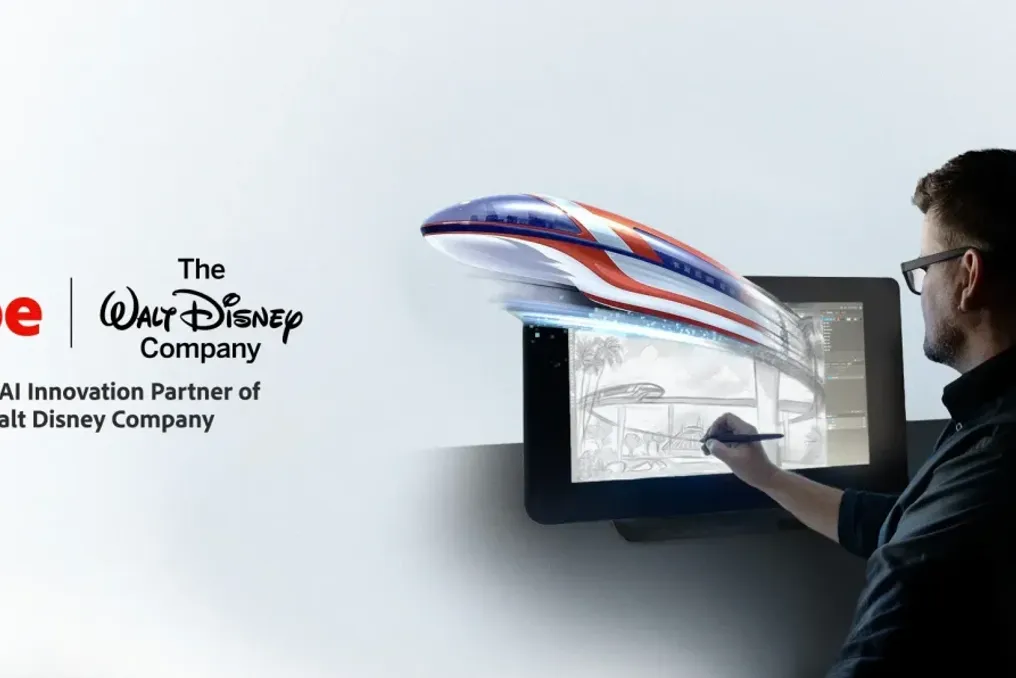
A new alliance focused on artificial intelligence was established between Disney and Adobe this Tuesday, November 10th. This agreement ensures that the software company's generative AI models will be prioritized for The Walt Disney Company, aiming to benefit both the audiovisual and theme park segments.

Disney's interest in generative AI is not new; the company has already participated in a partnership with OpenAI and acquired shares in Character.AI after the startup's bankruptcy. Prior to the collaboration with Adobe, Disney had already announced the use of Firefly AI to create toys in its theme parks.

The partnership will also cover marketing activities, event collaborations, and other services. Adobe emphasized its commitment to responsible AI development, ensuring the protection of Disney creators and their work materials.

According to Adobe, this collaboration will allow for AI development specifically shaped by Disney's properties. This implies targeted training using the company's creations, taking into account styles, character traits, and settings.

The generative AI models will be accessible through the Firefly Foundry service, which was already in use. In June, Adobe itself reported that Disney used this platform to develop new toys for its parks. Additionally, the AI will assist in audiovisual production and content adjustments for ESPN, the Disney group's sports channel.

Besides this recent pact with Adobe, Disney was already engaged in the use of generative AI. In December 2025, the company signed an agreement with OpenAI to make its content available on Sora, a video creation platform based on technology. According to ArsTechnica, this agreement would cost Disney US$ 1 billion (equivalent to R$ 5.5 billion), but it was finalized in March of this year due to Sora's closure.

More recently, Character.AI filed for bankruptcy in the United States, and Disney showed interest in absorbing employees and buying shares in the company. Shortly before closing the deal with Adobe, Bloomberg reported plans by Disney to carry out mass layoffs, aiming to reduce 20% of operational costs.

Similar stories

Adobe integrates AI tools into Windows 11 Photos app in partnership with Microsoft
Read more
olhardigital.com.br

Adobe integrates AI tools into Windows 11 Photos app in partnership with Microsoft

Adobe and Microsoft have formalized a strategic partnership aimed at incorporating artificial intelligence features and creative tools into the Windows 11 operating system. This collaboration involves introducing Adobe Express functionalities within the system's Photos app, as well as optimizations to professional software such as Photoshop, Premiere, and After Effects, specifically for high-performance Windows computers with Arm architecture.

The announcement was made during Adobe MAX, the company's annual event focused on technology and creativity, this Tuesday, the 10th. The feature integrated into Photos will initially be available in preview phase for members of the Windows Insiders program starting in December.

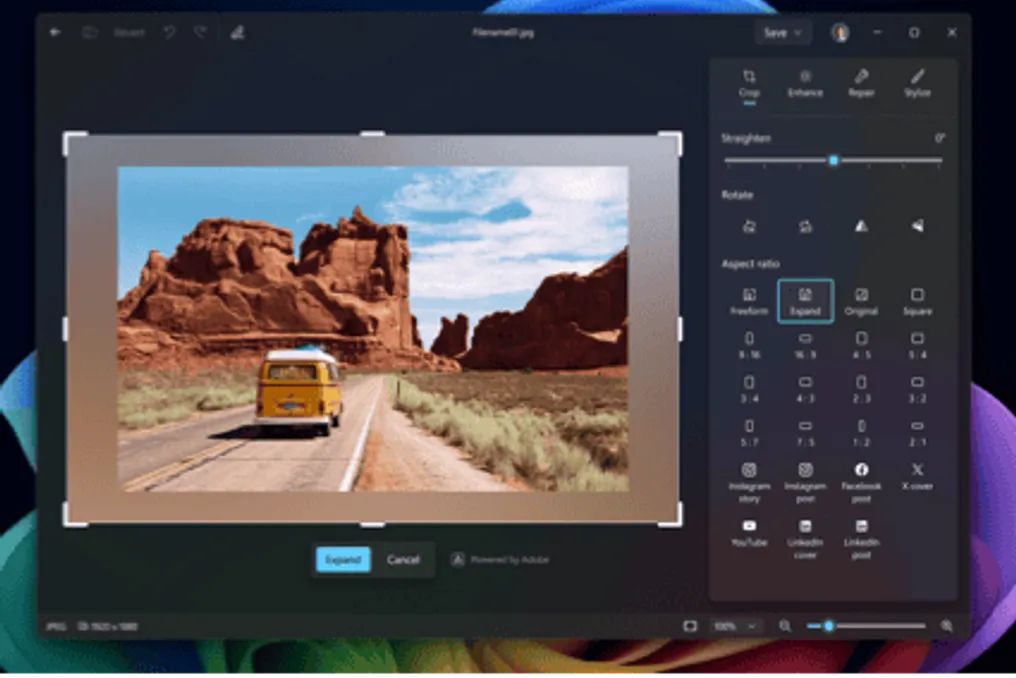
This new addition will enable image editing using AI features directly within the native Windows 11 application. Among the planned capabilities are the ability to expand photographs beyond their original limits, fill empty spaces after rotating an image, and eliminate unwanted elements by reconstructing the background.

Additionally, users will be able to insert or alter image components through text commands. The integration will also allow files to be opened directly in Adobe Express via the Windows Photos Viewer, giving the user the option to select templates for creating various materials, such as invitations, brochures, and social media content.

On another front, Substance 3D Painter, which is still in beta version, has received optimizations to facilitate the creation and texturing of three-dimensional models on more compact and portable laptops, while maintaining adequate performance for workstation tasks.

The implemented improvements cover the reduction of time spent on processes that require greater GPU power, such as mesh map generation and the processing of large sets of assets and textures.

Rodrigo Arndt, who holds the position of Country Manager for Adobe Brazil, stated that the goal of this initiative is to make editing and creation tools more accessible, benefiting both professionals handling complex projects and regular users producing content for social media, presentations, and communication materials.

Raghavan from IBM asserts that AI will create more software and change developer roles
Read more
business-standard.com

Raghavan from IBM asserts that AI will create more software and change developer roles

Sriram Raghavan, General Manager of IBM Software India and Software Innovation Lab, stated that artificial intelligence (AI) agents will accelerate the software creation process and transform developer functions. He also emphasized the necessity for enterprises to strengthen cybersecurity, governance, and personnel skills.

According to Raghavan's estimates, up to two billion AI agents could eventually be deployed globally, with AI writing half of all code. He clarified that the proliferation of these agents will not lead to the disappearance of software development but, on the contrary, will trigger the creation of significantly more software, fundamentally changing developers' work and technology building methods in companies.

At the IBM Think event in Mumbai, Raghavan told Business Standard that there is likely to be an increase in the volume of software produced. He noted that AI has already caused significant changes in software development concerning team organization, workflow management, and the software creation process itself.

The role of the developer is undergoing a fundamental shift: instead of writing code, specialists are now engaged in monitoring, verifying, and critically evaluating the results generated by AI. Raghavan stressed that this is a skills change requiring different training for developers.

He compared this trend to the automation of electronic design in the semiconductor industry. According to him, automation has allowed engineers to develop increasingly complex chips without eliminating the need for hardware engineers. Raghavan expects a similar transformation in the software sphere, where automation will enable the creation of more applications but will require new competencies.

Expertise in this area is now focused on verification, validation, strategy definition, setting constraints, and directing AI to perform the correct tasks. Raghavan believes that this is the direction software engineering is moving. He predicts that more software will be produced in the next two to three years than ever before, as innovation opportunities have become unprecedented, and value now lies in ideas and their implementation, rather than in the creation of code itself.

Nevertheless, Raghavan warned that the growing use of AI will not diminish the importance of fundamental engineering skills; on the contrary, judgment and core skills are becoming even more important.

Responding to questions about recent security issues related to new AI models, Raghavan stated that the adoption of AI is radically changing the cybersecurity landscape. He noted that one must think about cybersecurity in a completely different way because of AI. Raghavan emphasized that proactive, continuous integration of best practices and technologies into vulnerability management and risk prioritization based on AI is vitally necessary. He added that the company's proposals reflect this approach, insisting on the need to integrate AI into defense alongside concerns about AI misuse.

Regarding risks associated with unintended actions by AI agents, Raghavan advised enterprises to implement stricter controls over agent identifiers, permissions, and access to internal systems. Agents should only be granted the minimum necessary permissions to perform a specific task, rather than broad access to all corporate systems. He explained that an agent only needs a certificate and a token to perform an action on behalf of a user for 30 seconds. Furthermore, he highlighted the importance of constant monitoring, as AI systems do not always behave predictably, unlike traditional software.

AI Adoption in India

Referencing an IBM study conducted jointly with MeitY earlier this year, Raghavan reported that only about 15 percent of Indian enterprises have reached the stage of scaling AI adoption, while the remaining 85 percent continue to face difficulties. Companies that successfully scale AI have moved beyond isolated use cases and are integrating the technology across their entire structure.

According to Raghavan, approximately 15% of enterprises are truly scaling AI, meaning they have passed the stage of implementing one case that was integrated into the organization and may be moving to a second or third case. For the remaining companies, the main obstacles remain data governance, corporate governance, and a shortage of skilled personnel.

Using AI for software reverse engineering calls into question the business model of large tech companies
Read more
techcentral.co.za

Using AI for software reverse engineering calls into question the business model of large tech companies

One of the early applications of generative artificial intelligence tools, such as ChatGPT and Claude, was the creation of source code—the instructions in computer language that form the basis of software like word processors and web browsers. Because code has a structured nature, this facilitates the generation process for AI tools. This raises the question of whether they can help create complex software that is usually paid for?

The method of reverse engineering involves using AI tools to decompose an existing software product into constituent parts and then writing code to recreate these components. This approach is more effective for large and complex programs than 'vibe coding,' where the user simply describes the desired functionality.

Recently, one software engineer used AI tools to create free alternatives to Microsoft Office and Adobe products, such as Photoshop. The situation was further highlighted by the viral success of a freely available AI tool called Reverse Engineer Anything within the developer community.

Some people welcome this development as a return to the early internet era when software was free both to use and to modify. Even if the situation does not fully revert, this innovation raises serious questions about the future of commercial software.

A Peculiar Turn in Internet History

At the beginning of the internet's development, there was a special, unique period. In the 1990s, the internet seemed like a source of endless possibilities, and monetization methods had not yet been developed. Users spent a lot of time communicating with strangers in niche chat forums and created websites with imperfect designs to exchange information.

A large amount of software was either free or open-source. This meant that if a program did not work as desired, its source code could be downloaded, and changes could be made independently. Search engines often helped in this process, which were the second most popular query after technology at the time.

Today, it is almost impossible to imagine, but Google did not exist back then. Microsoft was already on the market and quickly became the most well-known representative of paid software—software that must be purchased and cannot be modified independently. Thus, the 1990s represented an arena of confrontation between free and open-source software, available for modification, and commercial software actively promoted by Microsoft.

The Rise of 'Big Tech'

In late 1998, paid software received significant legal protection in the form of the US Digital Millennium Copyright Act (DMCA). This law made attempts to bypass mechanisms preventing modification illegal. The future of commercial software was secured.

The internet became a mass phenomenon, ceasing to be a closed club for early adopters. Deep technical knowledge was no longer required to purchase and use computer programs. This is when the formation of companies known today as 'Big Tech' began: Microsoft already existed, Amazon, founded in 1995, achieved profitability in 2001, Google launched in 1998, and Apple transformed from a struggling niche company into a technological giant after releasing the iPod in 2001. Facebook, the last of the original tech giants, appeared in 2004.

Suddenly, free and open-source software became the domain of exclusively technically proficient people. Its development turned into a highly specialized interest. Most programs became impossible to recompile, improve, or personalize because access to the basic source code was technically difficult and illegal.

A New Utopia of Reverse Engineering?

It can be assumed that since reverse engineering does not violate any protective mechanisms, it may not contradict the DMCA, although this could lead to legal disputes. Combined with the vibe coding method, this new era of AI-based commercial software clones potentially marks the beginning of a time when anyone can get the desired functionality in Excel.

However, this new utopia is not perfect. Some generated programs are already reporting strange errors. These errors will likely be difficult to trace if most of the code was generated by AI rather than a human.

File compatibility issues may also arise. If everyone modifies their own copy of Word, there is no guarantee that the files will remain compatible. You might be able to open a file in the 'free' version of the software, but another user using the official Microsoft product might not be able to.

Another significant change since the beginning of the internet era has been the importance of data. Even if you successfully reverse engineer Photoshop, you will not gain access to the underlying dataset that allows Adobe's proprietary AI tools to function. Similarly, successfully reverse engineering Facebook will not grant access to the behavioral data that drives its advertising success.

Thus, reverse engineering is unlikely to take us back to the early days of the internet. However, it will most likely lead to a new era where traditional methods of software monetization cease to work. The future remains uncertain, and one can only hope for a restoration of the balance of power between consumers and software creators so that the future is at least a little more hopeful.
Popular