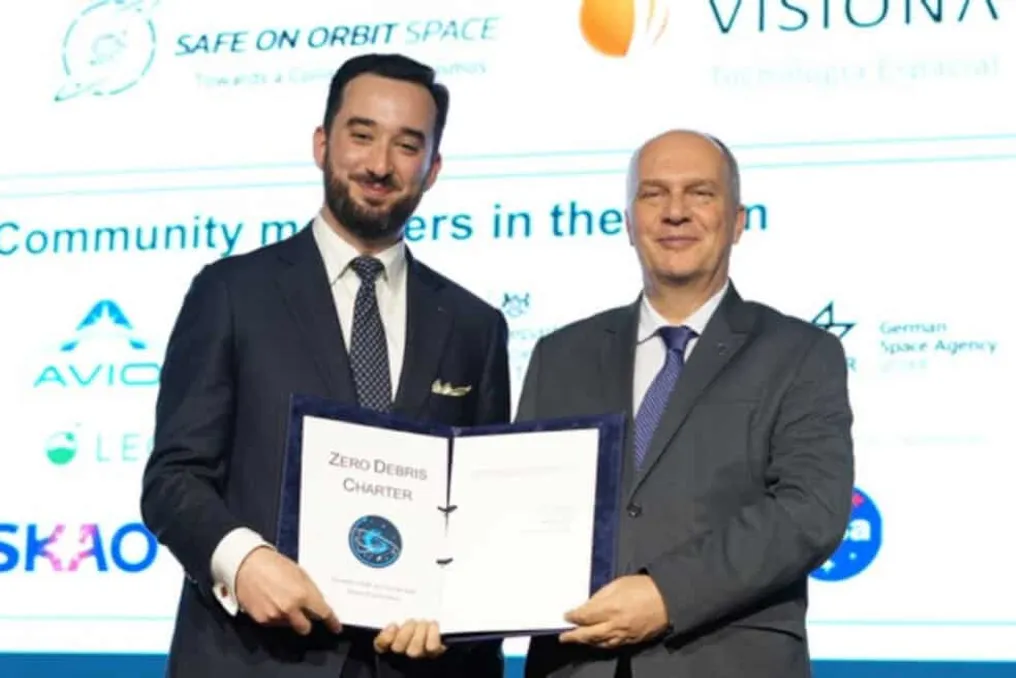
Brazil formalized its adherence to an international pact aimed at reducing the amount of space debris and enhancing the safety of satellites in orbit. This acceptance of the so-called Zero Debris Charter occurred on November 4th during the 8th Space Sustainability Summit, officially ratified by the Brazilian Space Agency (AEB). Brazilian companies Visiona Espacial and Safe on Orbit also signed this document.
This initiative, led by the European Space Agency (ESA), brings together governments, companies, higher education institutions, and other entities in the space sector. The central purpose is to define procedures to reduce debris creation and maintain operational conditions in space until the year 2030.
The agreement stipulates several actions, such as preventing orbital collisions and explosions, improving the monitoring of space objects, and planning appropriately for the disposal of satellites and other equipment after the completion of their functions.
The AEB, an agency linked to the Ministry of Science, Technology, and Innovation (MCTI), announced Brazil's entry into this commitment. According to the Agency's president, Marco Antonio Chamon, sustainability must be a factor considered from the initial phase of space project development.
The Zero Debris Charter constitutes a global agreement designed to encourage more sustainable methods in space activities. Its development began in 2023 through a collaborative process coordinated by the ESA, involving various representatives from industry, academia, and space agencies.
The document establishes collective goals and principles valid until 2030. One objective is to increase the availability of data on space objects measuring up to five centimeters in low Earth orbit and 20 centimeters in geostationary orbit. This would facilitate better risk assessment and maneuver planning to avoid impacts.
Additionally, the Charter mandates that the probability of generating debris from fragmentation or collisions should be less than one event in a thousand objects during their time in orbit.
Space debris comprises artificial artifacts that remain in orbit without performing any operational function. This category includes deactivated satellites, rocket parts, equipment remnants, and waste generated by explosions or collisions.
Even small particles can pose a danger to active satellites, as these fragments move at extremely high speeds, making potential impacts with small objects quite risky. The scenario could worsen, as a collision can generate new fragments, which then pose extra threats to other missions.
The concern extends beyond scientific activities, as satellites are vital for navigation, communication, environmental monitoring, and weather forecasting services. Damage to these devices can impact terrestrial services and infrastructure.
One of the pillars of the Zero Debris Charter is considering the fate of equipment even before its launch. When a satellite completes its useful life, it should not remain indefinitely in an orbital area used by other equipment. Depending on the altitude and mission characteristics, tactics can be implemented to remove it from the operational zone or induce its reentry into the Earth's atmosphere.
The initiative also sets goals for removing objects from low and geostationary orbits, aiming for a minimum success rate of 99% in vacating these regions after missions conclude.
Another aspect addressed is the reduction of risks to people on the surface. Certain components of space equipment may survive atmospheric passage and reach the ground.
It is important to note that the Zero Debris Charter does not have mandatory legal force. According to the ESA itself, it constitutes a collaborative commitment, dependent on the contribution of participants according to their capabilities and restrictions.
In the Brazilian context, the adherence did not come with new regulatory rules for those operating satellites, nor were specific national deadlines defined for the application of the measures. Thus, the country's participation signals an engagement with international space sustainability practices, during a period of growth in orbital activities and increasing attention to operational safety.